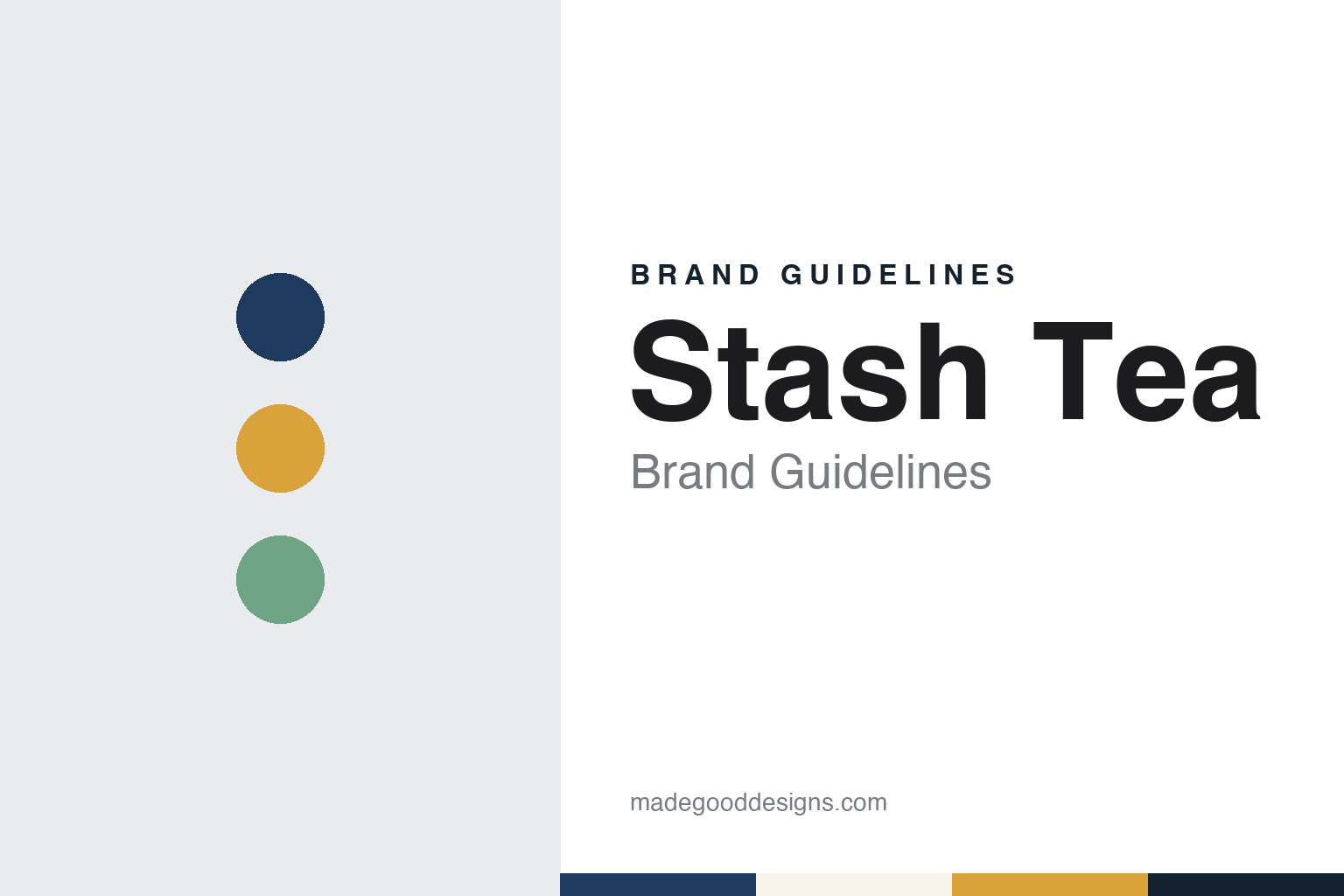
Stash Tea Brand Guidelines
The 1972 Portland tea blender owned by Japan’s Yamamotoyama.
Aa
Two constants: a Stash clipper navy, ginger gold and mint palette and a Voyager serif register. Abstract homage — not a Stash Tea product or mark; no package, logo or compass rose is reproduced.
A Victorian basement
Bulk herbs, spices and loose tea in 1970s Portland.
Stash Tea began in Portland, Oregon, in 1972. English Wikipedia, citing The Oregonian and The New York Times, names its founders as Steve Lee, Dave Leger and Steven Smith, the tea blender who later founded Tazo. The company’s own website now tells the story mainly through Smith, whom it calls “our founder,” while its careers page says Stash was started “by a couple of teaheads.” English Wikipedia says the three began with $7,000 of capital.
The first business was not a packaged tea brand. The company says Smith began “selling bulk spices to natural food stores from the cozy basement of a Victorian home,” and that the founders then moved into a warehouse in Portland’s Pearl District “to begin blending loose leaf tea in a humble cement mixer.” It also says it was the first to treat the Pacific Northwest’s wild mint as tea-worthy; English Wikipedia, citing The Oregonian, says Smith persuaded growers around Prineville and Madras, in central Oregon, to harvest peppermint to his specifications.
In 1975 Stash moved into tea bags and started a mail-order catalogue, which the company says delivered tea “directly to college campuses nationwide.” English Wikipedia, citing a US Commerce Department trade case study, describes it as one of the first companies to sell bagged herbal teas in the United States. Restaurants and other food-service buyers followed; at one point, according to a company history cited by English Wikipedia, they accounted for 80 percent of sales.
The name, the company says, comes from tea folklore: the small, valuable “stash” of tea said to have been given to the captain of a ship carrying it around the world.
Colour
A Japanese owner founded in 1690.
Stash’s owner is Japanese. Yamamotoyama traces itself to a tea shop the Yamamoto family opened in Tokyo in 1690 after moving from Kyoto, and its American arm, Yamamotoyama U.S.A., says it was set up in Los Angeles in 1975 to process tea and seaweed. The relationship with Stash began in 1977, when, according to English Wikipedia, the Japanese company became Stash’s West Coast tea packager; Stash’s own timeline describes that year as “a key partnership with Yamamotoyama” that took its expansion to Los Angeles.
Ownership followed in stages. English Wikipedia says Yamamotoyama took a 25 percent stake in 1979 and raised it over the following decade, then bought the remaining shares in the summer of 1993 after a contested sale, making Stash a wholly owned subsidiary of Yamamotoyama of America; it cites the International Directory of Company Histories (2017). Yamamotoyama’s US website also gives 1993; Stash’s own timeline dates the acquisition to 1991, so we give both dates. Following the sale, Steven Smith launched Tazo in January 1994, English Wikipedia says.
The family link remains visible at the top. Stash’s timeline says Nami Yamamoto became chief executive in 2016, and Tea & Coffee Trade Journal quoted her as CEO in 2018. The company says its signature Lemon Ginger and Chai flavours date from 1990, that stashtea.com launched in 1995 and that its range had passed 300 teas by 2000. The best-sellers on its website in October 2026 included Double Bergamot Earl Grey, Raspberry Hibiscus and Chamomile.
Stash was based for years in Tigard, a suburb of Portland, where it opened a retail shop at the Bridgeport Village centre in 2005. In July 2022 The Oregonian reported that the company planned to move its headquarters and shop to downtown Portland, near Director Park.
Typography
Design and documentation.
The seven brands in this group all sell tea in North America: Bigelow, Celestial Seasonings, Stash, Tazo, Mighty Leaf and Numi are American, and Red Rose was founded in Canada before crossing the border. Between them they cover much of what a North American shopper finds on the tea shelf, from boxes of bagged black tea to herbal blends and caffeine-free infusions, sold through supermarkets as well as natural-foods stores.
A North American tea brand’s identity is usually carried by a box, a name and a blend rather than by a place, because the leaf inside may have been grown on another continent and blended somewhere else again. Names also travel between owners: a brand can be sold, licensed or split by country while the box on the shelf looks much the same, which makes the questions behind each one worth asking plainly — who started it, who owns it now, where its tea is bought and where it is actually blended and packed.
Each guide separates what independent sources record from what the company says about itself — its founding story, its owners over time, where its tea comes from and where it is packed — and marks plainly what rests only on the company’s own word.
Aa
A voyager serif — a brand named after a ship captain’s stash. (Specimen set in Fraunces, a serif STAND-IN; NOT the Stash Tea logo.)
Stash Tea
A compass rose, redrawn with tea leaves.
Where the tea is made is only partly documented. Stash says it buys its teas “directly from the world’s premier tea gardens,” buys herbs and spices whole and mills them “right before blending,” and that every element that steeps in the cup, “including the tea bag and string,” is Non-GMO Project Verified. Yamamotoyama says its US production site is an SQF-accredited facility in Pomona, California; we found no statement on the pages we read saying which Stash products are blended or packed there, so we make no claim. Stash says it sells to grocery, food-service, online, natural and mass-market buyers, and internationally “in 40 countries.”
The look has been revised more than once. Stash became a Certified B Corporation in September 2017, according to World Tea News. In October 2018 Tea & Coffee Trade Journal reported a packaging redesign with bright colours and bold ingredient imagery, and a compass rose logo “streamlined and adorned with tea leaves.” World Tea News reported in 2019 that the company had cut its box materials by about 18 percent. The company’s timeline says it unveiled “a bold new look” in 2025, and its FAQ says it is moving to 18- and 20-count boxes whose “bold colors and images” make flavours easier to find. We found no published designer credit and no public brand guidelines.
For a design guide, Stash shows how a navigational emblem — a compass rose for a brand named after a ship captain’s stash — can carry one story through five decades of repackaging. Compare Tazo, the brand Steven Smith started next, and Harney & Sons, another American tea blender. For this guide we use a clipper navy, a ginger gold and a mint green with a serif, an unofficial interpretation; no product or logo is reproduced.
Explore & save
Keep Stash Tea’s identity on hand — save it to a board in the Made Good inspiration library.
Stash Tea identity set
Pin the Stash clipper navy, ginger gold and mint palette and the Voyager serif register to your own board.