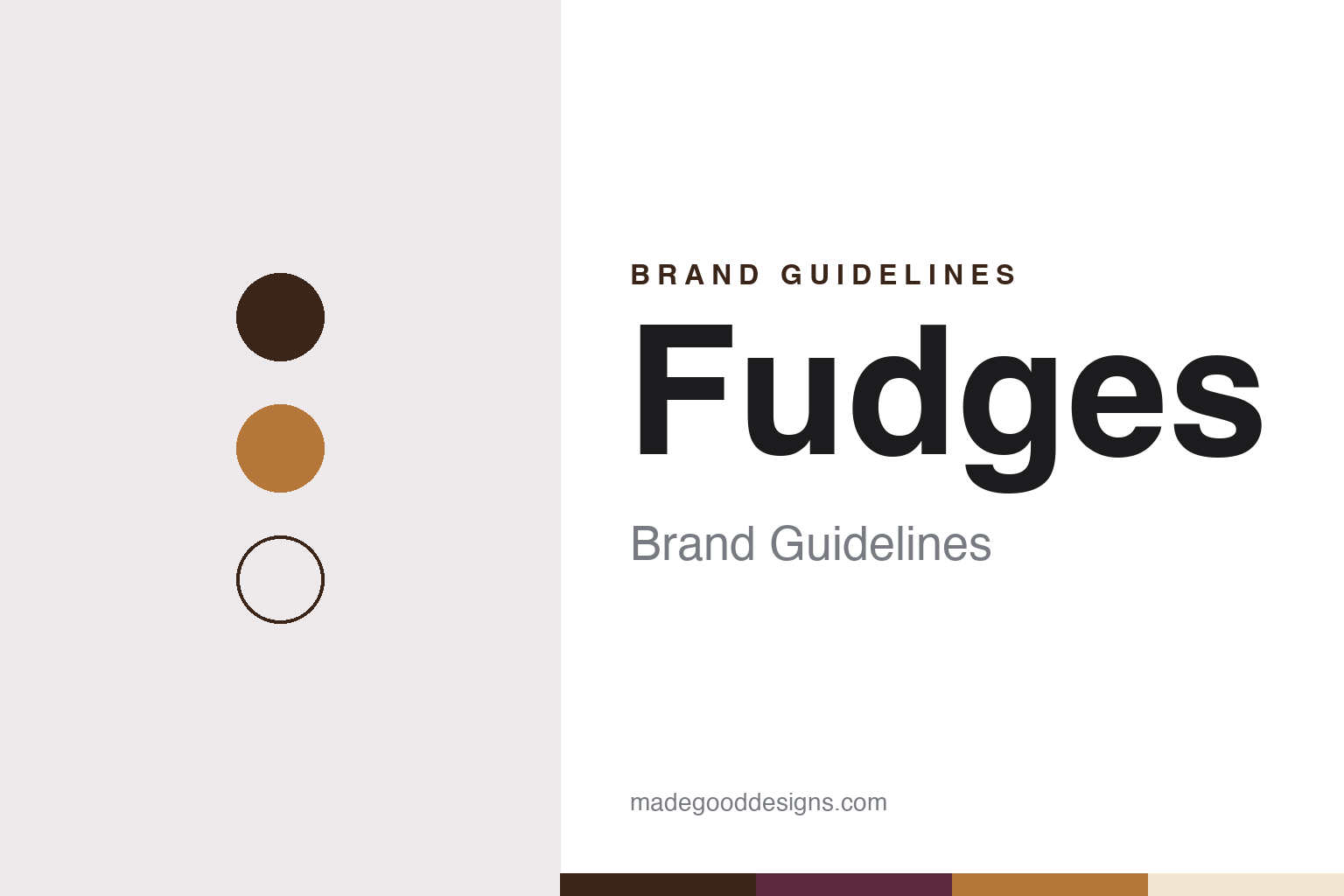
Fudges Brand Guidelines
The Dorset bakery behind Thomas Fudge’s Florentines.
Aa
Two constants: a Fudges chocolate, damson and caramel palette and a high-contrast serif register. Abstract homage — not a Fudges or Thomas Fudge’s product or mark; no pack, logo or biscuit is reproduced.
A village bakery in Dorset
Bread, cakes and three generations.
Fudges began as a village bakery in north Dorset. The earliest version of the company’s website in the Wayback Machine, captured in January 1998, said that Percy Fudge opened the bakery at Leigh, near Sherborne, in 1926, that many of his original recipes were still in use, and that its skills had been built up over three generations. A 2008 version of the site repeated the date, describing the business as founded in 1926 “traditionally as a baker of bread and cakes,” and named three members of the Fudge family among its directors. The 1998 site said the bakery no longer supplied only its locality but sold across the United Kingdom and to several other countries.
Later accounts give a different start. Since a rebrand in 2015 the company has dated the business to 1916: its 2015 website said it had been baking “since 1916,” when “our great-great-uncle, Thomas J Fudge, first set up shop,” and the current owner, FBC UK, also gives 1916 as the year the brand was created. We report both dates, each as the company gave it.
The 2008 timeline describes how the bakery changed. In the 1990s, it said, Fudges changed direction and began making niche products for specialist food shops, London stores, hamper companies and supermarkets. In 1998 it “set up home in Stalbridge,” another north Dorset town, where it produced handmade sweet and savoury biscuits, flatbreads, cheese straws and florentines. FBC UK says that Dorset Village Bakery Ltd was formed in 1998, including the brand, and the company’s websites from 2008 to 2015 gave its name as Dorset Village Bakery Ltd, of Stalbridge.
Colour
Biscuits for cheese and Marmite.
By the 2000s Fudges was best known for savoury biscuits — cheese straws, wafers, flatbreads and biscuits for cheese — alongside sweet biscuits and florentines. Its 2008 website listed its stockists as farm shops, delicatessens and independent stores as well as Waitrose, Tesco, Morrisons, Booths and Sainsbury’s, and a recruitment notice on the same site named Fortnum & Mason and Harrods among the shops it supplied.
The bakery also made biscuits under other companies’ brands. Its 2008 timeline says that in 2004 it began a partnership with Unilever to make dual-branded biscuits such as Marmite Biscuits, and that in 2006 the partnership grew to include Marmite Flatbreads and Colman’s Mustard savoury biscuits. In the same year, it says, it began working with Tate & Lyle on two products, biscuits and flapjacks half-dipped in Belgian chocolate.
The same site listed many awards, all as reported by the company. It said its Florentines had won gold at the Great Taste Awards in 2002 and 2006, its Cheese Straws gold in 2003, and its Marmite Flatbreads gold in 2006, and that it was named Bakery of the Year at the Baking Industry Awards in 2006. In 2007, it said, its Jalapeño Wafers, Walnut Wafers and Biscuits for Cheese took Great Taste golds. The list reached back to the bakery’s early decades, with entries for a Hovis competition in 1939, a diploma for bread in 1940 and another Hovis competition in 1958. The site also named the trade bodies Fudges belonged to, among them the National Association of Master Bakers and the British Society of Baking, and said the business had become an Investor in People in 2004.
Typography
Biscuits, wrappers and ownership.
The seven brands in this group all make biscuits, and they come from three parts of Britain: Border Biscuits, Paterson’s, Island Bakery and Crawford’s from Scotland, Duchy Originals and Fudges from England, and Burton’s from Britain more widely. Biscuit brands in general sit at many different points in the trade, from everyday packets on a supermarket shelf to small-batch boxes sold through delicatessens, and a single company can work at both ends at once.
A biscuit brand’s identity is usually carried less by a single mark than by a recipe, a wrapper and the familiar shape of the biscuit inside, and the name on the front may have outlived the bakery, the family or the town that first made it. That makes the questions behind each name worth asking plainly: who started it, who owns it now, which larger groups it has passed through, and where its biscuits are actually baked today.
Each guide separates what independent sources record from what the company says about itself — its founding story, its owners over time, its recipes and where its biscuits are made — and marks plainly what rests only on the company’s own word.
Aa
A high-contrast serif — a heritage bakery’s register. (Specimen set in Playfair Display, a serif STAND-IN; NOT the Fudges or Thomas Fudge’s logo.)
Fudges
Thomas J Fudge’s, then FBC UK.
In 2015 the bakery gave its brand a new name and a new story. Its website, captured in August 2015, introduced Thomas J Fudge’s and said the company had “wiped our baking tray clean,” dropped some old products, added new ones and “wrapped everything in marvellous new boxes.” The site credited its design to the agency Big Fish. By 2018 the brand appeared as Thomas Fudge’s, with the line “The Art of Indulgence” and ranges of Florentines, flapjacks, biscuits for cheese and wafers.
The ownership then changed. FBC UK’s company history says that in 2019 Dorset Village Bakery Ltd, together with Paterson Arran, was bought by Burton’s Foods, the maker of Jammie Dodgers. The Guardian reported in June 2021 that Burton’s had been bought by the Ferrero family; FBC UK says the buyer was a Ferrero-affiliated company, which had bought Fox’s Biscuits in 2020, and that Fox’s and Burton’s merged in 2022 as FBC UK (Fox’s Burton’s Companies). FBC UK now lists Thomas Fudge’s as one of its brands.
The old addresses, fudges.co.uk and thomasfudges.co.uk, now redirect to FBC UK’s page for the brand. That page shows a range of three chocolate Florentines — milk, dark and salted caramel — sold through Sainsbury’s, Waitrose and Ocado, and describes them as the work of “Dorset’s bakers,” the company’s phrase. We found no published brand guidelines and no official colour values.
For a design guide, Fudges shows how a family bakery’s name can be rebuilt around a founder figure and then carried into a larger group. Compare Fox’s Biscuits, its sister brand at FBC UK, and Nairn’s, a maker of biscuits for cheese. For this guide we use a dark chocolate brown, a damson, a caramel and a Dorset cream with a serif, an unofficial interpretation; no product or logo is reproduced.
Explore & save
Keep Fudges’s identity on hand — save it to a board in the Made Good inspiration library.
Fudges identity set
Pin the Fudges chocolate, damson and caramel palette and the high-contrast serif register to your own board.


