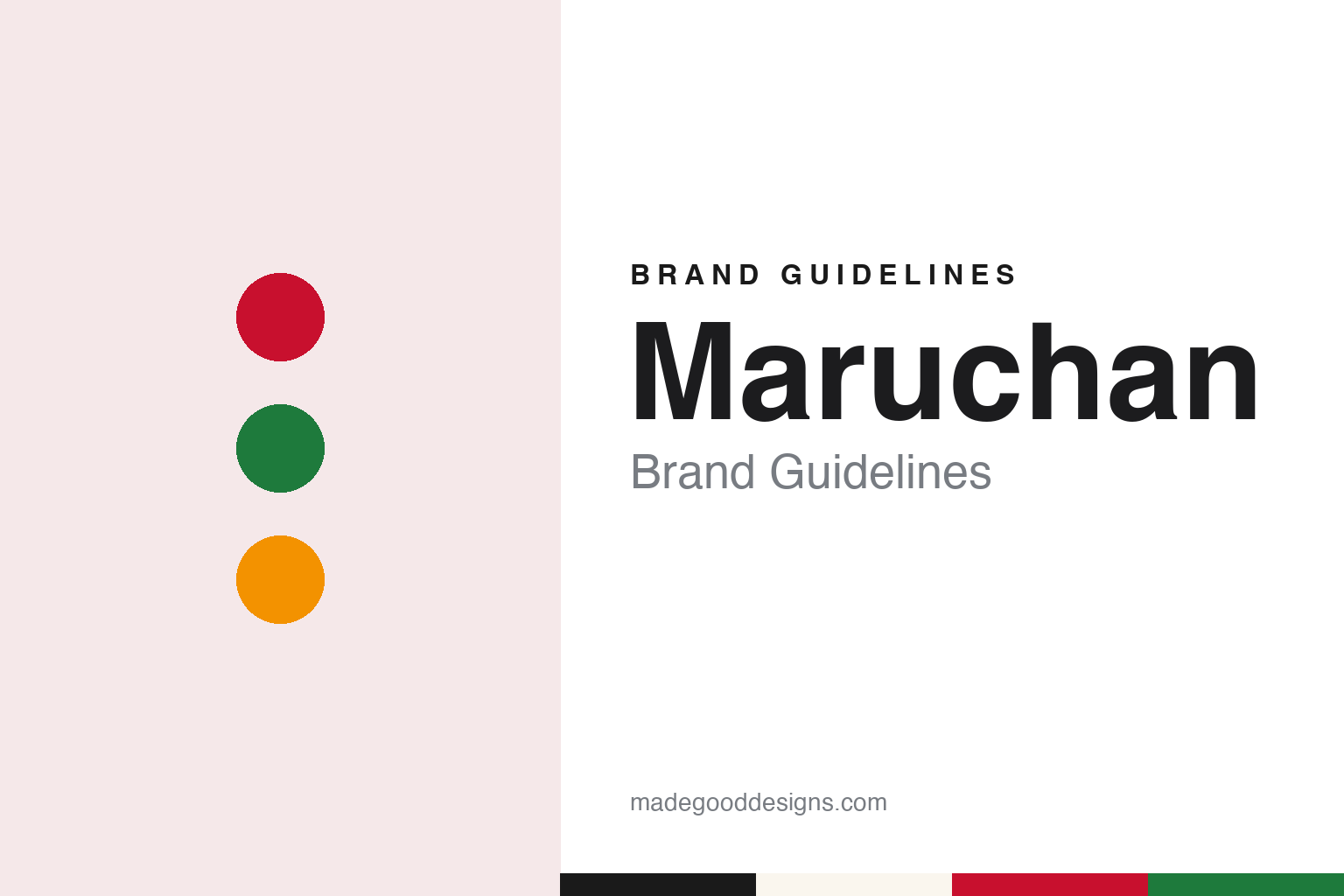
Maruchan Brand Guidelines
Toyo Suisan’s round-faced noodle brand, from Tsukiji to Irvine.
Aa
Two constants: a kitsune red, tanuki green and smile orange palette and a rounded friendly sans register. Abstract homage — not a Maruchan product or mark; no cup, pack or logo is reproduced.
From Tsukiji to the noodle aisle
A fish trader that needed a winter product.
Maruchan is first of all a brand: the name under which Toyo Suisan, a Tokyo food company, sells its noodles, and the operating name of its American business. Toyo Suisan began in March 1953 at Tsukiji, Tokyo’s wholesale fish market. Japanese Wikipedia gives its first name as Yokosuka Suisan and says it took its present name in July 1956. Its founder was Kazuo Mori, whom English and Japanese Wikipedia and Maruchan Inc.’s own history all name; Maruchan’s American site describes the start as “a small frozen fish distributorship.” The Japanese company says it began by exporting frozen tuna.
Processed food followed. English Wikipedia says the company entered cold storage in 1955 and began making fish sausage in 1956; Toyo Suisan says its first processed products were fish ham and fish sausage made from tuna. Noodles came from a seasonal problem. Fish sausage sold best in summer, the company explains, so in 1961 it looked for a winter product and settled on instant noodles. Its first, made at what was then its Odawara plant, was sold under the old trade name as Maruto-brand seasoned ramen. Japanese Wikipedia dates the start of instant ramen under the Maruchan name to 1962, the year the company gives for the Maruchan mark.
The range spread across Japanese noodle styles. The company traces its Midori no Tanuki buckwheat noodles to a “tanuki soba” of 1963, which it says opened a new category in a market then built on Chinese-style noodles. It began making cup noodles in 1974. In 1975 it launched Maruchan Yakisoba in three-serving packs of fresh noodles with powdered sauce; the company says it sold them by setting up hot plates for tasting at wholesale produce markets, without television advertising, and that it is now the best-selling chilled noodle product in Japan, citing Intage data for 2019. English Wikipedia also describes Toyo Suisan’s fresh noodles as the market leader in Japan.
The company’s rise has been told as fiction. Toyo Suisan notes that the business novelist Ryo Takasugi wrote about its first 30 years, and that a film based on the book, Moyuru Toki, was released in February 2006.
Colour
A market trade name that became a smiling face.
The Maruchan mark grew out of the fish market. Toyo Suisan explains that many fish companies used the trade name they were known by inside the market, rather than their formal name, as a badge. Its own was the “Maruto” mark: a circle, “maru,” enclosing the hiragana “to,” the first sound of the company’s name. Japanese Wikipedia adds that the early mark combined the “to” with the hinomaru, the rising-sun disc of the Japanese flag, as a monogram. When the company entered the instant-noodle market it wanted a brand that children and older people alike would warm to, so “Maruto” became “Marutochan” and then “Maruchan,” and in 1962 a fully round, happily smiling face was drawn to match. English Wikipedia glosses the name: “maru” means circle or round, with a sense of friendliness, and “-chan” is an affectionate suffix used for children.
The face became a figure. In 1968, the company says, it made a Maruchan doll from the mark for shops to display: a round character whose belly is so full that he is hitching up his slipping trousers, holding a banner to promote new products. Japanese Wikipedia says the American Maruchan logo differs from the Japanese one, and that the overseas version was used in Japan only once, on the first Hot Noodle cup in 1992. It also records a corporate identity programme in March 1986, when Toyo Suisan added a “TS” mark commissioned from Landor Associates and slightly redrew the Maruchan face in June that year.
Colour has done the rest. The company says its Akai Kitsune udon, launched in August 1978, was going to be called “Atsui” (hot) kitsune udon. Instead it chose a design based on red, because red stood out on the shelf and suggested a hot, appetising dish, and the name changed to “Akai” (red) kitsune. The company cites the red torii gates and the red bibs on fox statues at Inari shrines, which are linked with foxes, as influences, along with a popular run of television dramas with “red” in their titles. Its green partner, Midori no Tanuki tempura soba, followed in August 1980; the company says the name was chosen partly to balance the red fox. Japanese Wikipedia says the actor Tetsuya Takeda has appeared in the pair’s advertising since launch. The company makes four regional versions of Akai Kitsune, with different stocks for eastern and western Japan, Hokkaido and the Kansai region.
Typography
Design and documentation.
The seven brands in this group all make instant noodles, and they come from Japan, Indonesia, Thailand, Britain, South Korea and Singapore: Nissin, Maruchan, Indomie, Mama, Pot Noodle, Nongshim and Koka. Instant noodle brands in general sit at many different points in the trade, from family firms that still carry a founder’s name to names that now belong to much larger food groups, and a single brand can be sold everywhere from a corner shop to a supermarket shelf on another continent.
An instant noodle brand’s identity is usually carried less by a single product than by a pack, a name and the quick meal it promises, because the company behind the name may have changed hands, opened factories abroad or grown far beyond the city where it started. That makes the questions behind each name worth asking plainly: who started it, who owns it now, and where its noodles are actually made and packed.
Each guide separates what independent sources record from what the company says about itself — its founding story, its owners over time, where its noodles are made and how its packaging has changed — and marks plainly what rests only on the company’s own word.
Aa
A rounded friendly sans for a brand named after a circle. (Specimen set in M PLUS Rounded 1c, a sans STAND-IN; NOT the Maruchan logo.)
Maruchan
Irvine, Mexico and a brand that became a verb.
Maruchan’s largest market outside Japan was built from California. Toyo Suisan set up Maruchan USA in 1972. English Wikipedia says it spent five years as a marketing company importing and distributing ramen from Japan, then built a factory in Irvine, California, in 1977 and began making Maruchan ramen there. Toyo Suisan’s English Wikipedia entry lists three wholly owned American companies today: Maruchan, Inc. in Irvine, Maruchan Virginia in Richmond, and Maruchan Texas in Von Ormy, Texas, as well as a frozen-noodle joint venture with Ajinomoto in Portland, Oregon. The Japanese company says it now has four production sites in the United States. The American range includes ramen packs, the Instant Lunch cup, bowls and yakisoba; Maruchan Inc. says it began selling a line called Maruchan Gold in 2019, and describes itself as the official soup of the 1984 Olympics.
Mexico turned the brand into a word. Japanese Wikipedia, citing the NNA news agency in 2017, says Maruchan Inc. began exporting instant noodles to Mexico around 1986 and kept selling through the 1994 peso crisis as rivals withdrew; Toyo Suisan’s own history dates its Mexican business to 1989, with exports from the United States around 1990. Japanese Wikipedia says that by 2006 the company held about 85 per cent of the Mexican instant-noodle market and that the Los Angeles Times reported, on its front page, that “Maruchan” was being used as a verb meaning to do something quickly. Toyo Suisan tells the same story through a Mexican newspaper headline about a legislature that had wrapped up its business in haste, and says Mexican fans at the 2006 World Cup spoke of “Maruchan tactics” for fast attacks. It set up Maruchan do Brasil in 2017.
In Japan, Toyo Suisan’s head office is in Konan, Minato ward, near Shinagawa station, and its own noodle plants include sites in Otaru, Hokkaido; Tatebayashi, Gunma; Hidaka, Saitama; Isehara, Kanagawa; Kobe; and Fukuoka, Japanese Wikipedia says. The brand has kept producing new hits: Maruchan Seimen, a bag noodle launched nationally on 7 November 2011, sold 300 million servings in under a year and a half, according to NEWS Post Seven in 2013. Toyo Suisan also still runs the businesses it started with, from seafood and cold storage to frozen and refrigerated foods.
The two websites are worth keeping apart: maruchan.com belongs to Maruchan Inc. in the United States, while maruchan.co.jp is Toyo Suisan’s Japanese site, with its own products and history.
For a design guide, Maruchan shows how far a simple, friendly symbol can travel: a fish-market trade name became a round face in 1962, and a cup coloured red for shelf impact gave a product its name. Compare Nissin, the Osaka noodle company it competes with in the United States, and Kikkoman, another Japanese pantry brand with a long-lived mark. For this guide we use kitsune red, tanuki green and smile orange with a rounded sans, an unofficial interpretation; no product or logo is reproduced.
Explore & save
Keep Maruchan’s identity on hand — save it to a board in the Made Good inspiration library.
Maruchan identity set
Pin the Maruchan kitsune red, tanuki green and smile orange palette and the rounded friendly sans register to your own board.


