Bisquick Brand Guidelines
Carl Smith’s train biscuits and General Mills’ yellow box.
Aa
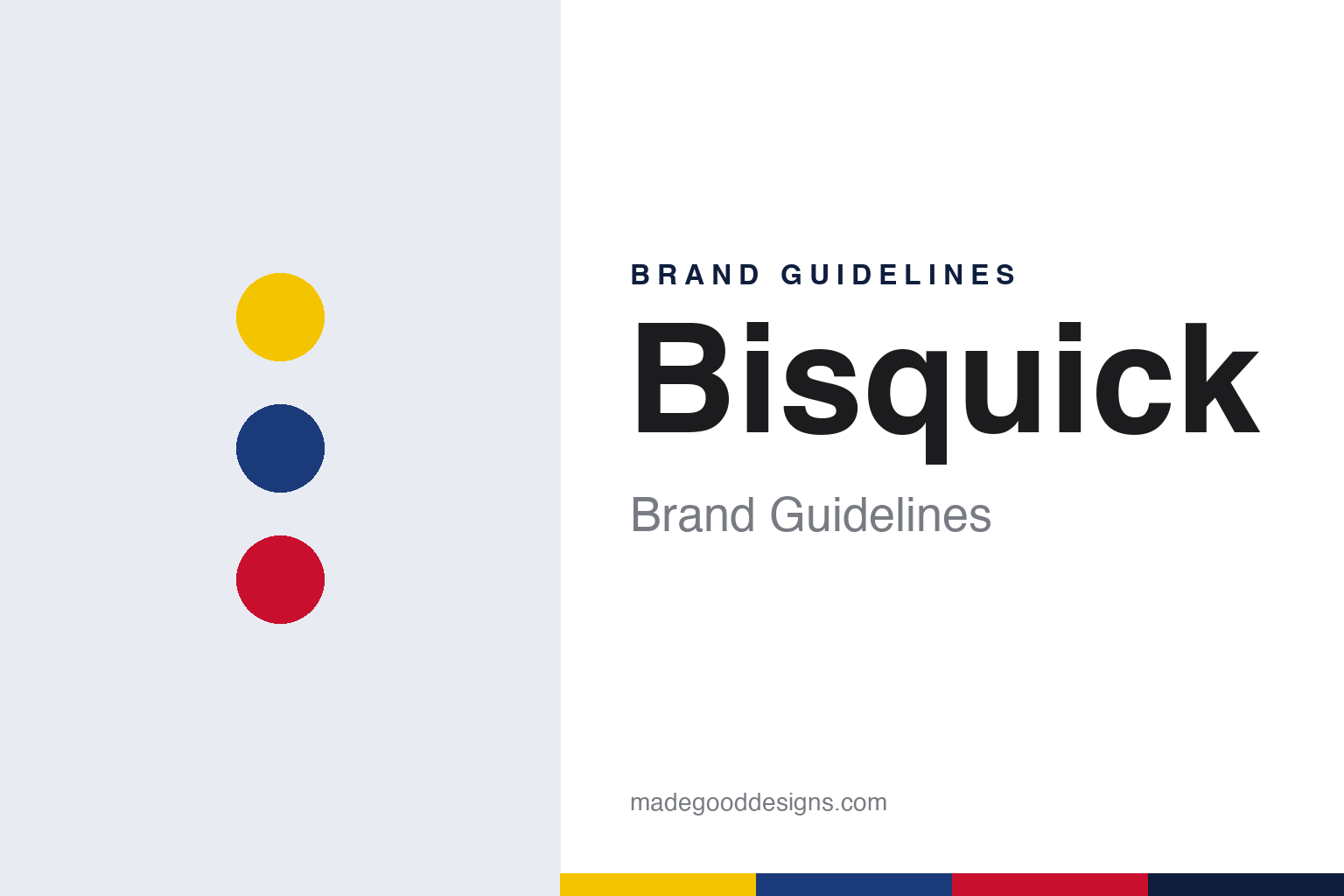
Two constants: a Bisquick yellow, blue and spoon red palette and a sturdy sans register. Abstract homage — not a Bisquick product or mark; no box, spoon or logo is reproduced.
The train biscuits
A salesman, a closed dining car and a chef’s ready-made mix.
Bisquick is a baking mix made by General Mills, and English Wikipedia says it is sold today under the company’s Betty Crocker brand. General Mills dates the idea to 1930 and the product to 1931: its brand page calls 1930 “the year that started it all,” and its own history of the mix, published in April 2015, says Bisquick was “discovered in 1931.”
The company’s story begins on a train. In its account it was late in the evening in 1930, the dining car was closed on a train to San Francisco, and a hungry General Mills salesman, Carl Smith, asked the chef for something quick. The chef served him a plate of hot biscuits and explained his secret: a ready-made blend of lard, baking powder, flour and salt, kept in an ice chest, from which he could bake biscuits in minutes. The food magazine TASTE, citing General Mills in 2017, placed the journey on a Southern Pacific train from Portland, Oregon, to San Francisco and called Smith an executive; English Wikipedia calls him one of the company’s top sales executives.
The chef is not named in the company’s account. TASTE reported that James Gray’s 1954 company history, Business Without Boundary: The Story of General Mills, mentions that the chef was Black, and that the historian Linda Civitello, in her book The Baking Powder Wars, writes that Black Americans were left out of a Bisquick recipe booklet of 1933 and shown only as servants in another of 1935.
Turning the chef’s blend into a boxed mix took work. General Mills says Smith took the idea to a food scientist, who had to produce a shelf-stable mix that baked as well as homemade; TASTE wrote that he went to the company’s chief chemist, and that one problem was keeping the shortening fresh for months. English Wikipedia says the recipe was adapted with hydrogenated oil, so that it no longer needed refrigeration. The mix reached grocers in 1931, and the Los Angeles Times reported in 2000 that it sold more than 500,000 cases within seven months of its introduction.
Colour
A Minneapolis miller, a fictional cook and a slogan.
General Mills was itself only a few years old. It was created on 20 June 1928, when James Ford Bell, president of the Minneapolis flour miller Washburn-Crosby, merged that company with three other mills, English Wikipedia says; the business traces its roots to the Minneapolis Milling Company of 1856 and to Washburn-Crosby, formed in 1877 and the maker of Gold Medal flour. Its headquarters are now in Golden Valley, Minnesota. Bisquick was launched by General Mills and is still sold by it.
The Betty Crocker name is older than the mix. General Mills says its predecessor, Washburn-Crosby, invented the character in 1921 to answer the cooking questions that arrived with entries to a Gold Medal flour puzzle promotion, and that the signature still used, with slight revisions, was chosen from a contest among female employees and written by Florence Lindberg. Bisquick soon had Betty Crocker’s backing in print: English Wikipedia records a 1933 booklet with the lengthy title Betty Crocker’s 101 Delicious Bisquick Creations, as Made and Served by Well-Known Gracious Hostesses, Famous Chefs, Distinguished Epicures and Smart Luminaries of Movieland.
The early advertising, General Mills says, was aimed squarely at women, telling them their Bisquick biscuits could beat their mother-in-law’s and that their husbands would never know the difference. TASTE gave the first slogan as “Makes Anybody a Perfect Biscuit Maker,” later changed to “A World of Baking in a Box” once the mix was being used for shortcakes and muffins, and wrote that by the 1960s a revised recipe used more shortening and sugar. General Mills says the Bisquick team won first place at the first Effie Awards, the American advertising-effectiveness prizes, in 1969.
The recipes went well beyond biscuits. General Mills says cakes, cookies, breads, churros and “Impossible” brunch and dinner bakes filled dedicated Bisquick cookbooks from the 1960s to the 1980s. It also records a stunt: in 1981 the World’s Largest Peach Shortcake was made at the South Carolina Peach Festival, five layers and 25½ feet across, using more than four tons of Bisquick and nine tons of peaches.
Typography
Pantry brands and their owners.
The seven brands in this group are all American pantry and convenience brands: Jif, Peter Pan, Kraft Mac & Cheese, Rice-A-Roni, Velveeta, Stouffer’s and Bisquick. American pantry brands in general sit at many different points in the food trade, from names that began with a single company or inventor to names that now belong to much larger food groups, and a single brand can be sold everywhere from a corner store to a national supermarket chain.
A pantry brand’s identity is usually carried less by a single recipe than by a pack, a name and the meal or shortcut it promises, because the company behind the name may have changed hands, moved its factories or grown far beyond the place where it started. That makes the questions behind each name worth asking plainly: who started it, who owns it now, and where its products are actually made and packed.
Each guide separates what independent sources record from what the company says about itself — its founding story, its owners over time, where its products are made and how its packaging has changed — and marks plainly what rests only on the company’s own word.
Aa
A sturdy sans — blue lettering on a yellow box. (Specimen set in Archivo, a sans STAND-IN; NOT the Bisquick logo.)
Bisquick
A yellow box and a red spoon.
The pack has its own history. General Mills says Bisquick has built its legacy with a yellow and blue box for more than 50 years; it gives no starting date. TASTE, in 2017, described the pack as a “sunny yellow box emblazoned with blue lettering.”
The red spoon came from Betty Crocker. General Mills says a 1953 logo enclosed Betty Crocker’s signature in a red oval, and that the New York firm Lippincott & Margulies turned the oval into the bowl of a spoon, adding a stem and handle. The Red Spoon first appeared on Gold Medal flour in 1954 and was later added to Betty Crocker cake mixes and to Bisquick; General Mills says it now appears on more than 200 products, Bisquick Baking Mix among them.
The range today, on General Mills’ brand page, includes Original Pancake & Baking Mix, Heart Smart Pancake & Baking Mix and Complete Cheese Garlic Biscuit Mix, under the line “Breakfast, lunch, dinner and dessert — all in one box”; the company’s 2015 history also mentions flavoured biscuit mixes, Shake ’n Pour pancake mix and a gluten-free Bisquick. In August 2024 General Mills announced a limited-edition Bisquick collaboration with the musician Kid Cudi, Cudi’s Funnel Cake Mix, in a fair-themed collectible box showing Kid Cudi and his dog Nino, sold only through his website.
For a design guide, Bisquick shows how a pack colour and a borrowed emblem can carry a single product for decades. Compare Cheerios, another General Mills brand in a yellow box, and Old El Paso, also owned by General Mills. For this guide we use a box yellow, a lettering blue and a spoon red with a sans, an unofficial interpretation; no product or logo is reproduced.
Explore & save
Keep Bisquick’s identity on hand — save it to a board in the Made Good inspiration library.
Bisquick identity set
Pin the Bisquick yellow, blue and spoon red palette and the sturdy sans register to your own board.