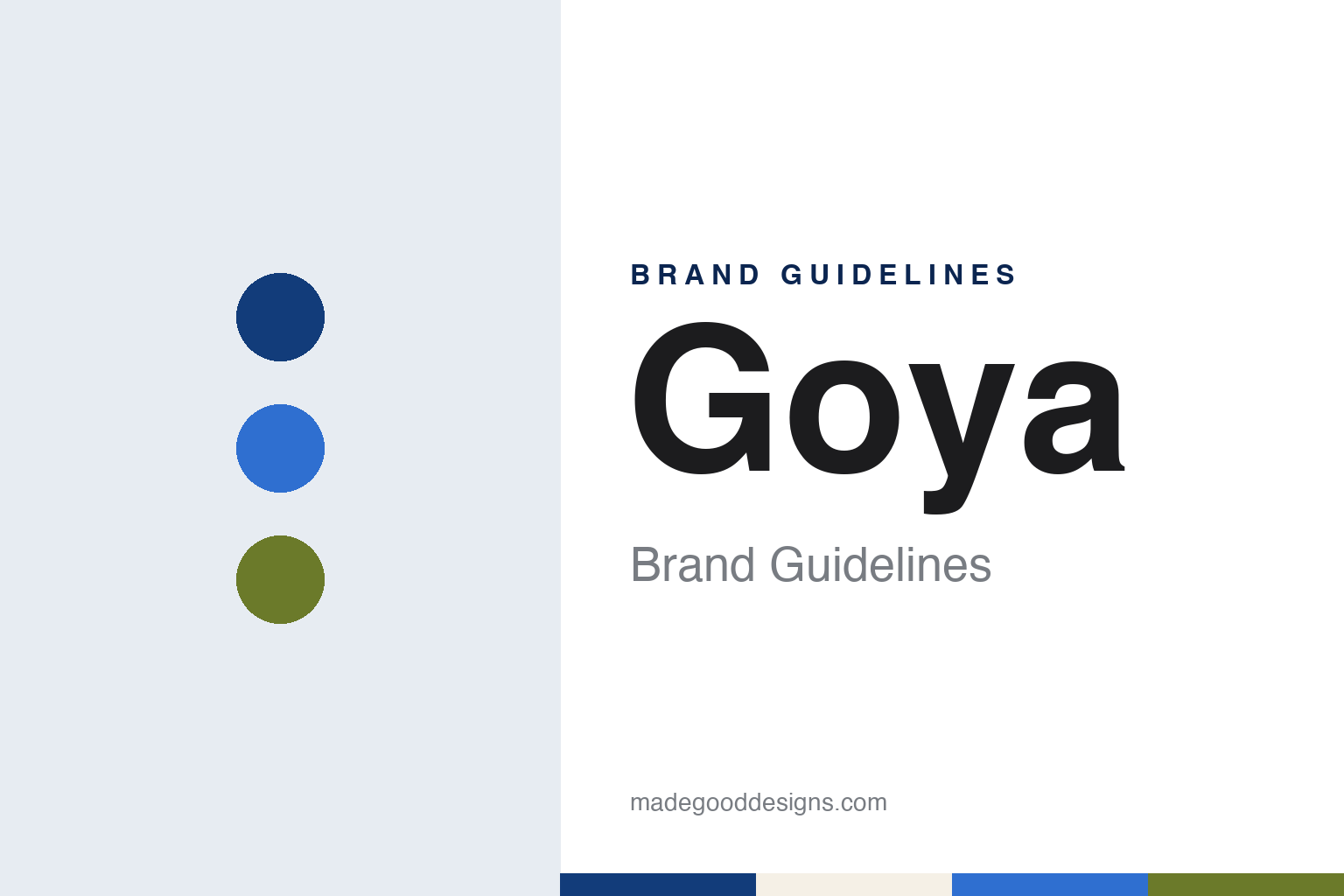
Goya Brand Guidelines
The Duane Street importer and its one-dollar name.
Aa
Two constants: a deep blue, bright blue and olive green palette and a bold grocery sans register. Abstract homage — not a Goya product or mark; no can, label or logo is reproduced.
Duane Street
Two Spanish emigrants, a warehouse and a borrowed name.
Goya began in 1936 as a small import business in Lower Manhattan. Its founders, Prudencio Unanue (1886–1976) and his wife Carolina Casal (1890–1984), were Spaniards who had each emigrated to Puerto Rico, where they met and married. Spanish Wikipedia says Unanue came from Villasana de Mena, in the province of Burgos, and Casal from Caldas de Reyes, in Galicia. The Smithsonian’s National Museum of American History, in a 2001 finding aid for the company’s archive, says Unanue reached Puerto Rico in 1902, married Casal in 1921 and moved on to New York, where he studied business and worked for a customs agency.
In 1936, the museum says, the couple opened Unanue, Inc., a warehouse on Duane Street, to supply the corner shops, or bodegas, of the city’s Spanish-speaking neighbourhoods. The company says it started with olives, olive oil and sardines from Spain. The same year the business bought the name Goya from a Moroccan sardine supplier — for one dollar, according to the Smithsonian. English Wikipedia says Unanue thought his own surname would be hard for American customers to pronounce and liked the link to the Spanish painter Francisco Goya.
The name went on the products long before it went on the company. The business became Unanue and Sons, Inc. in 1946 and took the name Goya Foods, Inc. only in 1961, the museum’s history says, although Goya had been the brand since 1936. Over three decades the importer began processing, canning and packing food itself, and in 1958 it bought its first factory, in Brooklyn. In 1974 it moved its headquarters and a factory across the Hudson to Secaucus, New Jersey, where it stayed for four decades.
Colour
Bodegas, parades and a museum archive.
As more Caribbean immigrants arrived in the United States in the 1960s, Goya went looking for new customers, the Smithsonian says, and it became a visible sponsor of community life: music festivals, sports teams, parades and beauty pageants in New York, New Jersey and Puerto Rico. The museum also credits the company with pioneering television advertising in Puerto Rico. Spanish Wikipedia says Goya moved first into Puerto Rican cooking and then, from the early 1990s, into Mexican, Central American and South American foods. By 1998, The New York Times reported, it sold about 800 items, among them rice, beans, sauces and spices. Today the company says it offers more than 2,600 products.
Its slogan is a promise of consistency: “If It’s Goya, It Has To Be Good,” which the company calls its credo. Goya’s own history also stresses the route its products took, from bodegas and small speciality shops to national retailers including Costco, Sam’s Club and BJ’s.
Much of that visual history now sits in a museum. In 1999 Goya donated its archive to the National Museum of American History, where the Archives Center catalogues the Goya Foods, Inc. Collection, covering 1960 to 2000. Its 20 cubic feet include box and can labels, point-of-purchase material, calendars, cookbooks, recipe packages, scrapbooks and television commercials, and the museum’s Division of Cultural History holds related promotional items, display props, products and containers, and a neon sign. English Wikipedia notes that Goya’s logo and imagery have also turned up in art, including work by the Cuban-American artist Ric Garcia and the sculptor Alexander Mijares.
Typography
Design and documentation.
The seven brands in this group are all food brands, and all of them come from Mexico and the United States: Goya, Herdez, Bimbo, Maseca, Jumex, Sabritas and Gamesa. Food brands in general sit at many different points in the trade, from family firms that still carry a founder’s surname to names that now belong to much larger food groups, and a single brand can be sold everywhere from a corner shop to a supermarket shelf.
A food brand’s identity is usually carried less by a single product than by a pack, a name and the meal or snack it promises, because the company behind the name may have changed hands, moved its factory or grown far beyond the town where it started. That makes the questions behind each name worth asking plainly: who started it, who owns it now, and where its food is actually made and packed.
Each guide separates what independent sources record from what the company says about itself — its founding story, its owners over time, where its food is made and how its packaging has changed — and marks plainly what rests only on the company’s own word.
Aa
A bold, plain sans for a pantry brand built in bodegas. (Specimen set in Archivo, a sans STAND-IN; NOT the Goya logo.)
Goya
Three generations of Unanues and a move to Jersey City.
Goya remains a private company owned by the Unanue family, now in its third generation, English Wikipedia says. In 1976 the business passed to his sons Joseph, Charles, Francisco and Anthony. Joseph A. Unanue became president and chief executive, while Francisco ran Goya de Puerto Rico, which handled much of the manufacturing. Under Joseph the company grew to about 2,000 employees by 1998, The New York Times reported. In 2004, amid a family dispute over the company’s direction reported by The Wall Street Journal, he was replaced by his nephew Robert Unanue, Anthony’s son, who was chief executive until 2025. In 2019 Goya held talks about a possible sale, CNBC reported, and the deal did not go ahead.
The company has stayed in the New Jersey Meadowlands. In 2012 it broke ground on a new headquarters and distribution centre in Jersey City, backed by state tax incentives, The Wall Street Journal reported, and it opened there in 2015, NJ.com reported. Goya says it now runs 26 manufacturing and distribution facilities in the United States, Puerto Rico, the Dominican Republic and Spain, employs more than 4,000 people and is the largest Hispanic-owned food company in the US. English Wikipedia names a manufacturing plant in San Cristóbal, in the Dominican Republic, and a distribution centre in Bayamón, Puerto Rico. In July 2020 Robert Unanue’s praise of President Donald Trump at a White House event prompted calls for a boycott and, in response, for a “buycott,” English Wikipedia records. The company marks its 90th anniversary in 2026.
For a design guide, Goya shows how a painter’s name, bought in 1936, could carry an immigrant importer from a Duane Street warehouse to supermarket shelves across the country. Compare Rancho Gordo, the California heirloom-bean company, and Herdez, the Mexican food group. For this guide we use a deep blue, a bright blue and an olive green with a bold sans, an unofficial interpretation; no product or logo is reproduced.
Explore & save
Keep Goya’s identity on hand — save it to a board in the Made Good inspiration library.
Goya identity set
Pin the Goya deep blue, bright blue and olive green palette and the bold grocery sans register to your own board.