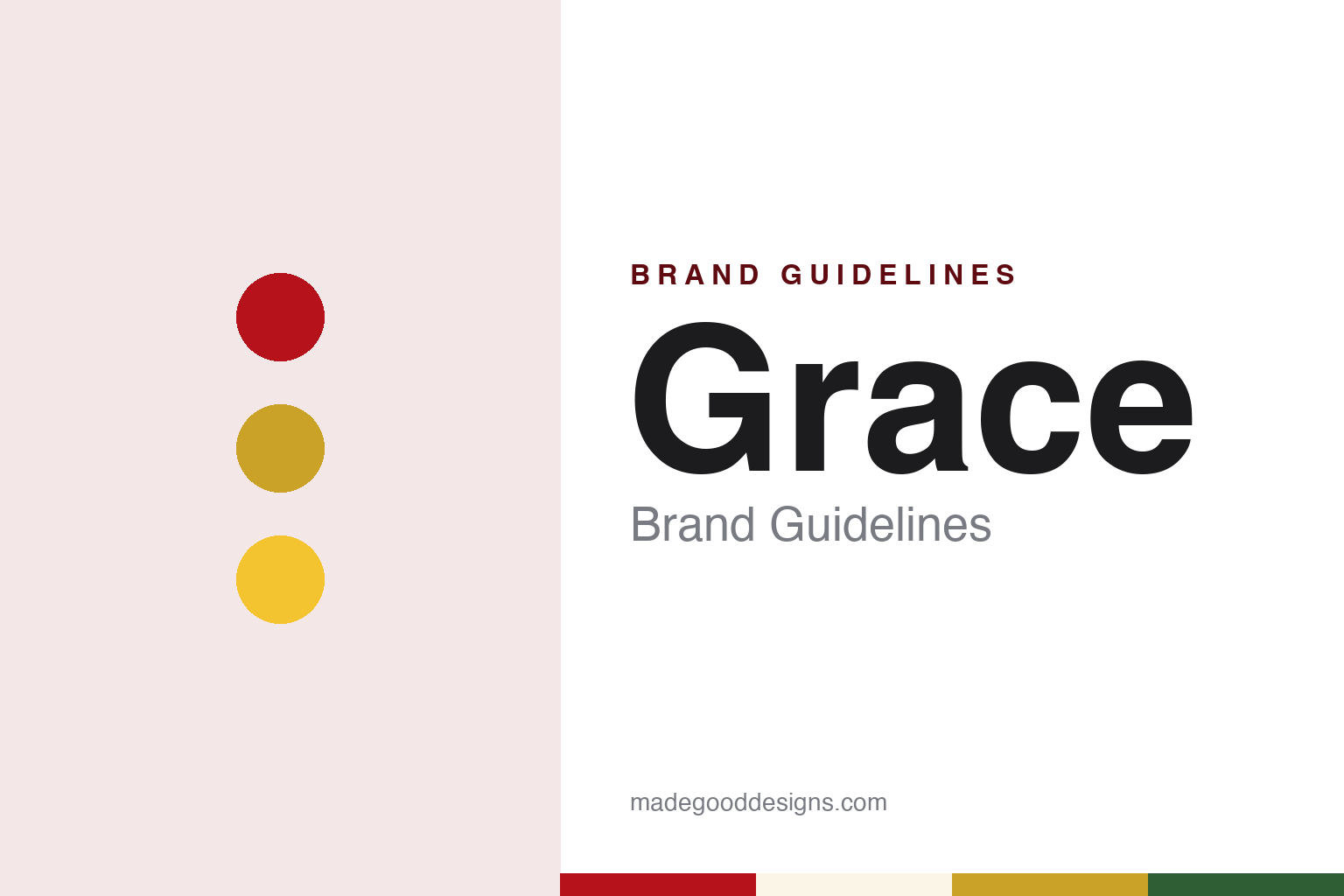
Grace Brand Guidelines
GraceKennedy’s crowned label from Kingston.
Aa
Two constants: a pepper red, crown gold and ackee yellow palette and a display serif register. Abstract homage — not a Grace product or mark; no can, label or logo is reproduced.
Grace, Kennedy
A New York branch, a Valentine’s Day launch and a wharf.
Grace is the food brand of GraceKennedy, one of the Caribbean’s largest groups, and its name comes from a New York trading house. The company says its founders, Dr John J. Grace and Fred William Kennedy, both worked in Jamaica for Grace Limited, a wholly owned subsidiary of W. R. Grace & Company of New York. After a sharp American recession in 1920–21, the parent decided to sell its Jamaican branch. Grace judged that the Kingston business was sound and was being sold only to relieve pressure in New York, and decided to keep it, with Kennedy’s backing. On Kennedy’s recommendation James Moss-Solomon, then with the United Fruit Company, joined as accountant.
The new firm, Grace, Kennedy & Company Limited, was launched on 14 February 1922 — Valentine’s Day and, the company notes, the birthday of Kennedy’s mother. English Wikipedia, citing the historian Douglas Hall’s company history Grace, Kennedy & Company Limited: A Story of Jamaican Enterprise, describes it as a small trading business that soon acquired wharf facilities to handle its imports. The company’s history says a wharf at its Harbour Street premises in Kingston was working by March 1924.
For its first decades the firm was a merchant, not a manufacturer. In the 1930s, the company’s history says, it represented thirty-two overseas manufacturers and imported goods from steel safes to silks, but its most important lines were salted and pickled fish and meat, rice and flour, the staples of working-class Jamaican cooking. A young billing clerk, Carlton Alexander, who joined in 1933, won large counter-flour orders, and during the Second World War the firm was given about a quarter of the island’s flour import quota. Alexander would later chair the company.
Colour
A trademark problem, a film star and a small crown.
The Grace name on cans began as a question of trademarks. The company’s history says Grace, Kennedy had been allowed to use the Grace trademark in Jamaica after it bought the old branch, but that permission did not cover its overseas subsidiaries. The first of those was Grace, Kennedy & Co. (Canada), opened in Montreal in 1952. Its manager from 1957, Boerries Terfloth, whose family had long been in the German food-import trade, needed a registered mark by the mid-1960s as the overseas business grew.
Terfloth chose Grace for two reasons, the history says: it tied the products to the parent company in Jamaica, and, for consumers far away to whom that link meant little, it could call to mind the film star Grace Kelly. The company’s account adds that the later design of the Grace brand, like Kelly, carries a small crown. The first overseas use of the Grace label was on a shipment of cherries from Canada to Germany; the crowned logotype was first used on lobster sent from Canada to Germany, where, the history says, people still spoke of “Crown Lobster.” In Jamaica, it credits Arnold “Junior” Foote with much of the work on successive logo designs and advertising slogans.
W. R. Grace in New York objected to the label being used outside Jamaica. Luis Fred Kennedy reached a tentative agreement with it early in 1967, and after many months of talks the Grace trademark was registered in the United States in December 1969, the history says. At home, the company relied on local canneries to pack produce under the Grace label until it moved into processing itself; by September 1972 it had both a meat division and a canning division under the name Grace Food Processors.
Typography
Design and documentation.
The seven brands in this group all make food or drink, and all of them come from Central America, Peru or Jamaica: Flor de Caña, Zacapa, Toña, Dos Pinos, Big Cola, Grace and Walkerswood. Food and drink brands from this part of the world sit at many different points in the trade, from family firms and cooperatives that still carry a founder’s or a place’s name to names that now belong to much larger groups, and a single brand can be sold everywhere from a village shop to a supermarket shelf abroad.
A food or drink brand’s identity is usually carried less by a single product than by a label, a name and the meal or occasion it promises, because the company behind the name may have changed hands, moved its production or grown far beyond the town where it started. That makes the questions behind each name worth asking plainly: who started it, who owns it now, and where its products are actually made, bottled and packed.
Each guide separates what independent sources record from what the company says about itself — its founding story, its owners over time, where its products are made and how its labels have changed — and marks plainly what rests only on the company’s own word.
Aa
A display serif for a label that borrowed a film star’s crown. (Specimen set in DM Serif Display, a serif STAND-IN; NOT the Grace logo.)
Grace
A listed group, a centenary and a label abroad.
GraceKennedy became a public company on 11 September 1986, when its shares were listed on the stock exchange in Jamaica, according to its history; it is also listed in Trinidad and Tobago. In 1995 it set a “2020 Vision” to turn itself from a Jamaican trading company into a global consumer group, English Wikipedia says, citing the company. Today the group works in food and in financial services, from banking and insurance to remittances, and its food website calls GraceKennedy the Caribbean’s leading food manufacturer and distributor. The company says its purpose is “enriching lives through trusted food and financial services” and its vision is “to be the #1 Caribbean brand in the world.” Frank James became group chief executive on 14 February 2025, the company says.
The Grace brand reaches shelves through a network of subsidiaries. The company lists food businesses in Jamaica, Belize, Canada, the United States and the United Kingdom, where Grace Foods UK is based in Welwyn Garden City, Hertfordshire, alongside sister companies including Enco Products. Its websites list ranges from beverages and coconut products to soups, sauces, spices and canned fish and meat, and name related brands such as Dunn’s River, Encona and Nurishment. For the group’s centenary in 2022 the UK business issued special-edition “GK100” packs, including its Grace Tropical Rhythms drinks and Dunn’s River Jamaican jerk seasoning, and its website names the dancehall artist Ding Dong as a Grace Foods ambassador. The company says its mission remains “to satisfy the unmet needs of Caribbean people” wherever they live.
For a design guide, Grace shows how a borrowed surname, a film star’s glamour and a small crown became the mark of Jamaican food abroad. Compare Walkerswood, the Jamaican jerk-seasoning maker, and Marie Sharp’s, the Belizean hot-sauce maker. For this guide we use a pepper red, a crown gold and an ackee yellow with a display serif, an unofficial interpretation; no product or logo is reproduced.
Explore & save
Keep Grace’s identity on hand — save it to a board in the Made Good inspiration library.
Grace identity set
Pin the Grace pepper red, crown gold and ackee yellow palette and the display serif register to your own board.