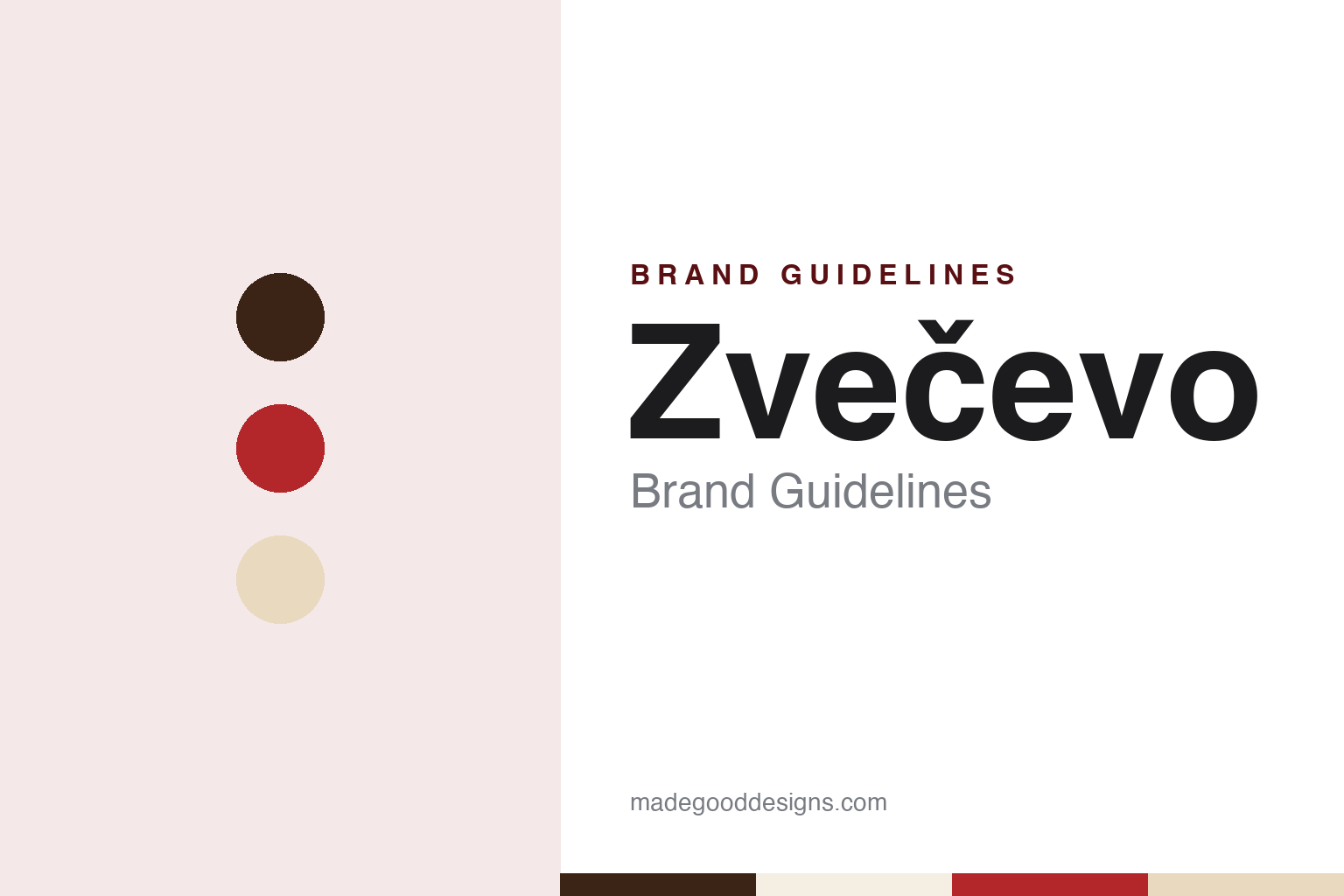
Zvečevo Brand Guidelines
The Požega chocolate maker since 1921.
Aa
Two constants: a Požega red, cocoa and rice cream palette and a small-caps serif register. Abstract homage — not a Zvečevo product or mark; no pack, logo or bar is reproduced.
From cognac to cocoa
A spirits works in Slavonia that turned to chocolate.
Zvečevo is made in Požega, a town in the Slavonia region of eastern Croatia, and it dates itself to 1921. Croatian and English Wikipedia both give the founding date as 20 October 1921 and the first name as Stock Cognac Medicinal, and English Wikipedia says the factory began with strong alcoholic drinks. The company tells the same story in its own words: it says its history begins in 1921 “in a small factory that began producing alcohol,” and that the first chocolates left its plant as early as 1924.
The Swiss connection came in the 1930s. The company says its cooperation with Nestlé began in 1934, bringing new knowledge and modern technology to Požega. Croatian Wikipedia gives the detail: Nestlé offered a rental contract for the chocolate and sweet works in 1934 and received permission to start chocolate production in 1936. English Wikipedia says the factory was rented to Nestlé from 1936 to 1946.
After the Second World War the works was nationalised; Croatian Wikipedia says production carried on under the nationalised factory from 1946. In 1951 it took the name Zvečevo, which both the company and Croatian Wikipedia date to that year. In 1958 the dairy business Slavonka was merged in, which, the company says, let Zvečevo make its own milk powder and butter. Croatian Wikipedia says that in the 1960s the firm dropped unprofitable fruit-juice and flour production to concentrate on cocoa products, alcoholic drinks and milk powder, and that wafer production based on flour followed in 1987.
Colour
Mikado, Braco and Seka.
The product Zvečevo is best known for is Mikado, a milk chocolate with crisped rice. The company calls it “the first chocolate with rice in the world,” and English Wikipedia, repeating the claim, dates its design to 1964; it is the company’s own description rather than an independently tested first, so we report it as such. The company places Mikado in what it describes as an era of innovation in the 1960s, alongside other lines it still names among its key brands: Braco and Seka — Croatian for “little brother” and “little sister” — and the gift chocolates “Volim te!” (“I love you!”) and “Samo ti!” (“Only you!”).
The Nestlé relationship returned after the war. Croatian Wikipedia says Zvečevo signed a long-term business cooperation agreement with Nestlé in 1970, and English Wikipedia says that cooperation resumed in 1970 and ended in 1995. The company says that from the 1970s its staff trained in Switzerland as the plant was modernised.
Today the company’s range, as listed on its website, runs across chocolates, chocolate bars, marshmallow, sweet popcorn and wafers. Its slogan is “Tvornica radosti i slasti” — roughly “the factory of joy and sweetness” — and its home page calls Zvečevo a “synonym for chocolate since 1921.” The company says it exports to markets including North America, Australia, New Zealand, Austria, Germany, Hungary and Switzerland.
The year has become part of the mark. On the company’s 2024 stock-exchange notices, the letterhead carries the name Zvečevo in red capitals, with the year 1921 set beneath it between two short rules. Recognition has come for the factory as well as its sweets: in 2001 Croatia’s Ministry of Environmental Protection gave Zvečevo an environmental award, known as the “Croatian Oscar,” according to both the company and Croatian Wikipedia.
Typography
Design and documentation.
The seven brands in this group all make food or drink, and all of them come from Croatia: Dukat, Vindija, Zvečevo, Franck, Cedevita, Jamnica and Ledo. Croatian food and drink brands in general sit at many different points in the trade, from firms that still carry the name of the town or region where they started to names that now belong to much larger food groups, and a single brand can be sold everywhere from a corner kiosk to a supermarket shelf.
A food or drink brand’s identity is usually carried less by a single product than by a pack, a name and the everyday moment it promises, because the company behind the name may have changed hands, moved its production or grown far beyond the town where it started. That makes the questions behind each name worth asking plainly: who started it, who owns it now, and where its products are actually made and packed.
Each guide separates what independent sources record from what the company says about itself — its founding story, its owners over time, where its products are made and how its packaging has changed — and marks plainly what rests only on the company’s own word.
Aa
A small-caps serif for a chocolate maker that puts its founding year under its name. (Specimen set in Cormorant SC, a serif STAND-IN; NOT the Zvečevo logo.)
Zvečevo
A listed company and a change of owner.
Zvečevo is a joint-stock company, Zvečevo d.d., with its seat in Požega. Croatian Wikipedia dates the conversion to a joint-stock company to September 1994, while English Wikipedia gives 1995, so we note both dates. Its shares trade on the Zagreb Stock Exchange under the ticker ZVCV, Croatian Wikipedia says, and as a listed issuer the company publishes its notices to the exchange and the market regulator on its own website.
Those notices document the most recent change of ownership. In a notice dated 28 March 2024, Zvečevo said that on 26 March 2024 its majority shareholder, Zdravko Alvir, then president of the management board, had signed a share purchase agreement with Flexway Adriatic, a company based in Zagreb, and that the buyer was obliged to make a takeover offer for the company. A further notice dated 24 April 2024 said the shares had been transferred on 22 April 2024, and that Zdravko Alvir no longer held any Zvečevo shares. The company published a notice of changes to its management and supervisory boards in April 2024 and a report on the takeover in July 2024. Its website now names Hrvoje Alvir as chairman of the management board.
Zvečevo sits in a small group of long-lived Croatian confectioners. The best known of them, Zagreb’s Kraš, traces its own roots to 1911. Zvečevo’s history also runs through Nestlé, which rented its Požega works before the war and returned as a partner from 1970.
For a design guide, Zvečevo shows how a regional confectioner can lean on a single date: the year 1921, set under the name, does the work that a mascot or a colour does for larger rivals, and named lines like Mikado, Braco and Seka carry the personality. Compare it with Kraš, Croatia’s larger Zagreb confectioner, and with Cailler, the Swiss chocolate name owned by Nestlé. For this guide we use Požega red, cocoa and rice cream with a small-caps serif, an unofficial interpretation; no product or logo is reproduced.
Explore & save
Keep Zvečevo’s identity on hand — save it to a board in the Made Good inspiration library.
Zvečevo identity set
Pin the Zvečevo Požega red, cocoa and rice cream palette and the small-caps serif register to your own board.