Royal Stag Brand Guidelines
Seagram’s Indian whisky of 1995, now Pernod Ricard’s.
Aa
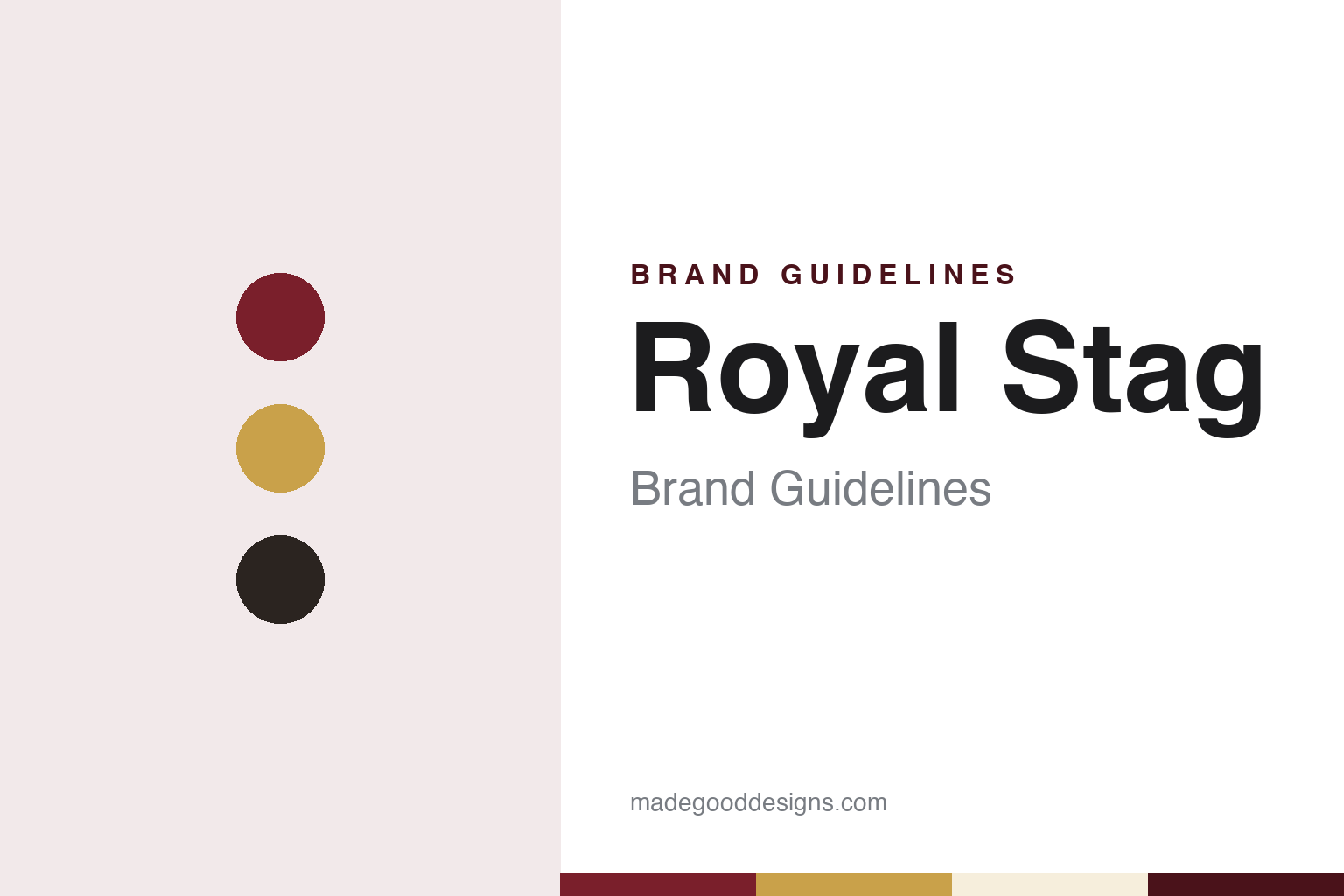
Two constants: a stag maroon, antler gold and ivory palette and a high-contrast serif register. Abstract homage — not a Royal Stag product or mark; no label, logo or bottle is reproduced.
A Seagram whisky that changed hands
Launched by one global drinks group, inherited by another.
Royal Stag, often labelled Seagram’s Royal Stag, is an Indian whisky launched in 1995 by the Indian business of Seagram, the Canadian drinks group, English Wikipedia says, citing Encyclopædia Britannica, The Financial Express and BusinessLine. The whisky is a blend of grain spirits and imported Scotch malts, and English Wikipedia credits the brand with building its blend on grain spirit at a time when much of the Indian market relied on spirit distilled from molasses.
The brand did not stay with the company that created it for long. Seagram’s drinks business was bought jointly by Pernod Ricard and Diageo in a deal agreed in December 2000, and when the two groups divided the assets, Royal Stag went to Pernod Ricard, English Wikipedia says. The Financial Express reported in February 2002 that Pernod Ricard India was set to take over Seagram’s local operations. The Seagram name stayed with the whisky, which English Wikipedia notes is also known as Seagram’s Royal Stag.
Under its new owner the whisky grew quickly. English Wikipedia, drawing on Indian business press, records that the brand first crossed 10 million cases a year in 2010, and that in 2011, at about 12.3 million cases, it overtook Absolut vodka to become the biggest-selling brand by volume in Pernod Ricard’s worldwide portfolio. By 2014 it was selling about 16.1 million cases, and English Wikipedia ranks it as India’s third-biggest whisky from 2011, behind Officer’s Choice and McDowell’s No.1.
Pernod Ricard has named Royal Stag one of five core brands for its business in India, English Wikipedia says, alongside Imperial Blue, Blenders Pride, Chivas Regal and 100 Pipers; Royal Stag sits with the locally blended whiskies sold in India as India-made foreign liquor.
Colour
A stag, a maroon label and a slogan about ambition.
The emblem is in the name. English Wikipedia says the brand is named after a deer known for its antlers, and a stag appears in the logo. The label’s ground colour is a deep maroon, which the brand’s packaging agency says it later brightened.
The London packaging agency Sedley Place says it worked on Royal Stag at its launch under Seagram, and describes a later redesign for Pernod Ricard India on its own website. The agency says it drew a taller, rectangular rather than square bottle with flatter, straighter shoulders and a more pronounced taper, added embossed details on the sides reading “Seagram Quality” with a crest and “Since 1857,” refined the label to follow the new shoulder, updated the wordmark and the ribbon that holds it, brightened the maroon with a graduated hue, added a bar carrying a “Mark of Purity” message and redrew the stag’s head in a more stylised form. The agency’s page does not date the redesign.
Variants have been built around the same animal. Pernod Ricard launched Royal Stag Barrel Select in December 2011 in India, the Gulf and other Asian markets, positioned above Royal Stag and below Blenders Pride, English Wikipedia says. The British branding consultancy CARTILS handled its positioning, bottle shape, packaging and carton: a tapered version of the rectangular bottle carrying a gold two-tone illustration of the stag. Trade titles including Packaging Gateway later reported a further CARTILS update with a silver metallic finish and a taller, slimmer bottle, while the blend stayed the same.
In August 2024 Food Business MEA reported that Pernod Ricard India had launched Royal Stag Double Dark Peaty, a smoky blend, alongside a new Blenders Pride whisky, with packaging designed by FCB India and limited use of cartons during the launch phase. For the 2019 Cricket World Cup the brand issued a limited-edition pack designed by Ogilvy and inspired by the trophy, Ambrosia India reported.
The words matter as much as the antlers. The brand’s long-running slogan is “It’s your life, make it large,” English Wikipedia says, and much of its advertising has been built around that idea of ambition.
Typography
Design and documentation.
The seven brands in this group are all Indian and Japanese spirits names: Old Monk, McDowell’s, Royal Stag, Officer’s Choice, Blenders Pride, Hibiki and Nikka. Spirits brands in general sit at many different points in the trade, from houses that still carry a founder’s name to labels that now belong to much larger drinks groups, and a single brand can be sold everywhere from a corner shop to a hotel bar.
A spirits brand’s identity is usually carried less by a single bottle than by a label, a name and the story it tells, because the company behind the name may have changed hands, moved its production or grown far beyond the place where it started. That makes the questions behind each name worth asking plainly: who started it, who owns it now, and where its whisky or rum is actually distilled, blended and bottled.
Each guide separates what independent sources record from what the company says about itself — its founding story, its owners over time, where its spirits are made and how its labels have changed — and marks plainly what rests only on the company’s own word.
Aa
A high-contrast serif for a heritage-style whisky label. (Specimen set in Playfair Display, a serif STAND-IN; NOT the Royal Stag logo.)
Royal Stag
Music, films and cricket in a market without liquor advertising.
Royal Stag grew up in a market where alcohol cannot be advertised directly on television. English Wikipedia notes that an amendment to India’s cable television rules banning such advertising took effect on 8 September 2000, and that drinks companies instead promote brand extensions and associated properties, a practice known as surrogate advertising. Royal Stag’s answer was three themed properties: Mega Music, Mega Movies and Mega Cricket. Bikram Basu, then vice-president of marketing at Seagram India, said the company had developed Mega Cricket and Mega Movies to promote the brand, The Times of India reported; Mega Cricket sold cricket gear and sponsored matches, while Mega Movies sponsored releases of Hollywood films.
Sport came first. The brand sponsored the Sahara Cup matches in Toronto from 1996 to 1999, English Wikipedia says, and in 2002 Seagram signed eight international cricketers, among them Harbhajan Singh, Glenn McGrath and Jonty Rhodes, in a campaign handled by Ogilvy & Mather. Music followed: under the name “Seagram’s Royal Stag Mega Music,” the brand sponsored a multi-city tour in January 2008 featuring the Pakistani band Strings and the Indian rock band Parikrama, and it has been title sponsor of the Mirchi Music Awards.
Film stars carried the slogan on screen. The actor Saif Ali Khan fronted the brand’s first television commercial as ambassador in 2007, again by Ogilvy & Mather; Pernod Ricard India signed Shah Rukh Khan in February 2010 and added Ranveer Singh and Arjun Kapoor in 2014, English Wikipedia says. One advertisement drew protest: in 2006 an advertisement showing Harbhajan Singh without his turban was criticised by Sikh religious bodies, which asked for it to be withdrawn, and the cricketer apologised, English Wikipedia records.
For a design guide, Royal Stag shows how a single animal, a maroon label and one line of copy can hold a whisky brand together across a change of owner and a market where it can rarely be advertised in its own name. Compare Blenders Pride, its stablemate at Pernod Ricard India, and Chivas Regal, the Scotch blend from the same group. For this guide we use stag maroon, antler gold and ivory with a high-contrast serif, an unofficial interpretation; no product or logo is reproduced.
Explore & save
Keep Royal Stag’s identity on hand — save it to a board in the Made Good inspiration library.
Royal Stag identity set
Pin the Royal Stag maroon, antler gold and ivory palette and the high-contrast serif register to your own board.