Bunnahabhain Brand Guidelines
The unpeated Islay malt of the helmsman, since 1881.
Aa
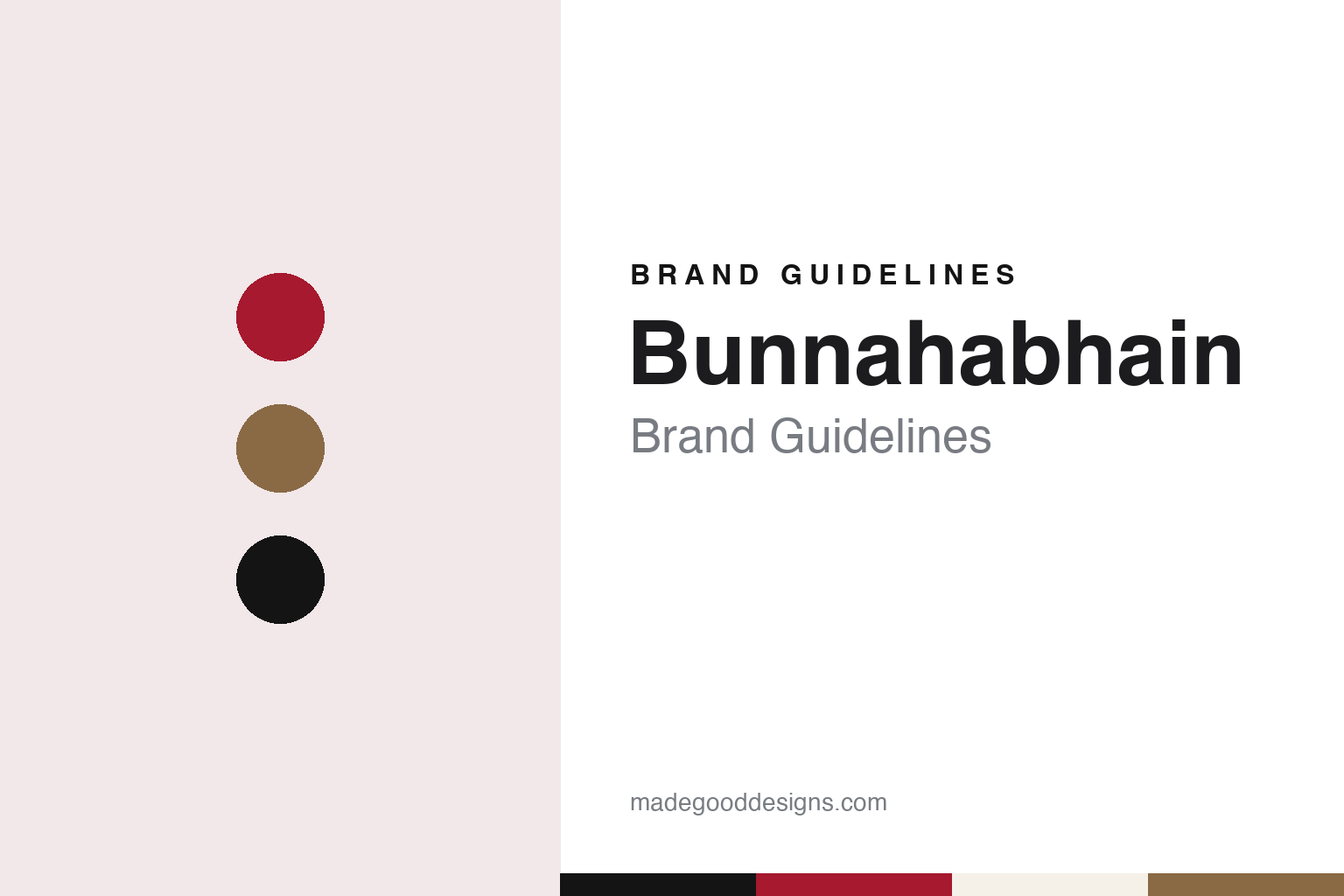
Two constants: a helm red, sepia and label black palette and a transitional serif register. Abstract homage — not a Bunnahabhain product or mark; no label, logo or bottle is reproduced.
The mouth of the river
A distillery and a village built together on Islay’s north-east coast.
Bunnahabhain is a single malt Scotch whisky distilled on the north-east coast of Islay, near Port Askaig. The name is an anglicised form of the Gaelic Bun na h-Abhainne, “mouth of the river.” The company says the distillery was established in 1881 by the blender William Robertson, of Robertson & Baxter, in partnership with the brothers William and James Greenlees, and that production began in 1883. The village of Bunnahabhain was built at the same time to house the workers and their families.
The partners’ business became the Islay Distillery Company, and in 1887 it was one of the founding companies of Highland Distillers, the forerunner of Edrington, according to the whisky reference site scotchwhisky.com. For most of its life the distillery made whisky for blending; the same source names The Famous Grouse and Cutty Sark among the blends it supplied. English Wikipedia, citing the Oban Times of 3 February 1894, says the distillery was fitted with electric light that year, the earliest record of electricity on Islay. Supplies came by sea: the company says a road reached the distillery only in 1960, and the last delivery by ship came in 1993. The distillery closed in 1981 and reopened in 1984, the Aberdeen Press and Journal reported in November 1983.
Ownership changed in 2003, when Edrington sold Bunnahabhain and the Black Bottle blend to Burn Stewart Distillers, scotchwhisky.com says. Burn Stewart’s Trinidad-based owner, CL Financial, collapsed in 2009, and its receivers sold Burn Stewart to the South African drinks group Distell in 2013, as the Financial Times reported in April that year.
Colour
A helmsman, a red label and a song about sailing home.
The figure on the label is a seafarer at the wheel. Transform magazine reported on 5 June 2018 that Bunnahabhain had been redesigned by the Edinburgh agency threebrand, and that the helmsman, hand-drawn in gold in the 2006 design, had been redrawn by the Scottish illustrator Iain McIntosh in a sepia tone. The magazine said the new label kept the brand’s signature red, used a clearer white-on-black wordmark and added subtle maps of Islay to the pack. Derek Scott, then brand director at Distell, told the magazine that the redesign reflected a new positioning for the brand.
The helmsman is tied to a song. The company calls the traditional Islay song “Westering Home,” about a journey home across the sea, the island’s anthem, and has used it for special bottlings. A 17-year-old called Westering Home was released for the Fèis Ìle festival in 2014 with a label by the Swedish artist Mathilda Holmqvist, chosen through the distillery’s “Tales of the Sea” label competition, which It’s Nice That reported in 2013; the whisky blog Whisky Saga credits the label to her. In 2025 the distillery began a three-year Westering Home Collection for Fèis Ìle, opening with a 15-year-old named Turas Math; the second chapter, An Cuan Garbh, reached the United States in July 2026, the company announced.
The taste is part of the brand’s difference on Islay, an island better known for peat smoke. The company describes its spirit as unpeated, and its core range is built around aged whiskies such as the 12 and 18 years old. The core range the company listed in 2022 also included two whiskies without an age statement, Stiùireadair and Toiteach A Dhà, alongside 25-, 30- and 40-year-old bottlings.
Typography
Design and documentation.
The seven brands in this group are all Scotch whisky names: Monkey Shoulder, Whyte & Mackay, Auchentoshan, Old Pulteney, Glengoyne, Bunnahabhain and Caol Ila. Scotch whisky brands in general sit at many different points in the trade, from distilleries that still carry the name of the place where they stand to labels that now belong to much larger drinks groups, and a single brand can be sold everywhere from a corner shop to a hotel bar.
A whisky brand’s identity is usually carried less by a single bottle than by a label, a name and the place it promises, because the company behind the name may have changed hands, rebuilt its distillery or grown far beyond the place where it started. That makes the questions behind each name worth asking plainly: who started it, who owns it now, and where its whisky is actually distilled, matured and bottled.
Each guide separates what independent sources record from what the company says about itself — its founding story, its owners over time, where its whisky is made and how its labels have changed — and marks plainly what rests only on the company’s own word.
Aa
A transitional serif for a maritime, label-like register. (Specimen set in Libre Baskerville, a serif STAND-IN; NOT the Bunnahabhain logo.)
Bunnahabhain
A flagship malt in a group that stayed outside a brewer’s takeover.
Bunnahabhain’s current owner was shaped by a larger deal. Heineken agreed in November 2021 to buy a controlling stake in Distell and completed the transaction in April 2023, but Distell’s Scotch whisky business was left out of it. That business stayed with Capevin Holdings, controlled by the South African investment group Remgro, and on 27 April 2023 the company formerly known as Distell International became CVH Spirits, the journalist Ian Fraser reported in June 2023. CVH, based in East Kilbride, also owns the Deanston and Tobermory distilleries and the Ledaig malt, and Fraser described Bunnahabhain as its flagship single malt. In September 2024 the Campari Group took a minority stake in Capevin Holdings, Just Drinks reported, with Remgro remaining the majority shareholder.
The distillery has also invested in its own energy. CVH said its biomass plant at Bunnahabhain won Sustainable Development of the Year at the Scottish Green Energy Awards in December 2022, Ian Fraser reported. The whisky’s cask-strength editions continue under the master blender Julieann Fernandez, who selected the casks for the 2025 releases, The Whiskey Wash reported.
Bunnahabhain is one of the distilleries that host a day of the annual Fèis Ìle festival on Islay. The name needs care online: Bunnahabhain is also the name of the village built with the distillery. The brand’s own site is bunnahabhain.com.
For a design guide, Bunnahabhain shows how one figure, a helmsman, and one song can carry a whisky from an island pier to shelves abroad, with a red label holding the line through each redraw. Compare Caol Ila, the Islay neighbour near Port Askaig, and The Famous Grouse, one of the blends Bunnahabhain once supplied. For this guide we use helm red, sepia and label black with a transitional serif, an unofficial interpretation; no product or logo is reproduced.
Explore & save
Keep Bunnahabhain’s identity on hand — save it to a board in the Made Good inspiration library.
Bunnahabhain identity set
Pin the Bunnahabhain helm red, sepia and label black palette and the transitional serif register to your own board.