Stewart Golf Brand Guidelines
The Gloucestershire family firm behind remote and follow trolleys.
Aa
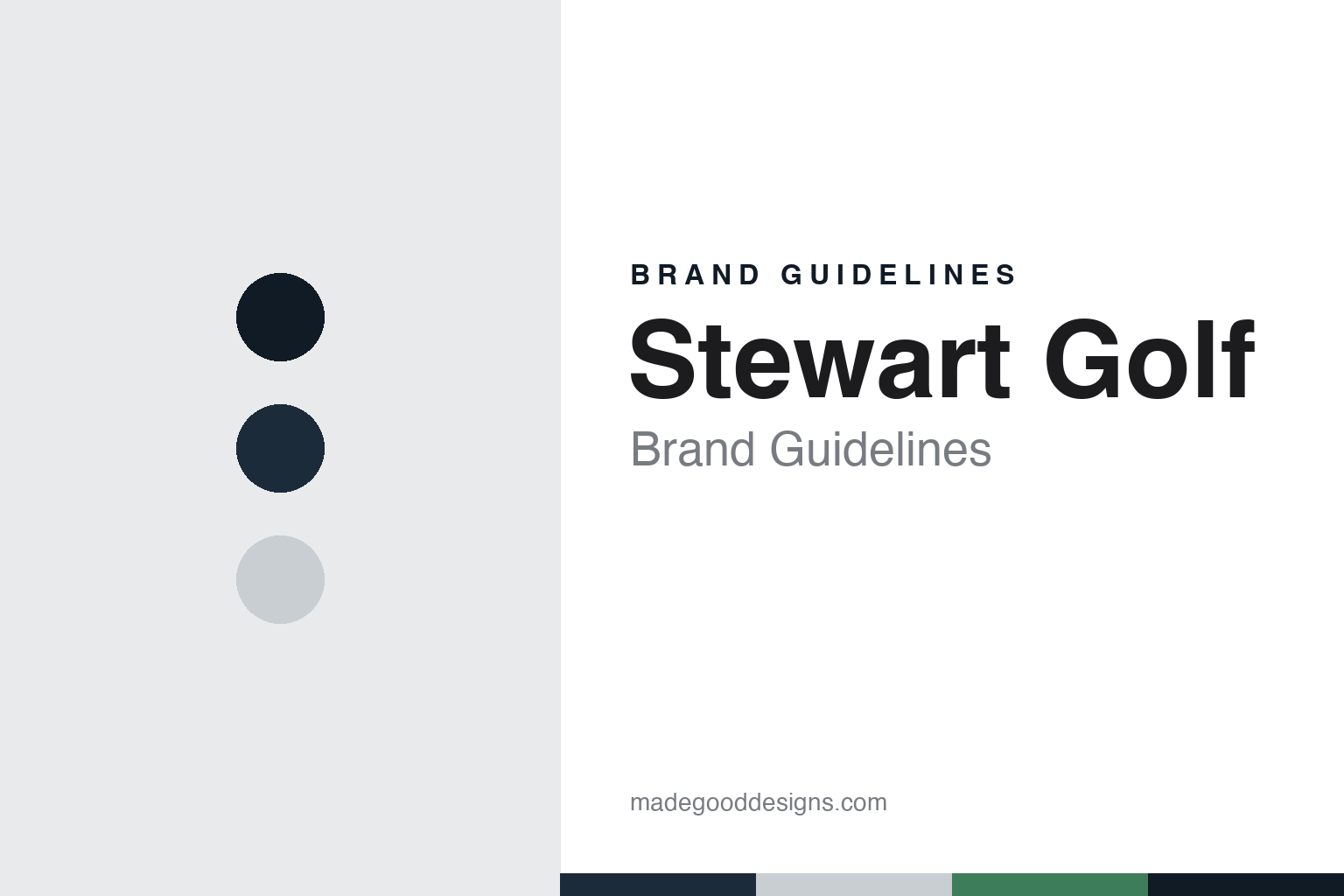
Two constants: a Stewart Golf navy, alloy and green palette and an engineered sans register. Abstract homage — not a Stewart Golf product or mark; no trolley, logo or nameplate is reproduced.
Three generations
A retired engineer, his son and his grandson.
Stewart Golf is a maker of electric golf trolleys based in Gloucestershire, in the west of England. Its story, as told by GolfMagic in an article updated in July 2026, begins in 1999 with Roy Stewart, described as a retired nuclear engineer, who wanted to make carrying clubs around a course easier. His son Ross and his grandson Mark built the first prototypes.
The first idea was not a trolley at all. GolfMagic reports that the family’s 1999 concept was a fully waterproof golf bag, nicknamed the “Carousel,” which held the clubs with their heads pointing down. It never got past the prototype stage, and the family turned to the trolley instead.
The company record is plain. Companies House lists Stewart Golf Limited as a private limited company incorporated on 12 December 2003, under the name ValueGolf Limited; it took its present name at the end of January 2004. The register gives its business as the manufacture of sports goods, and its registered office is at Quedgeley, in Gloucester.
The first product was the X1R, a remote-controlled electric trolley that the company dates to 2003. GolfMagic quotes one magazine’s verdict that it looked “half trolley, half learjet,” and in an interview with National Club Golfer in November 2025, chief executive Mark Stewart recalled the company’s beginnings with a remote-control electric trolley “in the very early 2000s.”
Colour
Remote control, then Follow.
Remote control has been the thread through Stewart Golf’s range. The company says remote technology has been at the heart of the business “from the very beginning,” with the X1R of 2003, and its present remote models include the V10 Remote and the Vertx Remote. National Club Golfer’s 2025 feature also pictured the Q Remote and an R1-S push trolley.
The second thread is what the company calls Follow. According to GolfMagic, the X9, unveiled in 2014, was designed to follow a walking golfer without the player steering it by hand; the company’s own history also dates the introduction of Follow to 2014. GolfMagic says the original X1R line later evolved into the more restrained Q Follow family, which is now the company’s flagship, alongside a carbon version, the Q Follow Carbon.
Stewart Golf says its patented designs reflect “years of thinking differently about how a golf trolley should look, fold and move.” The company also sells golf bags alongside the trolleys.
The brand has moved premises as it has grown. GolfMagic reports that the company left its early workshop in the Cotswolds for larger premises in 2017, and that it opened a facility in the United States in 2015 to support its growth there. Stewart Golf’s website names that facility as being in Houston, Texas, and describes the Gloucestershire site as its home.
Follow remains the centre of the company’s pitch. Its history page says that since introducing the technology in 2014 it has spent “more than a decade refining the hands-free walking experience,” and its shop is split between Follow trolleys, which travel behind the golfer, and Remote trolleys, which the golfer steers with a handset. Both kinds are electric, and the company describes itself as having spent more than two decades “designing, engineering and hand building electric golf trolleys for golfers around the world.”
Typography
Design and documentation.
The seven brands in this group are all names from the golf course’s carrying and clothing trade: OGIO, Sun Day Red, PowaKaddy, Motocaddy, Stewart Golf, BIG MAX and Clicgear. They cover golf bags, push carts, electric trolleys and a new apparel label.
A bag or trolley brand’s identity is usually carried by a name, a mark and a recognisable product shape rather than by any one model, because the company behind the name may have changed hands, moved its manufacturing or changed the way it sells. That makes the questions behind each name worth asking plainly: who started it, who owns it now, and where its products are actually designed and made.
Each guide separates what independent sources record from what the company says about itself — its founding story, its owners over time, where its products are made and how its range has changed — and marks plainly what rests only on the company’s own word.
Aa
An engineered sans for a trolley maker. (Specimen set in Archivo, a sans STAND-IN; NOT the Stewart Golf logo.)
Stewart Golf
Family-owned, the company says, and made in Gloucestershire.
On ownership and manufacture, Stewart Golf speaks for itself. Its website says the business was “founded by a family with a passion for golf and engineering” and “remains family-owned today”; the founding story told by GolfMagic names three generations of the Stewart family, and National Club Golfer identified Mark Stewart as chief executive in 2025. The site is operated, its terms say, by Stewart Golf Ltd, a company registered in England and Wales.
The company’s strongest claim is about where its trolleys are made. Its homepage describes them as “designed, engineered and hand built in Great Britain,” and its history page says that “from our headquarters in Gloucestershire, we design, engineer and hand build our electric golf trolleys under one roof.” GolfMagic repeats that every product is designed, engineered and built in Britain. These are the company’s own statements; Companies House classifies its business as the manufacture of sports goods.
The brand presents itself through engineering. Its website organises the range by technology — Follow trolleys, Remote trolleys and golf bags — and its stated values lead with “pioneering engineering” and walking the course: “At Stewart, we don’t follow trends, our trolleys follow you.” The company frames walking as “the purest way to play golf” and says its machines are built to make that possible. A third stated value, “Care That Outlasts the Sale,” is about after-sales service rather than design, and the company’s website pairs it with a UK service and support offer.
For a design guide, Stewart Golf shows how a small family engineering firm can build a brand around a single technical idea — a trolley that moves on its own — and keep it recognisable across two decades of models. Compare PowaKaddy and Motocaddy, two other British names in electric trolleys. For this guide we use a dark navy, a brushed alloy grey and a fairway green with a sans, an unofficial interpretation; no product or logo is reproduced.
Explore & save
Keep Stewart Golf’s identity on hand — save it to a board in the Made Good inspiration library.
Stewart Golf identity set
Pin the Stewart Golf navy, alloy and green palette and the engineered sans register to your own board.