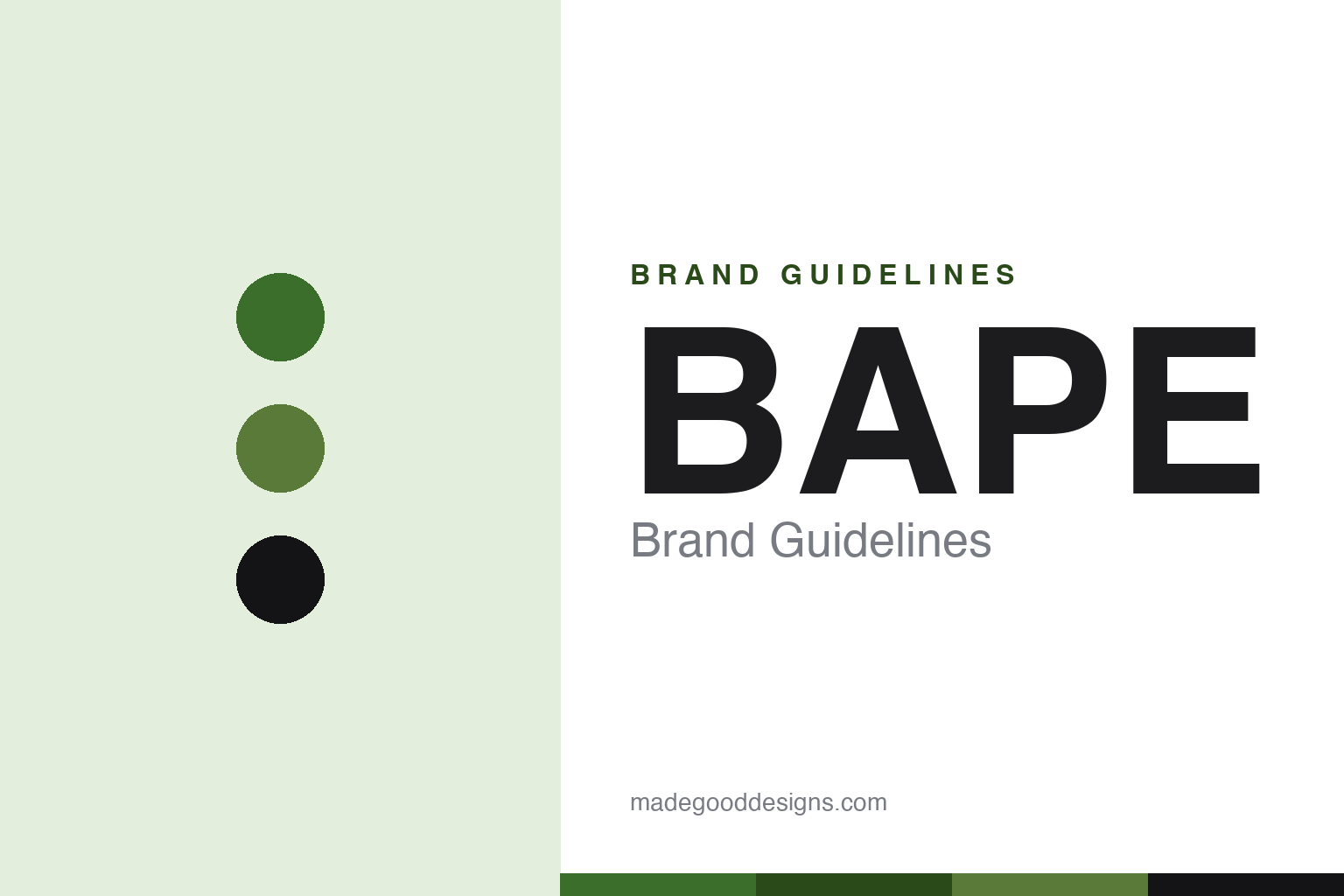
BAPE Brand Guidelines
The ape head, the camo, and the drop — the Ura-Harajuku label that helped write the rules of streetwear hype.
Aa
Two constants: a camo-green palette and a bold graphic display face. Abstract homage — not the BAPE ape head or wordmark.
A bathing ape
BAPE helped write the rules of hype.
BAPE (A Bathing Ape) is a lesson in scarcity and iconography as a brand. It was founded in 1993 by Nigo (real name Tomoaki Nagao) in Tokyo’s Ura-Harajuku district. The name is self-aware satire: it references the Japanese phrase “a bathing ape in lukewarm water,” a wry dig at the lazy, complacent overindulgence of Japan’s younger generation. (An origin detail: in 1993 Nigo co-founded the NOWHERE shop with Jun Takahashi of UNDERCOVER — the seedbed of both brands.) (Honest caveats: no official brand hex is published — the camo green below is approximate — and the wordmark typeface is undocumented.)
BAPE’s power is its instantly-recognisable iconography: the APE HEAD logo, the ABC (BAPE) camo, the Baby Milo character, the shark-face full-zip hoodie, and the BAPESTA sneaker — modelled on the Nike Air Force 1 silhouette, with a “STA” shooting-star side logo in place of the swoosh (an homage/inspired-by silhouette, not a licensed Nike product). The wordmark is a collegiate/varsity block style, echoing a Planet of the Apes visual lineage.
BAPE’s biggest contribution, though, is a business model: artificial scarcity and limited “drops,” heavy collaboration culture (music and brands), and cultivated exclusivity — widely credited as a template for the modern streetwear “drop” economy. On ownership: in 2011 the Hong Kong conglomerate I.T Group acquired about 90% of BAPE for roughly US$2.8 million (a strikingly small sum for its cultural footprint); Nigo stayed on briefly and left in 2013. He later became artistic director of Kenzo (2021) and runs his own brand, Human Made (launched 2010). The identity is bold and graphic — camo green, the ape head. A bathing ape.
Colour
BAPE lives in camo green. Click a swatch to copy the hex.
BAPE’s identity is dominated by its signature camo — the multi-tone ABC camo, anchored by an olive/military green — with black. The camo green reads as bold, playful and instantly recognisable — a graphic, streetwear-native pattern that became one of the most copied motifs in fashion — while the black grounds it. It’s a loud, ownable scheme (paired with the ape head and Baby Milo) that made BAPE a walking logo and a status signal, perfectly matching its hype-and-scarcity model. The camo is the brand. The honest caveat: BAPE publishes no official brand hex — the camo green (an olive-drab within the multi-tone ABC camo) here is an observed approximation, not a first-party value (and it’s unrelated to the separate Monster/other “green” brands).
The lesson is bold, ownable iconography for a hype brand. BAPE’s camo and ape head are instantly recognisable and endlessly reproducible — perfect for a status-and-scarcity model. For designers, it’s a reminder that strong, ownable graphic motifs can turn a brand into a walking logo. The takeaways: build bold, ownable iconography (the camo, the ape head, Baby Milo); make it graphic and reproducible for recognition; and treat specific hexes as approximate when no official spec is published.
Typography
The wordmark is a graphic display — bold and streetwear-native.
BAPE’s identity pairs a collegiate/varsity block wordmark with the iconic ape-head silhouette. The bold, graphic letterforms read as loud, playful and streetwear-native, matching a brand built on instantly-recognisable iconography and hype, and the varsity styling (with its Planet of the Apes lineage) gives it a pop, logo-forward energy. Set in camo green and black, the type feels bold and graphic — exactly the status-signalling, drop-culture personality BAPE cultivates. It’s loud and graphic rather than subtle, appropriate for a brand where the logo is the product. Because the exact wordmark is custom collegiate lettering, the honest description is “a graphic display face,” not a named font. The type behaves like the brand: bold, graphic and streetwear-native.
Aa
A graphic display face — bold and streetwear-native. (Specimen set in Bungee, a bold urban display face in the graphic spirit of the BAPE wordmark; the real mark is custom collegiate lettering.)
Scarcity as the strategy
BAPE built the drop.
BAPE is a lesson in scarcity as a brand strategy. Long before “drops” were universal, BAPE pioneered artificial scarcity — limited releases, cultivated exclusivity, heavy collaborations — turning bold, ownable iconography (the ape head, the camo) into coveted, status-signalling objects. That model is BAPE’s deepest contribution: it’s widely credited as a template for the modern streetwear “drop” economy that brands from Supreme onward would ride. It’s a strong lesson in demand engineering: make the product instantly recognisable, limit its supply, wrap it in collaborations and cultural cachet, and let scarcity drive desire. There’s also a cautionary footnote — despite its huge cultural footprint, BAPE sold for only ~$2.8 million in 2011, a reminder that cultural influence and captured financial value don’t always align (much like the Beats story). But the strategic legacy is undeniable: BAPE helped write the rules of hype. Engineer scarcity, and demand follows.
For designers and brand-builders, BAPE offers a clear takeaway: scarcity, strong iconography and collaboration can engineer demand and cultural influence. The lessons: build instantly-recognisable, ownable iconography (the ape head, the camo, Baby Milo); use limited drops and exclusivity to drive desire (the scarcity model); and leverage collaborations for cultural cachet. It’s also a reminder to keep the facts precise — BAPE was founded in 1993 by Nigo in Ura-Harajuku (the name a satirical “bathing ape in lukewarm water”), is known for the ape head, ABC camo and Bapesta (modelled on the AF1), pioneered the streetwear drop model, and was acquired ~90% by I.T Group in 2011, with Nigo later leading Kenzo. BAPE built the drop — proof that scarcity can be a brand strategy.
Explore & save
Keep BAPE’s identity on hand — save it to a board in the Made Good inspiration library.
BAPE identity set
Pin the camo-green palette and the graphic-display spirit to your own board.