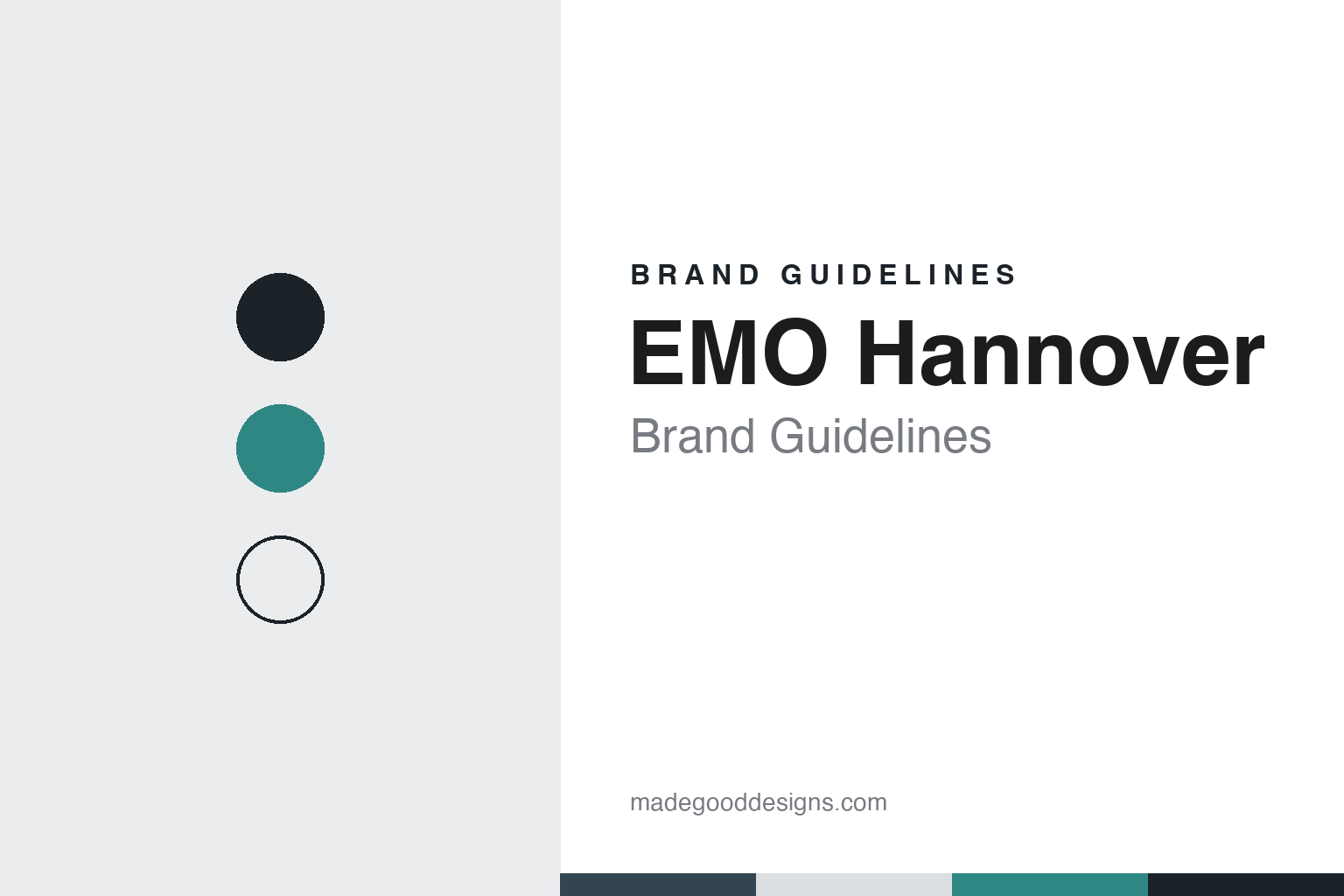
EMO Hannover Brand Guidelines
The machine-tool show that grew out of the 1951 E.E.M.O.
Aa
Two constants: a steel, silver and teal palette and a geometric grotesque register. Abstract homage — not an EMO logo or key visual; no mark or stand design is reproduced.
From E.E.M.O. to EMO
A European exhibition, then a world one.
EMO grew out of a European exhibition. CECIMO, the European association of the machine-tool industries, says on its website that organising a new kind of exhibition was its first concern after its foundation in 1950, and that the first E.E.M.O. — Exposition européenne de machines-outils, the European machine tools exhibition — was held in 1951. Its rules, CECIMO says, allowed only manufacturers to exhibit and placed machines of one category in the same hall. Until the end of 1971 the show was limited to manufacturers from CECIMO’s membership, and between 1951 and 1971 its exhibition space trebled.
In 1975 the exhibition became EMO, Exposition Mondiale de la Machine-Outil, the world exhibition of machine tools, and opened to manufacturers from outside Europe, according to CECIMO. The VDW, the German machine tool builders’ association, says on its fiftieth-anniversary page that CECIMO launched EMO with major involvement from the VDW in an economically difficult period, and that the first EMO was held in June 1975 at the Parc des Expositions at the Porte de Versailles in Paris. German Wikipedia, citing a 1989 VDW history by Harald Scherbarth, gives 1,369 exhibitors on about 94,000 square metres of net space at that first show. English Wikipedia notes that CECIMO no longer uses the French expansion; CECIMO describes EMO as its registered trademark.
Hannover came two years later. The VDW says the first EMO Hannover, in 1977, brought more than 1,600 exhibitors from 27 nations, now showing complete installations as well as machine tools; German Wikipedia gives 1,619 exhibitors on 116,675 square metres. The original rotation, German Wikipedia says, ran Paris, Hannover, Milan, Hannover. The 1981 Hannover show had 1,845 exhibitors on 140,558 square metres, among them 234 firms from 21 countries outside Western Europe, and by 1989 there were 2,149 exhibitors on 187,000 square metres. The shows of 1985 and 1989, German Wikipedia adds, reflected the spread of manufacturing cells, shop-floor-programmable machines and CAD/CAM.
Colour
One name, three associations, two cities.
Three associations stand behind the name. CECIMO owns the EMO brand; in Hannover the fair is organised by the VDW, and in Milan by UCIMU, the Italian machine-tool builders’ association, according to the VDW and English Wikipedia. The Hannover editions are held on the exhibition grounds run by Deutsche Messe; English Wikipedia places the Milan editions at the Fiera Milano exhibition centre. EMO falls in odd-numbered years, and English Wikipedia notes an agreement between CECIMO and the US Association for Manufacturing Technology under which the IMTS show in Chicago takes the even-numbered years. Since 2005, German Wikipedia says, the cycle has run Hannover, Hannover, Milan, so that the VDW holds two consecutive editions and Milan hosts one every six years.
The range covers metalworking from the machine to the controls. CECIMO lists cutting and forming machine tools, precision tools, automated material flow and industrial electronics among the areas shown, alongside manufacturing systems, computer technology and accessories. September is the usual month in Hannover.
Each Hannover edition has carried a motto. German Wikipedia records “machine tools and more” for 2011 (19 to 24 September, with 2,037 exhibitors from 41 countries and 138,651 visitors), “Intelligence in Production” for 2013, when close to 145,000 visitors came, 34 per cent of them from abroad, and the programme included an EMO congress on smarter production and a focus on India; “Connecting systems for intelligent production” for 2017, with 2,226 exhibitors from 44 countries and about 129,000 visitors, 48 per cent from abroad; and “Smart technologies driving tomorrow’s production!” for 2019, with about 117,000 visitors. For 2023, CECIMO gives 1,850 exhibitors from 45 countries and 92,500 trade visitors from 136 countries, and the VDW says the show filled 15 halls and 235,000 square metres.
Typography
Design and documentation.
Industrial, print and packaging trade fairs tend to present themselves through a short coined name rather than a description. Some compress two words into one, as drupa does with the German for print and paper; others are written entirely in lower case or entirely in capitals, and some add the host city to the name, as with EMO Hannover. The name is usually the most stable part of the identity, carried from one edition to the next for decades while organisers, halls and themes change around it.
The second constant is the calendar. Rather than meeting every year, many of these fairs keep a fixed cycle of two, three or four years, set to suit industries whose machines take years to develop, and an edition is known by its year in a way that buyers and exhibitors plan around. Behind most of them stands an exhibition company working with an industry association or an exhibitor committee whose recommendations the organiser takes into account.
The halls themselves are part of the language. These fairs fill very large exhibition grounds and arrange them by segment, such as prepress, printing, finishing, packaging materials or machine tools, so that a visitor reads the show hall by hall. Stands often carry working machines rather than models, which gives the halls the look of a temporary factory floor alongside conference stages and themed special areas.
Visually, the pattern is a fixed wordmark with a changing key visual. Each edition receives its own campaign image, edition line or set of themes, presented in the year or two before opening, while the name and the venue stay put. For a design guide, the lesson is that balance between a permanent mark and a temporary campaign.
Aa
A geometric grotesque for a precise, engineered register. (Specimen set in Space Grotesk, a sans STAND-IN; NOT the EMO logo.)
EMO Hannover
Fifty years, and the cycle reset.
The 2025 edition, held from 22 to 26 September 2025, marked fifty years of EMO under the motto “Innovate Manufacturing,” CECIMO says. ingenieur.de reported on 26 September 2025, citing the organiser, that about 80,000 trade visitors came, more than half of them from abroad, and that automation and artificial intelligence were the main topics; the VDW gives more than 1,600 exhibitors. An EMO Story Wall in Hall 12 traced five decades of production technology, the VDW says, and its anniversary pages carry a look back at the show’s history by the technology journalist Nikolaus Fecht. The VDW now describes the Hannover show as taking place every two to four years.
The venue was then reconsidered. German Wikipedia says that the VDW’s contract with Deutsche Messe ran out in 2025 and that the association put the event out to tender. On 28 November 2025 the VDW announced that its board had decided at its autumn meeting to keep EMO in Hannover after a two-year tender with two exhibition companies, and that, in agreement with CECIMO and UCIMU, the cycle would shift until 2031: Milan in 2027, Hannover in 2029 and Milan again in 2031, before a return to the usual pattern. Machinery Market reported the decision on 10 December 2025, quoting the EMO general commissioner, Carl Martin Welcker.
For a design guide, EMO Hannover shows a three-letter name that outlived its French expansion and is shared by one fair moving between two cities and two national associations, with a new motto for each edition — compare Deutsche Messe and Fiera Milano. For this guide we use a machine steel, a swarf silver and a coolant teal with a geometric grotesque sans, an unofficial interpretation; no product or logo is reproduced.
Explore & save
Keep EMO Hannover’s identity on hand — save it to a board in the Made Good inspiration library.
EMO Hannover identity set
Pin the EMO Hannover steel, silver and teal palette and the geometric grotesque register to your own board.
Source & notes
Frequently Asked Questions
What font can I use to match the EMO Hannover look?
This guide describes EMO Hannover’s type as “A geometric grotesque for a precise, engineered register”. Its type specimen is set in Space Grotesk from Google Fonts as a stand-in; Space Grotesk is not EMO Hannover’s own lettering.
What colours are in the EMO Hannover palette?
This guide’s EMO Hannover palette is Machine steel #344552, Graphite #1B2228, Coolant teal #2F8784, Swarf silver #DCDFE1 and Paper #F7F7F5. The tones are the guide’s own unofficial interpretation, not official EMO Hannover hex codes.