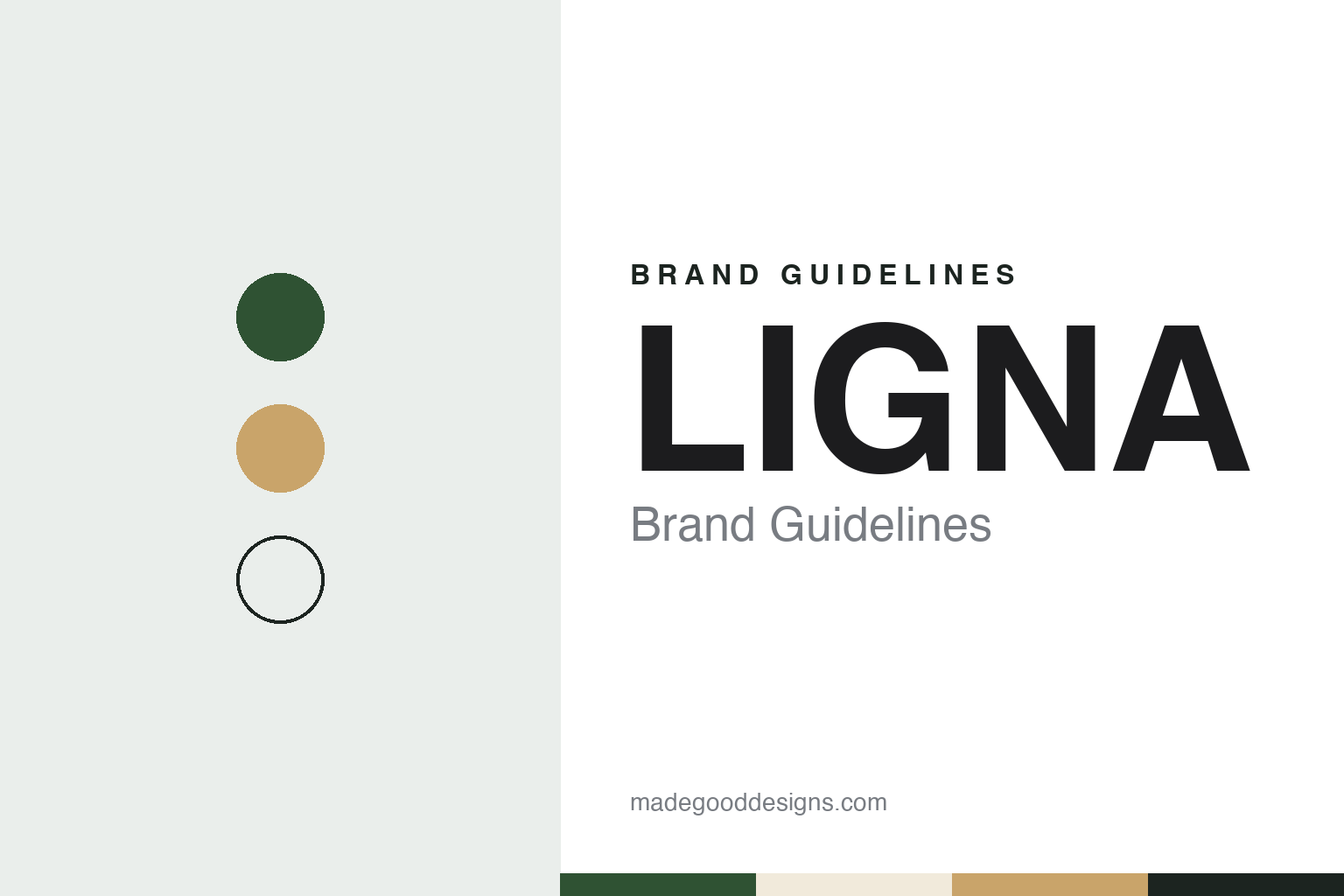
LIGNA Brand Guidelines
Hannover’s woodworking fair, held separately since 1975.
Aa
Two constants: a forest green, pale timber and charcoal palette and a grotesque sans register. Abstract homage — not a LIGNA asset or mark; no logo, key visual or product is reproduced.
Out of the Hannover fair
A woodworking show that became its own fair in 1975.
LIGNA is a trade fair for the woodworking and wood-processing industry, held every two years in May on the exhibition grounds in Hannover, Germany. English and German Wikipedia name Deutsche Messe as organiser, together with the woodworking machinery association within the VDMA, the German mechanical-engineering federation. Wood Review, an Australian trade magazine, gave the same pairing in March 2024, describing the fair as jointly organised by Deutsche Messe and VDMA Woodworking Machinery. The name is Latin: German Wikipedia glosses ligna as “the woods” or “timbers,” and the fair writes it in capitals.
The fair grew out of the Hannover fair. Deutsche Messe dates its roots to 1950, Wood Review reported, when a “Woodworking Machinery Group Show” took up 2,780 square metres at the German Industrial Trade Fair in Hanover; the same account gives 8,000 square metres in 1955 and 22,500 square metres by 1965. Both Wikipedias say the woodworking section stayed part of the annual Hannover fair until 1975, when the space it needed led to a separate event. Since then LIGNA has run on a two-year cycle, in odd-numbered years.
Deutsche Messe’s own history of the fair, published for its fiftieth anniversary, describes the 1975 premiere as a show of around 720 exhibitors in nine halls, with 47,113 visitors from 71 nations. For 1985, ten years after the split, it gives 1,045 exhibitors and about 80,000 visitors. The same history says that in 1991, the first edition after German reunification, fifteen companies from eastern Germany exhibited, and that from 1993 a single ticket admitted visitors to both LIGNA and interzum, the Cologne fair for suppliers to furniture production.
Colour
LIGNA plus, then LIGNA again.
The name has changed once and changed back. The organiser’s history says that in 1995 interHOLZ, a fair for the wood trade and wood marketing, ran alongside LIGNA for the first time, with 108 exhibitors in Hall 7, and that in 1999 interHOLZ was folded into the fair, which was renamed LIGNA plus and ran for six days. English Wikipedia’s attendance list uses “Ligna Plus” for the editions from 2001 to 2009 and “LIGNA” from 2011. In 2001, by the organiser’s account, the fair was shortened from six days to five.
Each edition has carried its own theme or slogan. The organiser lists “Everything that moves wood” as the 2007 motto and “Making more out of wood – Technology for Resource Efficiency” as the 2009 theme. It dates a special show called “Energy from Wood” to 2003 and a craft area, “Handwerk, Holz & mehr” (“Craft, wood and more”), to 2005. In 2017, it says, the halls were reorganised into seven main categories, which today run from forestry and sawmill technology through wood-based panel production and surface technology to machinery and tools for custom and mass production. The same history dates the arrival of Industry 4.0 at the fair to 2015, the year it also lists the first Wood Industry Summit, a meeting and presentation format for international participants from industry and research.
In 2021 there was no fair in the halls: the organiser says LIGNA was held online that year as the LIGNA.Innovation Network, a digital exhibition and conference programme. The fair returned to Hannover in person in 2023.
The 2025 edition, held from 26 to 30 May, marked the fair’s fiftieth anniversary. Bioenergy International reported on 2 June 2025 that it brought together 1,433 exhibitors from 49 countries and around 78,000 visitors from 156 countries, figures from the organiser, across ten halls, two pavilions and an outdoor area covering 114,078 square metres. The magazine listed the edition’s three focus topics as Connectivity, Sustainable Production and Engineered Wood, and two new formats: LIGNA.Circular, in Hall 12, and LIGNA.TruckStop, aimed at carpenters, joiners and other trades. It quoted Jochen Köckler, chief executive of Deutsche Messe, saying the visitor number was on a par with 2023, and reported, citing the organiser, that 56 percent of visitors came from outside Germany, with the largest groups from Poland, Italy and Austria.
Typography
Design and documentation.
Industrial, print and packaging trade fairs tend to present themselves through a short coined name rather than a description. Some compress two words into one, as drupa does with the German for print and paper; others are written entirely in lower case or entirely in capitals, and some add the host city to the name, as with EMO Hannover. The name is usually the most stable part of the identity, carried from one edition to the next for decades while organisers, halls and themes change around it.
The second constant is the calendar. Rather than meeting every year, many of these fairs keep a fixed cycle of two, three or four years, set to suit industries whose machines take years to develop, and an edition is known by its year in a way that buyers and exhibitors plan around. Behind most of them stands an exhibition company working with an industry association or an exhibitor committee whose recommendations the organiser takes into account.
The halls themselves are part of the language. These fairs fill very large exhibition grounds and arrange them by segment, such as prepress, printing, finishing, packaging materials or machine tools, so that a visitor reads the show hall by hall. Stands often carry working machines rather than models, which gives the halls the look of a temporary factory floor alongside conference stages and themed special areas.
Visually, the pattern is a fixed wordmark with a changing key visual. Each edition receives its own campaign image, edition line or set of themes, presented in the year or two before opening, while the name and the venue stay put. For a design guide, the lesson is that balance between a permanent mark and a temporary campaign.
Aa
A grotesque sans for a Latin name set in capitals. (Specimen set in Archivo, a sans STAND-IN; NOT the LIGNA logo.)
LIGNA
A Latin word in capitals.
LIGNA’s identity rests on a short Latin name set in capital letters, and on the Hannover grounds it shares with other Deutsche Messe fairs. The organiser’s website pairs the name with a guiding theme, currently “WOODBOUND FUTURE,” and with a family of formats that repeat the name followed by a full stop and a second word: LIGNA.Builds, LIGNA.TruckStop, LIGNA.SmartWood and LIGNA.Campus. LIGNA.Builds, the website says, is a wood-frame house built live over the five days of the fair.
The content of the show is working machinery. Bioenergy International described exhibitors in 2025 presenting solutions across the whole value chain, from forestry and sawmilling to production, manufacturing and craft, and counted more than 900 trade-fair premieres. Deutsche Messe’s history follows the same thread edition by edition, from the 1979 fair, where it says the oriented strand board was a central topic, to the 2019 fair, where the European woodworking machinery federation EUMABOIS and the VDMA presented a framework for a shared machine communication standard called Plug & Work.
For a design guide, LIGNA shows how a trade fair can carry one Latin word through half a century, with each new format named after it. Compare Deutsche Messe, its organiser, and interzum, the Cologne supplier fair that shared a ticket with LIGNA from 1993. For this guide we use a forest green, a pale timber and a charcoal with a sans, an unofficial interpretation; no product or logo is reproduced.
Explore & save
Keep LIGNA’s identity on hand — save it to a board in the Made Good inspiration library.
LIGNA identity set
Pin the LIGNA forest green, pale timber and charcoal palette and the grotesque sans register to your own board.
Source & notes
Frequently Asked Questions
What font can I use to match the LIGNA look?
This guide describes LIGNA’s type as “A grotesque sans for a Latin name set in capitals”. Its type specimen is set in Archivo from Google Fonts as a stand-in; Archivo is not LIGNA’s own lettering.
What colours are in the LIGNA palette?
This guide’s LIGNA palette is Forest green #2F5233, Charcoal #1C2420, Pale timber #C9A46A, Sawdust cream #F1EADB and Paper #FAF8F3. The tones are the guide’s own unofficial interpretation, not official LIGNA hex codes.