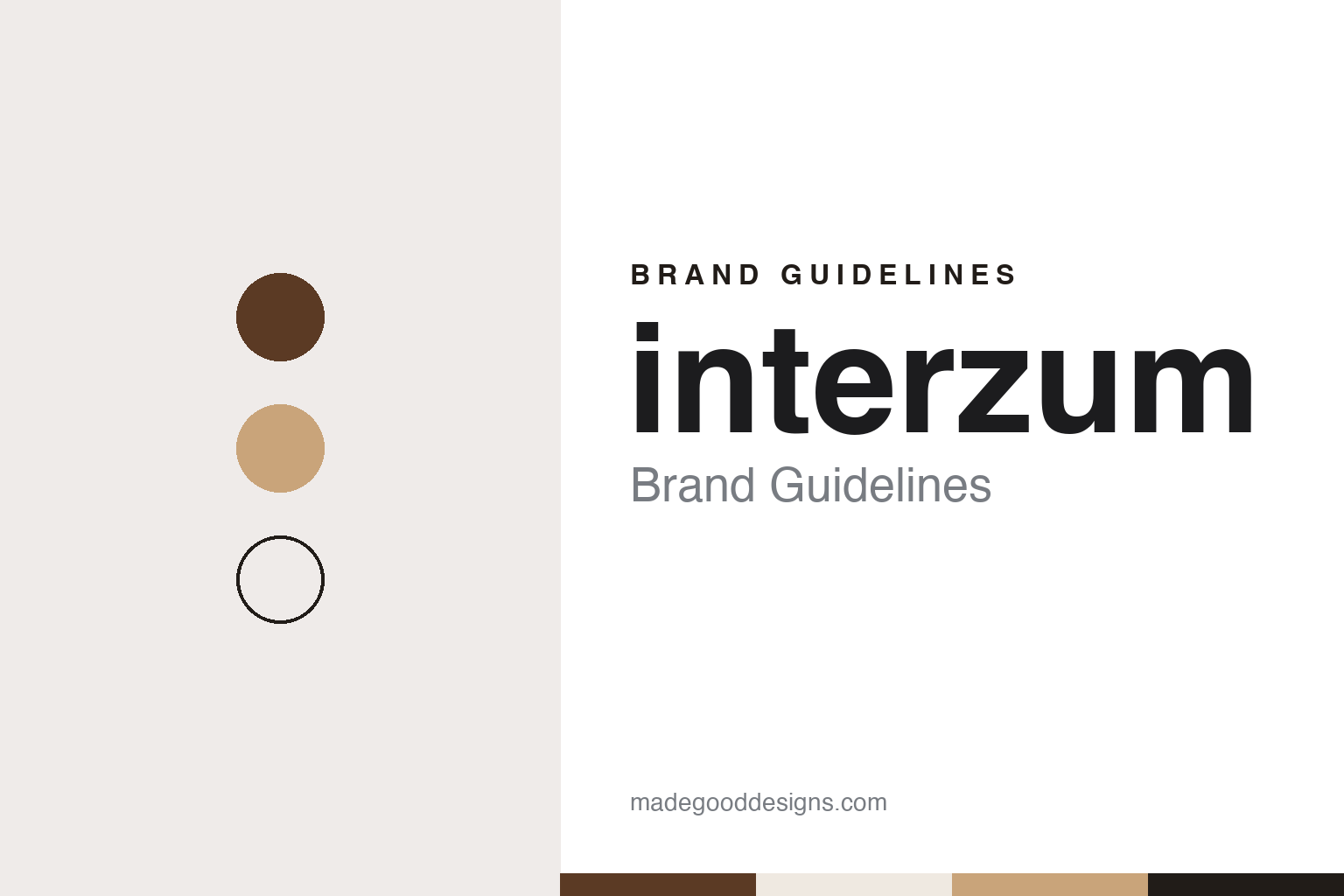
interzum Brand Guidelines
The Cologne fair where furniture is shown in parts.
Aa
Two constants: a walnut, oak and linen palette and a lower-case sans register. Abstract homage — not an interzum or Koelnmesse mark; no logo, key visual or product is reproduced.
A fair for the parts
Suppliers to the furniture trade, every other May.
interzum is a trade fair for the companies that supply the furniture and interior industries: the makers of boards, veneers, surfaces, fittings, fabrics and machines that furniture factories and joiners buy before a finished chair, kitchen or office desk exists. German Wikipedia expands the name as Internationale Messe Zulieferer Möbelindustrie, roughly “international fair of suppliers to the furniture industry,” and says it takes place every two years in May in Cologne, organised by Koelnmesse GmbH, the city’s exhibition company. The organiser’s own fact sheet gives the same cycle and venue and says the fair is open to trade visitors only.
The fair has a long run behind it. German Wikipedia says interzum marked fifty years in 2009, and gives an earlier snapshot of its scale: about 1,500 exhibitors from nearly 60 nations in nine halls, and almost 60,000 international trade visitors in 2015, among them 17,500 from Germany. Both the organiser and German Wikipedia write the name as a single lower-case word, interzum, with no capital.
The most recent edition was held from 20 to 23 May 2025. Koelnmesse says it brought together 1,600 exhibitors from 57 countries on 176,000 square metres of gross exhibition space, and counted around 60,000 visits from 157 countries; its review page rounds the trade-visitor figure to about 61,000. In its closing report the organiser said most visitors came from Italy, China, Spain, Poland and the Netherlands, and quoted Oliver Frese, chief operating officer of Koelnmesse, on the edition.
The fair has not always met in the halls. In 2021 it was held online as interzum @home, which ended on 7 May 2021; the organiser says more than 10,000 participants from 132 countries took part on the digital platform. The halls in Cologne were back in use in 2023, when the organiser reported about 62,000 trade visitors.
Colour
Three segments under one roof.
interzum arranges its exhibitors in three segments, the organiser says. Materials & Nature covers wood, veneers, parquet, decorative surfaces, decor papers, laminates, wood-based panels, mineral materials and edges. Function & Components covers fittings for cabinets, kitchens and office furniture, built-in parts, semi-finished products and lighting systems for furniture. Textile & Machinery brings together machines for upholstery and bedding with cover fabrics, leather, upholstery materials and adhesives. The target groups listed on the fact sheet run from industry and the skilled trades to architects, interior designers, office furnishers and designers.
Each edition carries a central theme that runs through the halls and the event programme. In 2025 it was “Rethinking Resources: Circular and Bio-based Solutions,” and Koelnmesse built three Trend Forums around it, alongside a Trend Stage for talks and a Product Stage for new products.
The special shows are where materials are put on display as ideas rather than products. A news page from the wood technology chair at TU Dresden, last updated in March 2026, describes the Trend Forum Materials & Nature on the theme “Biocircular Materials,” curated by the materials agency Haute Innovation, which showed examples of bio-based materials for furniture. Among them was a coat-hanger demonstrator from the university’s CellFormDesign research project, developed with a partner company.
The interzum name also travels. Koelnmesse’s list of its international portfolio, as published in November 2026, names interzum guangzhou; interzum jakarta in Indonesia, held alongside the furniture fair IFFINA+ and other hardware and woodworking fairs; interzum bogota in Colombia, which the organiser says was formerly called Feria Mueble & Madera; and interzum forum italy, a biennial event in Bergamo. In Tokyo, an interzum showcase area runs inside ORGATEC Tokyo through a partnership between Koelnmesse and the Japan Office and Institutional Furniture Association, the organiser says.
Typography
Industrial, print and packaging fairs.
Industrial, print and packaging trade fairs tend to present themselves through a short coined name rather than a description. Some compress two words into one, as drupa does with the German for print and paper; others are written entirely in lower case or entirely in capitals, and some add the host city to the name, as with EMO Hannover. The name is usually the most stable part of the identity, carried from one edition to the next for decades while organisers, halls and themes change around it.
The second constant is the calendar. Rather than meeting every year, many of these fairs keep a fixed cycle of two, three or four years, set to suit industries whose machines take years to develop, and an edition is known by its year in a way that buyers and exhibitors plan around. Behind most of them stands an exhibition company working with an industry association or an exhibitor committee whose recommendations the organiser takes into account.
The halls themselves are part of the language. These fairs fill very large exhibition grounds and arrange them by segment, such as prepress, printing, finishing, packaging materials or machine tools, so that a visitor reads the show hall by hall. Stands often carry working machines rather than models, which gives the halls the look of a temporary factory floor alongside conference stages and themed special areas.
Visually, the pattern is a fixed wordmark with a changing key visual. Each edition receives its own campaign image, edition line or set of themes, presented in the year or two before opening, while the name and the venue stay put. For a design guide, the lesson is that balance between a permanent mark and a temporary campaign.
Aa
A plain lower-case sans, in the spirit of the interzum wordmark. (Specimen set in Outfit, a sans STAND-IN; NOT the interzum logo.)
interzum
A lower-case name kept from edition to edition.
The identity of interzum rests on its name more than on any single image. The word is set in lower case throughout the organiser’s pages, and the same habit carries over to the sister events, from interzum guangzhou to interzum bogota, so that the city or country name simply follows the fair’s own. Each edition then adds its own central theme; the 2025 theme of circular and bio-based materials shows how the message is set edition by edition while the name stays fixed.
The fair also sits inside a larger Cologne calendar. Koelnmesse lists it in an international furniture portfolio that runs from Guangzhou and Jakarta to Bogotá and Bergamo, and the Tokyo showcase places interzum inside ORGATEC Tokyo, an office-furniture fair. For visitors, the practical shape of interzum is a walk through the three segments, from raw boards and veneers to hinges, lighting and fabrics, ending with the machines that join them.
Exhibitor and visitor numbers come from the organiser and vary slightly between its own pages: around 60,000 visits in 2025 on the fact sheet, about 61,000 trade visitors on the review page. Both are given here as Koelnmesse states them.
On a page, that suggests letting the lower-case word sit on its own, with the colours and textures of the materials in the halls, from wood and veneer to fabric, doing the rest of the work.
For a design guide, interzum shows how a fair can make a modest lower-case word stand for a whole supply industry, and lend it to editions on three continents. Compare Koelnmesse, which organises the fair, and LIGNA, the woodworking fair in Hannover. For this guide we use walnut, oak veneer and raw linen with a sans, an unofficial interpretation; no product or logo is reproduced.
Explore & save
Keep interzum’s identity on hand — save it to a board in the Made Good inspiration library.
interzum identity set
Pin the interzum walnut, oak and linen palette and the lower-case sans register to your own board.
Source & notes
Frequently Asked Questions
What font can I use to match the interzum look?
This guide describes interzum’s type as “A plain lower-case sans, in the spirit of the interzum wordmark”. Its type specimen is set in Outfit from Google Fonts as a stand-in; Outfit is not interzum’s own lettering.
What colours are in the interzum palette?
This guide’s interzum palette is Walnut #5B3A24, Workshop ink #211C18, Raw linen #EFE9E1, Oak veneer #C9A47A and Paper #F8F6F2. The tones are the guide’s own unofficial interpretation, not official interzum hex codes.