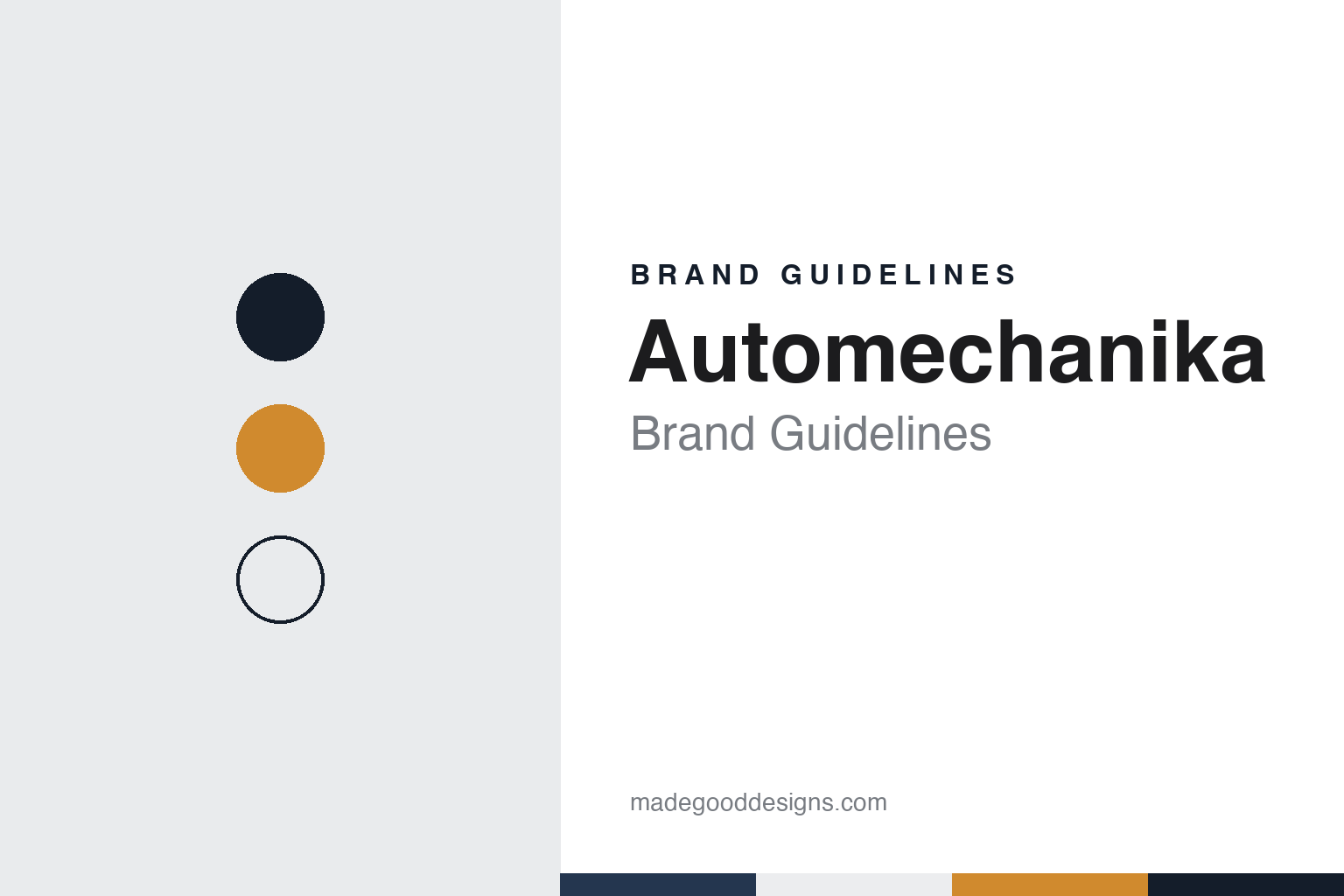
Automechanika Brand Guidelines
The Frankfurt aftermarket fair that began as a 1971 stand-in.
Aa
Two constants: a navy, grey and amber palette and a condensed sans register. Abstract homage — not an Automechanika logo or key visual; no mark or stand design is reproduced.
Automechanika 71
A replacement show for Frankfurt, 1971.
Automechanika began as a replacement. On 20 January 1971 the German car industry association VDA, which organised the Frankfurt motor show, the IAA, called off the car show it had planned for that September, citing costs; German Wikipedia cites the Frankfurter Allgemeine Zeitung of the following day. In mid-March 1971 Messe Frankfurt announced a new event for the same dates, Automechanika 71. German Wikipedia, citing the Frankfurter Neue Presse of 15 March 1971, says the idea came from the Würzburg motoring journalist Joachim Lattke, who won over associations of the motor trade and of the filling-station and garage business, whose members still wanted to show their products. Messe Frankfurt’s own history page says the cancellation led to Automechanika being developed “within a few short weeks.”
The first title spelled out the scope. In an April 2008 interview with Automotive Industries, Messe Frankfurt’s global brand manager for Automechanika, Stephan Kurzawski, gave it as “Automechanika 71, international exhibition for automobile parts, repair shop, service station and garage equipment,” and said the show had been born “of necessity” in a difficult year for the car industry. The first edition ran from 18 to 26 September 1971; German Wikipedia gives about 400 exhibitors and 75,000 visitors, and adds that some of those first exhibitors founded the ASA association of automotive service-equipment makers in 1972.
A second edition followed in 1972. Kurzawski told Automotive Industries that it drew about 100 more exhibitors and roughly half as much floor space again over five days, and that the organisers then decided to hold the fair so that it would alternate with the IAA. Since then Automechanika Frankfurt has been held every two years, in even-numbered years, in September, on the Frankfurt exhibition grounds. Unlike the motor show, it is open to trade visitors only, German Wikipedia notes.
Colour
Parts, workshops and everything after the factory.
The fair is built around the car after it leaves the factory: parts, repairs and the businesses that look after vehicles. In 2008 Automotive Industries described its range as automobile parts, car washes, workshop and filling-station equipment, accessories and tuning, and reported that the Frankfurt edition then filled close to 300,000 square metres gross, the whole of the Frankfurt exhibition centre. That year’s show, the 20th edition, ran from 16 to 21 September 2008. Messe Frankfurt said at the time that about 40 per cent of trade visitors and 80 per cent of exhibitors at the 2006 show had come from outside Germany.
Messe Frankfurt now arranges the Frankfurt show in eleven product groups, running from parts and components and from diagnostics and repair to body and paint and to classic cars, with further groups for electrics and electronics, connectivity, oils and lubricants, car wash and detailing, and accessories and customising. For 2026 it said that a new group for wheel management and tyre service would occupy Halls 8 and 9.
The latest Frankfurt edition ran from 8 to 12 September 2026. In its final report of 12 September, Messe Frankfurt said the fair drew more than 112,000 trade visitors from 173 countries, against 104,750 in 2024, and 4,400 exhibitors from 80 countries, and that its topics included artificial intelligence, software-defined vehicles, connected cars, driver-assistance systems and alternative drives. New that year, the organiser says, were a HighTech4Mobility focus in the Festhalle, an outdoor Experience Park in front of Halls 9 and 11, and a 200-metre Automechanika Pit Lane under the arcades of Hall 4. The Classic Car area filled Hall 11.1, and the AMBITION careers format, first held in 2024, returned to the Festhalle for school pupils, students and trainees. The organiser put the share of trade visitors from abroad at 70 per cent. German Wikipedia notes that the 2021 edition was held in hybrid form and that a smaller edition followed in 2022; its table gives 133,000 visitors and 4,800 exhibitors for 2016 and 135,000 visitors and 4,900 exhibitors for 2018.
Typography
Design and documentation.
Industrial, print and packaging trade fairs tend to present themselves through a short coined name rather than a description. Some compress two words into one, as drupa does with the German for print and paper; others are written entirely in lower case or entirely in capitals, and some add the host city to the name, as with EMO Hannover. The name is usually the most stable part of the identity, carried from one edition to the next for decades while organisers, halls and themes change around it.
The second constant is the calendar. Rather than meeting every year, many of these fairs keep a fixed cycle of two, three or four years, set to suit industries whose machines take years to develop, and an edition is known by its year in a way that buyers and exhibitors plan around. Behind most of them stands an exhibition company working with an industry association or an exhibitor committee whose recommendations the organiser takes into account.
The halls themselves are part of the language. These fairs fill very large exhibition grounds and arrange them by segment, such as prepress, printing, finishing, packaging materials or machine tools, so that a visitor reads the show hall by hall. Stands often carry working machines rather than models, which gives the halls the look of a temporary factory floor alongside conference stages and themed special areas.
Visually, the pattern is a fixed wordmark with a changing key visual. Each edition receives its own campaign image, edition line or set of themes, presented in the year or two before opening, while the name and the venue stay put. For a design guide, the lesson is that balance between a permanent mark and a temporary campaign.
Aa
A condensed sans for a workshop-and-hall register. (Specimen set in IBM Plex Sans Condensed, a sans STAND-IN; NOT the Automechanika logo.)
Automechanika
One Frankfurt name, many cities.
Automechanika is also a family of fairs. Automotive Industries reported in 2008 that Messe Frankfurt had launched its first international edition about a decade earlier, and Kurzawski named Moscow, Rome and Toronto as the most recent additions, with Automechanika Johannesburg to open in March 2009. Messe Frankfurt’s network page now counts 16 events worldwide, and German Wikipedia lists host cities including Shanghai, Dubai, Istanbul and Johannesburg. Each event adds its city to the same name.
Messe Frankfurt’s calendar for the autumn of 2026 shows how the network runs, with Automechanika editions in Tashkent and Johannesburg in October and in Dubai, at the Dubai Exhibition Centre for the first time, in November. Its company history page names Automechanika, alongside fairs such as Ambiente, Heimtextil and Light + Building, among the Frankfurt brands it has taken abroad.
The Frankfurt show keeps its working character. Automotive Industries described the 2008 edition as covering the entire Frankfurt grounds, and the 2026 report lists some 500 events, from stage talks and training sessions to live restorations in the classic-car hall.
For a design guide, Automechanika shows a single coined name carried from a Frankfurt replacement show in 1971 to a network of events on several continents, each one adding a city to the same word — compare Messe Frankfurt and Light + Building. For this guide we use a workshop navy, a hall grey and a signal amber with a condensed sans, an unofficial interpretation; no product or logo is reproduced.
Explore & save
Keep Automechanika’s identity on hand — save it to a board in the Made Good inspiration library.
Automechanika identity set
Pin the Automechanika navy, grey and amber palette and the condensed sans register to your own board.
Source & notes
Frequently Asked Questions
What font can I use to match the Automechanika look?
This guide describes Automechanika’s type as “A condensed sans for a workshop-and-hall register”. Its type specimen is set in IBM Plex Sans Condensed from Google Fonts as a stand-in; IBM Plex Sans Condensed is not Automechanika’s own lettering.
What colours are in the Automechanika palette?
This guide’s Automechanika palette is Workshop navy #24364F, Pit ink #141D2A, Signal amber #D08A2E, Hall grey #ECEDEF and Paper #F8F8F6. The tones are the guide’s own unofficial interpretation, not official Automechanika hex codes.