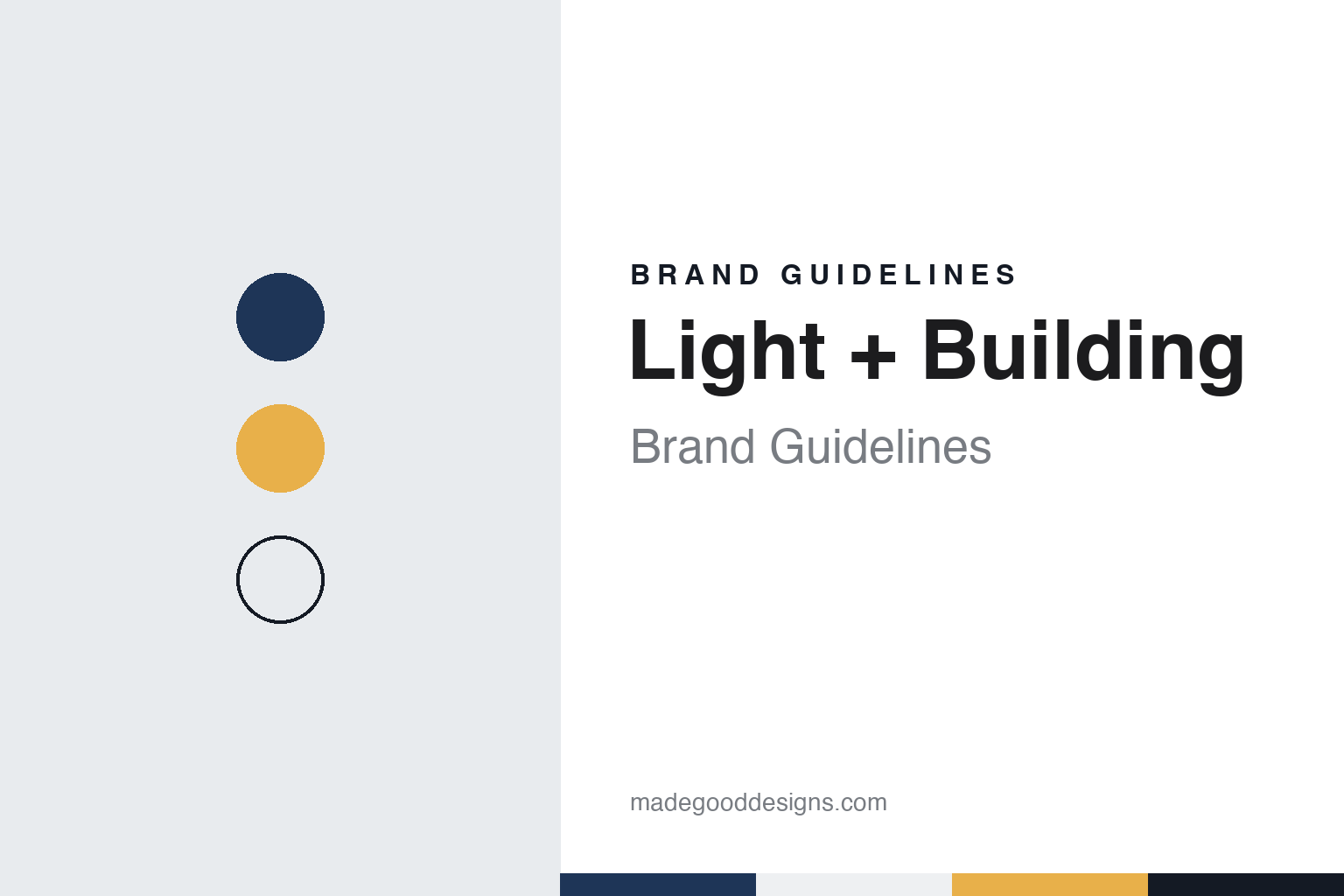
Light + Building Brand Guidelines
Lighting and building services, joined by a plus sign.
Aa
Two constants: a night blue, warm lamp and cool white palette and a technical sans register. Abstract homage — not a Light + Building or Messe Frankfurt mark; no logo, key visual or product is reproduced.
Four fairs under one roof
A new Frankfurt fair for the year 2000.
Light + Building opened for the first time in Frankfurt from 19 to 23 March 2000. The German building-services trade magazine SBZ announced it in the autumn of 1999 as an international trade fair for lighting and electrical engineering, climate technology and building automation, and reported that Michael Peters, managing director of Messe Frankfurt, had presented it at a press conference that September as a complementary group of four trade fairs under one roof. Messe Frankfurt described the new fair as a complement to ISH, its fair for heating and sanitary technology.
The new fair was assembled from existing pieces. According to SBZ in 1999, the earlier world lighting fairs, the Weltlichtmessen, were taken out of their previous industrial setting and given a new context in Frankfurt, and more than half the stand space at the first edition was given to lighting, from residential luminaires and technical lighting to lamps, control gear and lighting control. Climate technology was moved out of ISH into the new fair, while ventilation stayed at ISH, the magazine reported in 2000. Industry and trade associations including the electrical industry association ZVEI, the engineering association VDMA and the German electrical trades association ZVEH took part from the start. By early September 1999, the organiser told SBZ, 1,022 exhibitors from 39 countries had already registered.
The first edition drew more visitors than the fair’s management had at first hoped, SBZ wrote afterwards. The magazine reported that 1,800 exhibitors from 46 countries had taken part and that more than 100,000 visitors from 93 countries had come to Frankfurt. On a joint stand between halls 8 and 9, the national associations of the electrical trades and of the plumbing, heating and air-conditioning trades appeared together at a fair for the first time, the magazine noted. An international congress, “Building Performance,” ran alongside the halls from 20 to 22 March 2000.
The fair is held every two years, in even years and normally in spring, English and German Wikipedia say. For 2018, German Wikipedia, citing the organiser, gives 2,719 exhibiting companies from 55 countries and more than 220,000 visitors. The 2020 edition did not take place, the lighting trade magazine highlight reported.
Colour
Light, power and the connected building.
The fair’s scope has shifted with the industry. German Wikipedia lists four areas from an earlier version of the fair’s concept: lighting, electrical engineering, home and building automation, and software for the building trade. Messe Frankfurt now describes Light + Building as a meeting place for manufacturers of lighting, electrical engineering and home and building automation, and groups its lighting offer into technical lighting, decorative lighting, and components and accessories such as lamps, LEDs, lighting control and light measurement. The visitor groups it names include architects, interior architects, designers, planners and engineers, together with the skilled trades, wholesale and industry. The fair’s partner associations include ZVEI and ZVEH, the organiser says.
The most recent edition ran from 8 to 13 March 2026. In its closing report, Messe Frankfurt said that 1,927 exhibitors from 49 countries took part and that 144,767 visitors came from 143 countries, with the most international visitors coming from China, the Netherlands, Italy, Switzerland and France. The report quoted Wolfgang Marzin, president and chief executive of Messe Frankfurt. The edition was built around three themes, according to the organiser: Sustainable Transformation, Smart Connectivity and Living Light.
The design magazine Stylepark, reviewing the 2026 edition on 13 March 2026, wrote that building technology was increasingly becoming the focus of the fair, a trend it said had already been visible in 2024. Its review moved from lighting systems to door communication and building sensors.
Messe Frankfurt has also taken the name abroad. It lists Light + Building among the trade fair brands it has exported around the world, and says the brand is now represented by 14 trade fairs in growth markets for the industry.
Typography
Industrial, print and packaging fairs.
Industrial, print and packaging trade fairs tend to present themselves through a short coined name rather than a description. Some compress two words into one, as drupa does with the German for print and paper; others are written entirely in lower case or entirely in capitals, and some add the host city to the name, as with EMO Hannover. The name is usually the most stable part of the identity, carried from one edition to the next for decades while organisers, halls and themes change around it.
The second constant is the calendar. Rather than meeting every year, many of these fairs keep a fixed cycle of two, three or four years, set to suit industries whose machines take years to develop, and an edition is known by its year in a way that buyers and exhibitors plan around. Behind most of them stands an exhibition company working with an industry association or an exhibitor committee whose recommendations the organiser takes into account.
The halls themselves are part of the language. These fairs fill very large exhibition grounds and arrange them by segment, such as prepress, printing, finishing, packaging materials or machine tools, so that a visitor reads the show hall by hall. Stands often carry working machines rather than models, which gives the halls the look of a temporary factory floor alongside conference stages and themed special areas.
Visually, the pattern is a fixed wordmark with a changing key visual. Each edition receives its own campaign image, edition line or set of themes, presented in the year or two before opening, while the name and the venue stay put. For a design guide, the lesson is that balance between a permanent mark and a temporary campaign.
Aa
A clean technical sans, close to the spirit of the light+building wordmark. (Specimen set in Manrope, a sans STAND-IN; NOT the Light + Building logo.)
Light + Building
A plus sign and a city festival.
The name says what the fair joins. Written in full as Light + Building, it appears in the logo, German Wikipedia says, as light+building: lower case, with the plus sign closing the gap between the two words.
For much of its history the fair also reached into the city. Luminale, a festival of light installations on public and private buildings in and around Frankfurt, has been held alongside Light + Building every two years; German Wikipedia dates it from 2000, while highlight says it has accompanied the fair since 2002. highlight described it as an event initiated by Messe Frankfurt as a “bridge from the exhibition grounds into the city,” and reported that Messe Frankfurt held the organiser’s role and the brand rights. German Wikipedia records about 220 light installations in 2008 and a new concept in 2018 as a biennale for light art and urban design. Luminale was not held in 2022 or 2024, highlight reported.
On a page, that pairing suggests a calm technical type set against dark grounds, with a single warm colour standing in for light.
For a design guide, Light + Building shows how a single typographic sign can carry the logic of a merger, and how a trade fair can borrow a city at night as its showcase. Compare Messe Frankfurt, which organises the fair, and Automechanika, another Messe Frankfurt fair on the same grounds. For this guide we use night blue, a warm lamp yellow and cool white with a sans, an unofficial interpretation; no product or logo is reproduced.
Explore & save
Keep Light + Building’s identity on hand — save it to a board in the Made Good inspiration library.
Light + Building identity set
Pin the Light + Building night blue, warm lamp and cool white palette and the technical sans register to your own board.
Source & notes
Frequently Asked Questions
What font can I use to match the Light + Building look?
This guide describes Light + Building’s type as “A clean technical sans, close to the spirit of the light+building wordmark”. Its type specimen is set in Manrope from Google Fonts as a stand-in; Manrope is not Light + Building’s own lettering.
What colours are in the Light + Building palette?
This guide’s Light + Building palette is Night blue #1E3557, Graphite #141A24, Cool white #EEF0F2, Warm lamp #E8B04A and Paper #F7F8F9. The tones are the guide’s own unofficial interpretation, not official Light + Building hex codes.