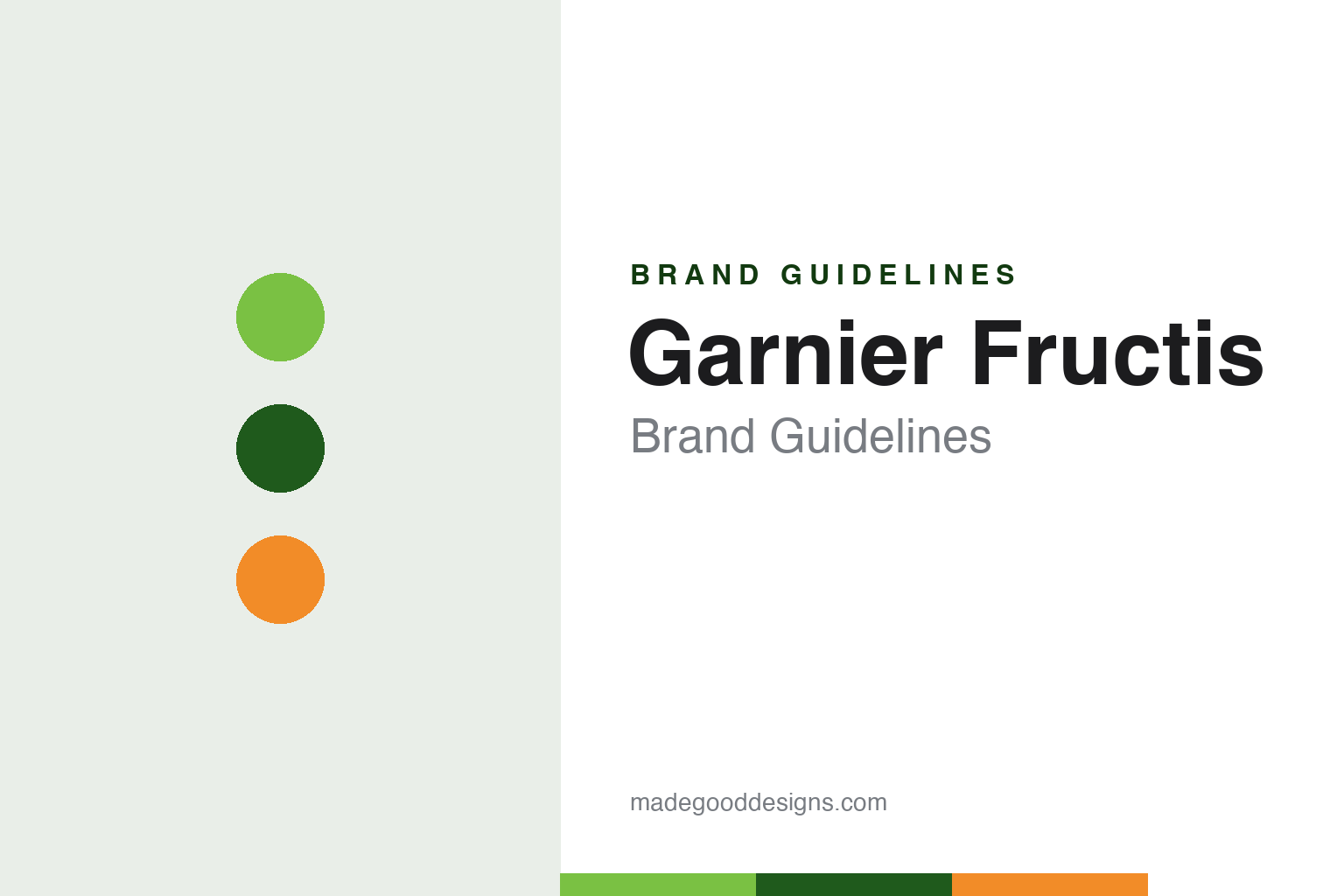
Garnier Fructis Brand Guidelines
L’Oréal’s green-bottle haircare line, launched 1996.
Aa
Two constants: a Fructis green, leaf and fruit orange palette and a bold grotesque sans register. Abstract homage — not a Garnier Fructis product or mark; no bottle, label or logo is reproduced.
A hairdresser’s lotion in Blois
The house behind Fructis began with one plant-based hair lotion.
Fructis is a line within a much older brand. Garnier’s own heritage page says the house began in 1904 in Blois, in the Loire valley, where the hairdresser Alfred Amour Garnier created a plant-based lotion for the hair in his salon. French Wikipedia, citing the trade publication Prodimarques, gives a precise date: on 2 June 1904 Garnier filed the formula for his hair lotion with the court in Blois, the moment the brand counts as its founding. French Wikipedia says he sold the shop in 1909, that it later became the Institut Garnier, and that the name Laboratoires Garnier was created in 1929, when the business widened into shampoo, skin care and toothpaste.
Garnier became part of L’Oréal in the 1960s or 1970s, depending on the source. French Wikipedia, citing L’aventure L’Oréal by François Dalle, L’Oréal’s former president, dates the acquisition to 1965; English Wikipedia gives 1970. L’Oréal has owned Garnier since then, and Garnier now sits in its consumer-products business, with its headquarters at L’Oréal’s Clichy campus, according to English Wikipedia.
By the 1980s Garnier was a hair-care brand in France with plant-led shampoos. Its heritage page says the Ultra Doux range launched in France in 1982 (it is sold in the United Kingdom as Ultimate Blends), and that Garnier has been a global brand since 1995.
Hair colour and sun care grew up alongside the shampoos. The same heritage page dates the Ambre Solaire tanning oil to 1935 and Belle Color, an at-home hair colour, to 1960, and says the colour line now sold as Nutrisse began in 1998 under the name Natéa. French Wikipedia adds that Ambre Solaire was attached to Garnier in 1987 and that the Ultra Doux shampoos replaced an older hairdresser-only product, Moelle Garnier, which had launched in 1946. That is the portfolio Fructis joined: a French house with a long run of hair products sold under the Garnier name.
Colour
A fruit name, a green bottle and a youth-led styling spin-off.
Fructis followed a year later. Garnier’s heritage page and French Wikipedia both date the line to 1996, and Garnier says its green bottle became known around the world. The roll-out was market by market. Horizont reported in November 1998 that Laboratoires Garnier, based in Düsseldorf, was launching Fructis nationwide in Germany that year with a television campaign on the major channels created by Publicis in Frankfurt, with spots stressing the range’s concentrated fruit-based actives.
Styling came next. French Wikipedia lists Fructis Style in 2000. Marketing Week reported in April 2001 that Laboratoires Garnier was launching Fructis Style in the United Kingdom: a unisex, mass-market range of 14 styling products, including hairsprays, mousse and a fibre gum gel, aimed at 16- to 24-year-olds and pitched against Wella’s Shockwaves. Until then, the magazine noted, the Fructis range had contained only shampoos and conditioners. Publicis created the campaign and Universal McCann bought the media.
The parent brand’s signature was simplified at the same time. French Wikipedia says that during the 2000s the words “Laboratoires” and “Paris” were dropped from the Garnier signature to support its international expansion, and its logo captions run from a “Laboratoires Garnier Paris” mark used from 1988 to a “Garnier Paris” mark used from 1995 and a plain Garnier logo from 2003.
Typography
Design and documentation.
The seven brands in this group are all mass-market haircare names: TRESemmé, Pantene, Herbal Essences, Garnier Fructis, Aussie, Not Your Mother’s and John Frieda. Haircare brands in general sit at many different points in the trade, from names that still carry a founder’s story to ranges that now belong to much larger consumer-goods groups, and a single brand can be sold everywhere from a corner chemist to a supermarket aisle.
A haircare brand’s identity is usually carried less by a single bottle than by a name, a colour and the promise on the label, because the company behind the name may have changed hands, moved its production or grown far beyond the place where it started. That makes the questions behind each name worth asking plainly: who started it, who owns it now, and where its shampoos and conditioners are actually made.
Each guide separates what independent sources record from what the company says about itself — its founding story, its owners over time, where its products are made and how its packaging has changed — and marks plainly what rests only on the company’s own word.
Aa
A bold grotesque sans for a short, punchy product name. (Specimen set in Archivo, a sans-serif STAND-IN; NOT the Garnier or Fructis logo.)
Garnier Fructis
A sub-brand inside L’Oréal’s mass-market portfolio.
Fructis is one of several Garnier lines that sit inside L’Oréal alongside very different hair-care names, from the salon brand Kérastase to mass-market hair colour. Garnier has also changed how it talks about its products as a whole. French Wikipedia says the slogan “Par Garnier, naturellement !” was introduced in 2018, and English Wikipedia records that Cruelty Free International announced Garnier’s approval under its Leaping Bunny programme on 5 March 2021.
The line keeps adding sub-ranges under the same name. In March 2026 Garnier announced the model Gisele Bündchen as its global ambassador, launching a Fructis styling product in Miami, according to the company’s release; that release also says Garnier entered the United States in 1999 with Nutrisse hair colour and lists Fructis and Fructis Style among its American ranges.
Across these changes a few constants are documented. The Fructis name has been in use since 1996; Garnier itself singles out the green bottle as the line’s calling card; and the line is sold under the Garnier name, which since the 2000s has appeared without “Laboratoires” or “Paris”. In advertising, Publicis created both the German launch campaign of 1998 and the British Fructis Style launch of 2001, according to Horizont and Marketing Week.
The names need a little care online. Garnier is also a common French surname; the brand’s own sites sit under garnier.com and its national domains, such as garnier.co.uk.
For a design guide, Garnier Fructis shows how a single colour can carry a mass-market haircare line across countries and decades, with a fruit-derived name doing the rest of the work. Compare Kérastase, L’Oréal’s salon hair-care house, and Herbal Essences, P&G’s botanical shampoo. For this guide we use Fructis green, leaf and fruit orange with a bold sans, an unofficial interpretation; no product or logo is reproduced.
Explore & save
Keep Garnier Fructis’s identity on hand — save it to a board in the Made Good inspiration library.
Garnier Fructis identity set
Pin the Garnier Fructis green, leaf and fruit orange palette and the bold grotesque sans register to your own board.