Giambologna designed sculpture that rewards walking around it. His marble groups twist upward so that every step reveals a new profile, and his small bronzes were made to be handled, turned and studied at close range. For anyone who designs objects, identities or product families, Giambologna is a case study in making one strong form work at every angle and at every scale.
This guide focuses on his design thinking and uses only works the Metropolitan Museum of Art flags as public domain. For more public-domain sculpture, prints and ornament, browse the MGD museum inspiration collection.
Who was Giambologna?
Giambologna was born Jean Boulogne in Douai in 1529; the Victoria and Albert Museum, the Cleveland Museum of Art and the Metropolitan Museum of Art all give 1529 and Flanders or Douai as his origin, and the Met records his death in Florence in 1608, a date also given by Encyclopedia.com. The V&A explains that “Giambologna” is a contraction of “Giovanni of Bologna”. The Cleveland Museum of Art and Encyclopedia.com both record his training with the Flemish sculptor Jacques du Broeucq.
Around 1550 he went to Rome to study ancient and Renaissance sculpture, according to the V&A, the Cleveland Museum of Art and The New York Review of Books; Encyclopedia.com gives about 1551 and notes that he made wax and clay sketches of what he saw. On his way home to Flanders around 1553 he stopped in Florence, where the banker Bernardo Vecchietti took him in, as Encyclopedia.com and The New York Review of Books both describe. Cleveland states that he settled in Florence in 1553.
He never left. Encyclopedia.com records that he was a salaried Medici court artist by 1561, and the V&A says he was firmly established as a court sculptor by the mid-1560s. He served successive Medici rulers until his death; Encyclopedia.com records that he was buried in a chapel he had decorated for himself in the church of Santissima Annunziata in Florence, which The Art Story also describes. For the wider context of Florentine art in these decades, see our guide to Renaissance art.
Giambologna’s key works
Samson Slaying a Philistine, probably 1560–62
This marble group, now in the V&A, was carved in Florence probably between 1560 and 1562 for Prince Francesco de’ Medici, according to the V&A; The Art Story also dates it from 1560. It first crowned a fountain in the Medici botanical garden. The V&A notes that the group stands on only five narrow points of contact with its base, a structural feat for two interlocked, larger-than-life figures in stone.
The Neptune Fountain, Bologna, 1560s
Encyclopedia.com records that he travelled to Bologna in 1562 to work on the Neptune Fountain, and The New York Review of Books dates his commission for the bronze Neptune to around 1562; The Art Story dates the fountain 1563–66.
Abduction of a Sabine Woman, Loggia dei Lanzi
His three-figure marble group stands in the Loggia dei Lanzi in Florence, as Encyclopedia.com and The Art Story both record. The New York Review of Books explains that it grew from a statuette made in 1579 for Duke Ottavio Farnese, and the Met dates the model behind one of its bronze reductions to about 1579. According to The New York Review of Books, the subject title was supplied afterwards, in Raffaello Borghini’s Il Riposo of 1584. The Art Story says the marble was placed in the loggia in 1582.
Equestrian monument of Cosimo I, 1594
The bronze horse and rider honouring Duke Cosimo I de’ Medici was erected in the Piazza della Signoria in 1594, according to the V&A and The Art Story. The V&A, citing the early biographer Filippo Baldinucci, credits Antonio Susini with executing the models and moulds and with a large part of the full-scale casting.
Encyclopedia.com also lists the colossal Appennino in the gardens at Pratolino and a Mercury made for the Villa Medici in Rome, and The New York Review of Books records a 1565 commission for a marble allegory of Florence’s victory over Pisa.
Technique: models, marble and bronze
The New York Review of Books describes Giambologna working in wax, clay, marble and bronze, concentrating on designing models and often leaving casting and finishing to assistants. Wax was central to that process: the Met holds a small red-wax model, a seated figure representing Astrology, which it dates to the mid-1570s.
From the early 1560s, according to The New York Review of Books, he developed about ninety models for small bronzes, cast by a few full-time assistants. Encyclopedia.com likewise notes that his smaller statuettes were often produced as multiples for collectors and as diplomatic gifts. The V&A records that the Medici sent a version of his pacing horse to Henry, Prince of Wales, in 1612, and that small versions of the horse became popular with collectors. The New York Review of Books adds that his workshop continued after his death, with some models remaining in production for a century or more.
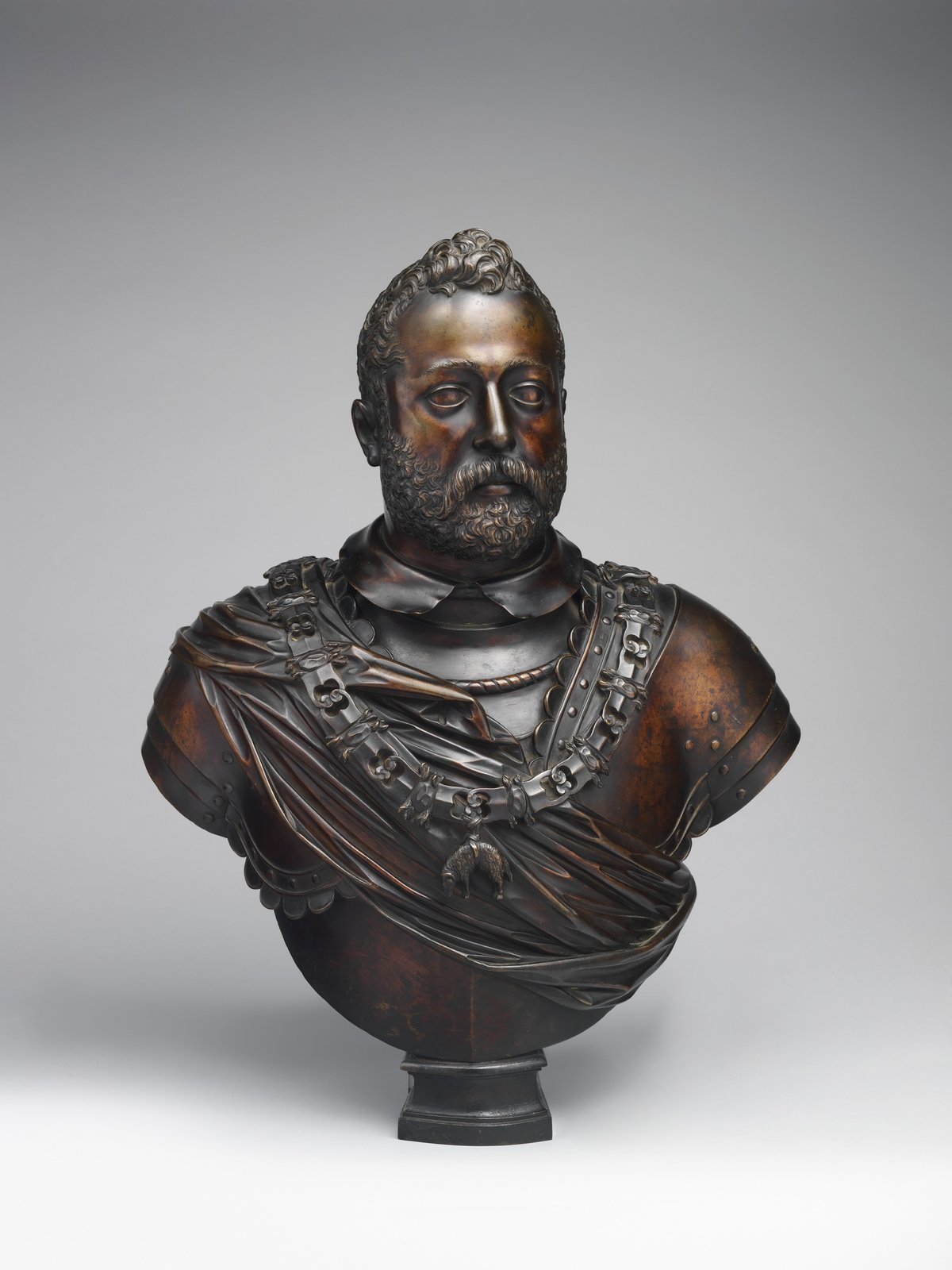
That longevity is why so many surviving bronzes are catalogued as “after a model by Giambologna” rather than by his own hand. The Met’s bust of Francesco I, for example, was modelled in 1585–87 and cast around 1611, after the sculptor’s death.
What to look at: composition, silhouette and surface
The spiral. The Sabine group stacks three bodies in a rising twist, so there is no single front view. The New York Review of Books describes his bronzes as made to be studied closely from many angles; the large marbles carry the same idea to public scale.
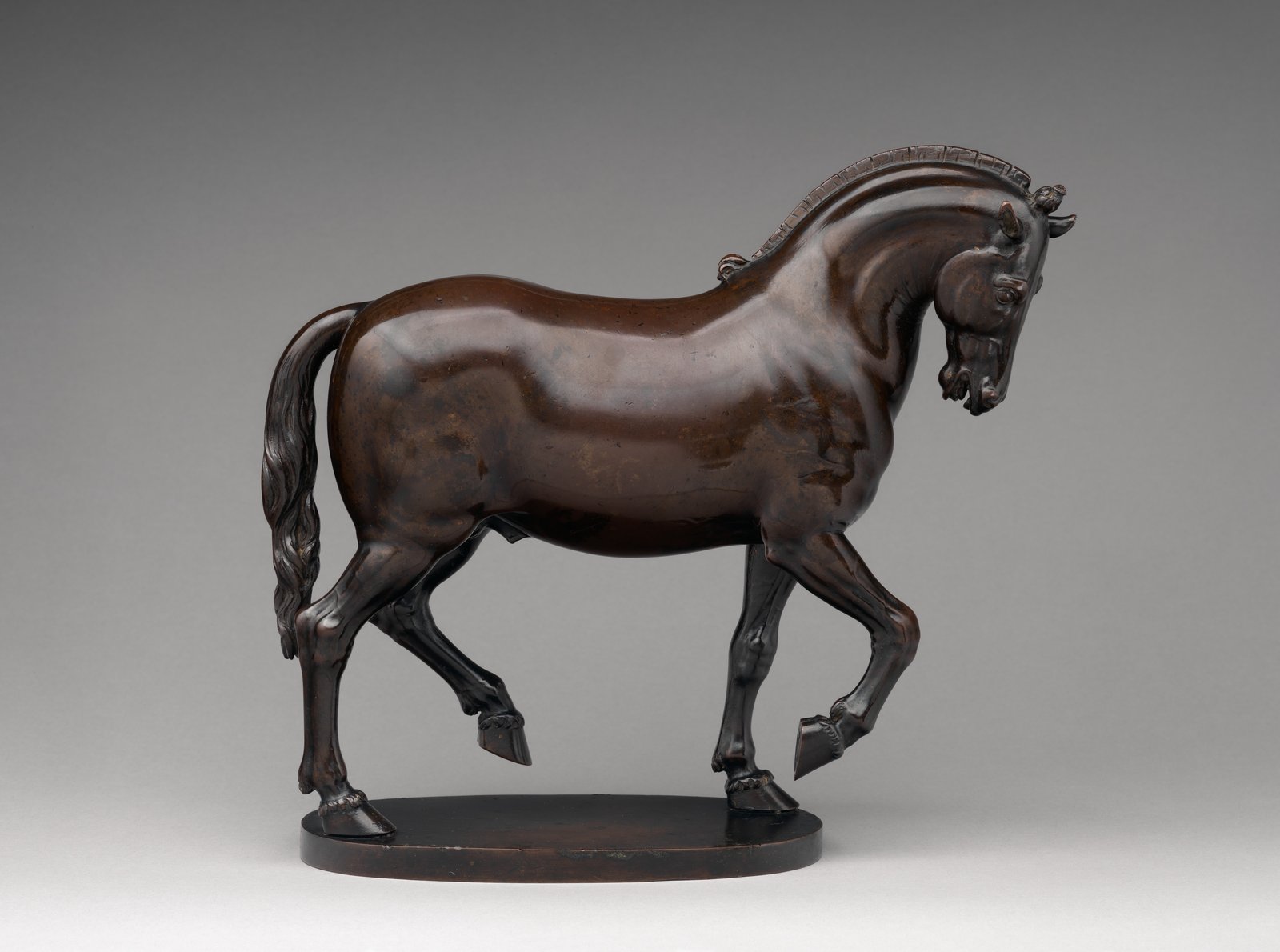
Open silhouettes. Look at the trotting horse: the raised foreleg, the gap under the belly and the bowed neck create negative shapes that read clearly even in a dark material against a light wall. In the Met’s photograph the shadow tones of this cast measure around #271C16 and #3F312B, measured from the museum’s scan of this object; they describe the photographed patina, not the original surface.
Texture as contrast. In the Francesco I bust, the smooth face sits against crisply chased armour, a heavy chain collar and deep folds of drapery. The highlights on this scan measure near #5D5651, with the darkest recesses at about #262424, measured from the museum’s scan of this object.
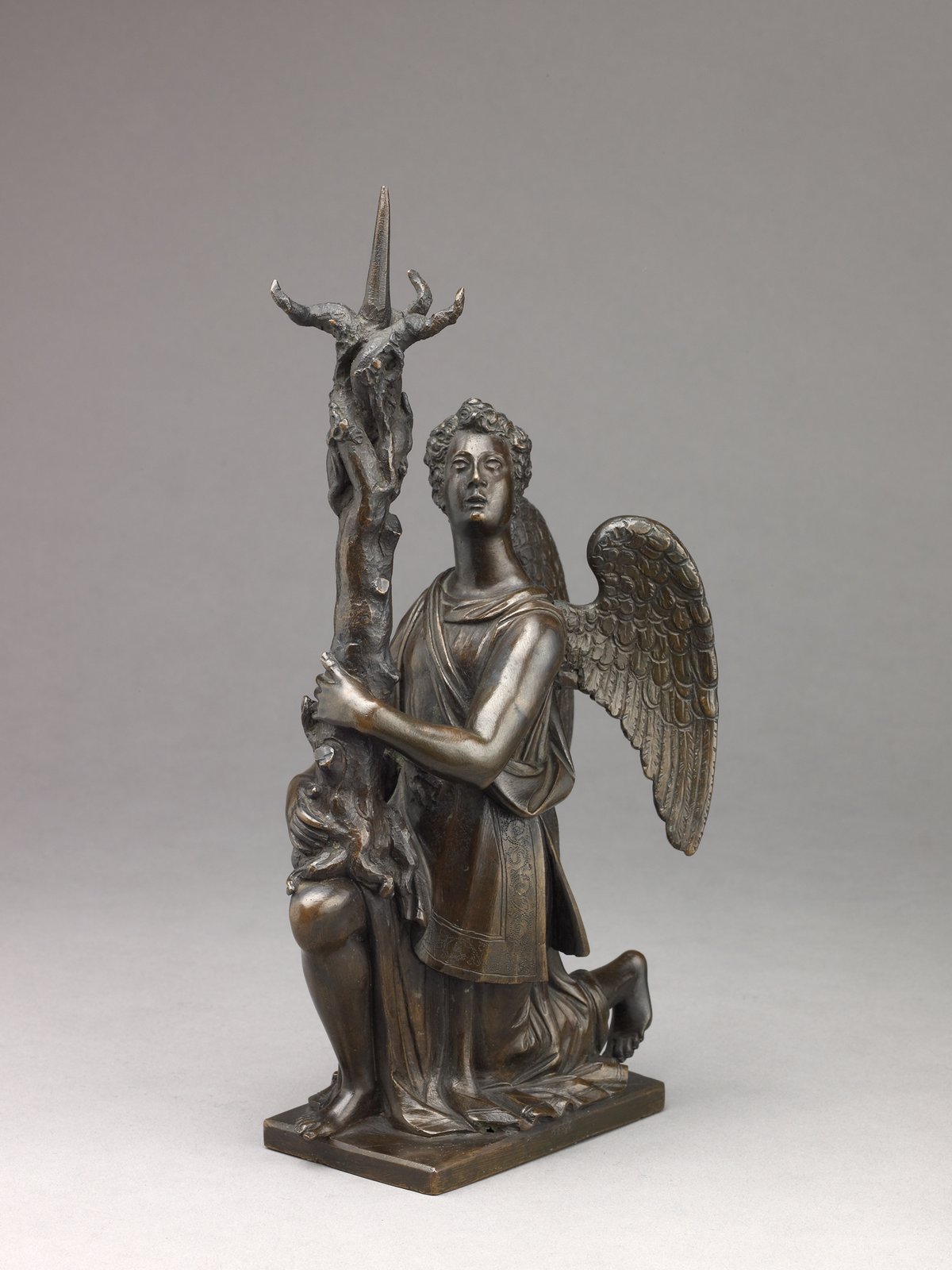
Sculpture as product. The kneeling-angel candlestick, which the Met attributes to a close collaborator of Giambologna, possibly Hans Reichle, shows the workshop applying figure design to a functional object: the angel’s arm and wing frame the stem, and the robe forms a stable base. The warm mid-tones of this scan sit near #605950, measured from the museum’s scan of this object.
How designers can borrow from Giambologna
- Design for every angle. For packaging, product or 3D brand assets, test the form in rotation, not just in a hero view. A spiral or twist gives each angle a reason to exist.
- Check the silhouette in one colour. Fill your logo, icon or illustration with a single dark tone. If it still reads, like a bronze horse against a wall, the shape is doing its job.
- Build a system from one master. Giambologna’s workshop turned a model into many casts. In a design system, one well-made master component can do the same across sizes and contexts.
- Use texture where colour is limited. A one- or two-colour print job can still feel rich if smooth areas sit next to hatched or patterned ones. Sample bronze tones from public-domain scans with the image colour picker.
Giambologna’s Sabine group was placed as a companion to Benvenuto Cellini’s Perseus in the same loggia, according to Encyclopedia.com. For a goldsmith-sculptor’s approach to bronze a generation earlier, see our guide to Benvenuto Cellini.
Where to see Giambologna’s work
In Florence, the Sabine group stands in the Loggia dei Lanzi and the equestrian Cosimo I in the Piazza della Signoria, as described above. The V&A in London holds Samson Slaying a Philistine. The Metropolitan Museum of Art, the Cleveland Museum of Art and the Art Institute of Chicago all list bronzes by or after Giambologna in their open collection data. Check each museum for current display.
Frequently asked questions
What is Giambologna known for?
He is known for marble groups such as the Abduction of a Sabine Woman in the Loggia dei Lanzi, the Neptune Fountain in Bologna, the equestrian monument of Cosimo I in Florence, and the small bronze statuettes his workshop cast from his models.
Why is he called Giambologna?
He was born Jean Boulogne in Douai. The V&A explains that “Giambologna” is a contraction of the Italian form of his name, Giovanni of Bologna.
Did Giambologna cast all his bronzes himself?
No. The New York Review of Books describes him focusing on models while assistants cast and finished many works, and the V&A credits Antonio Susini with a large part of the Cosimo I casting. Many bronzes are catalogued as “after a model by” him.
Are images of Giambologna’s sculpture in the public domain?
His works date from the sixteenth and early seventeenth centuries. The three images in this guide come from the Met’s open-access collection, which flags them as public domain; check each museum’s terms before using other photographs.