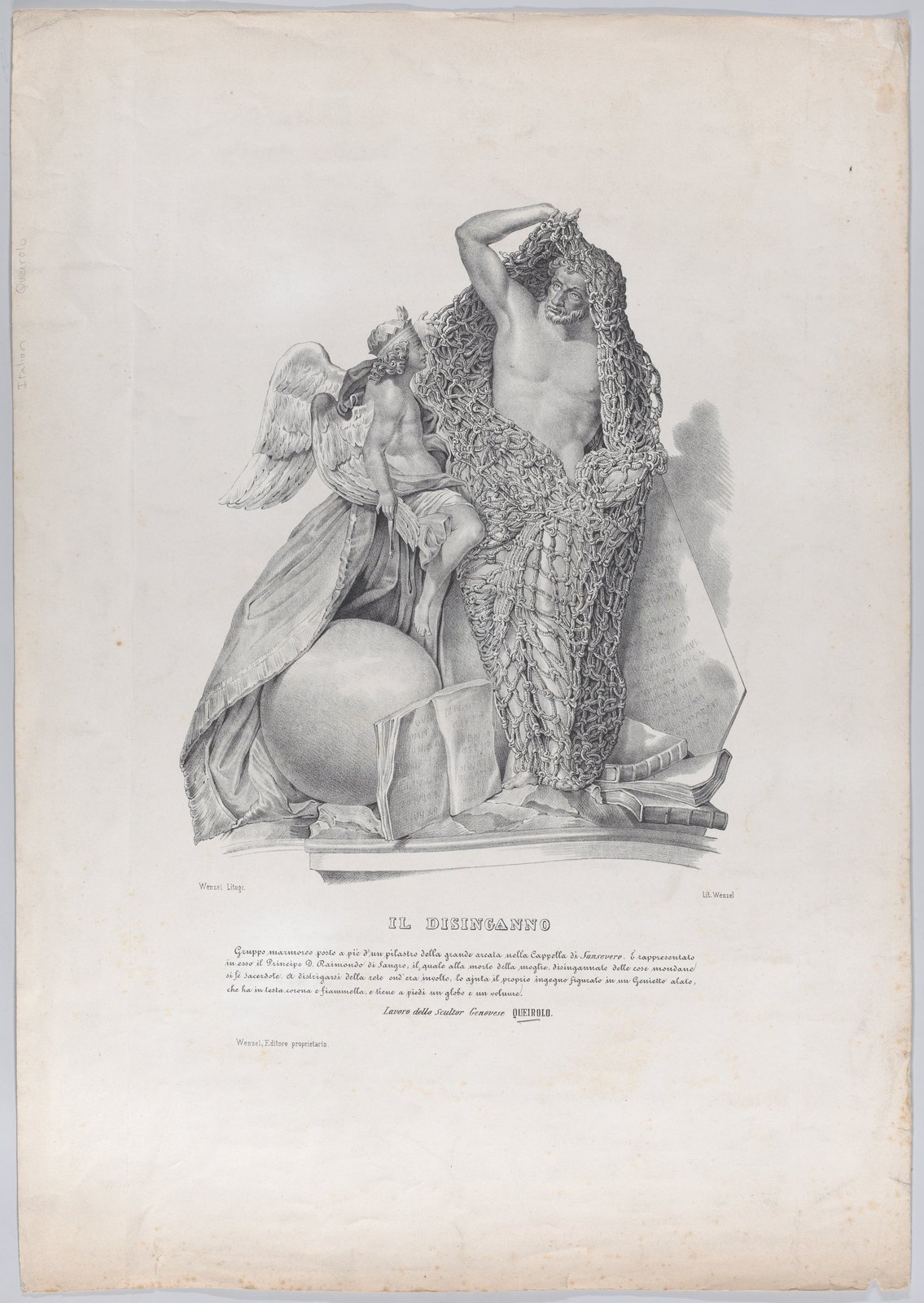
Giuseppe Sanmartino made his name with a single marble sheet that looks like cloth. In the Veiled Christ, a dead Christ lies on a cushioned bier beneath a shroud so fine that the face, ribs and folded hands show through it. The trick is carved, not cast, and it is the reason designers still study him: the veil is a layer that hides and reveals in the same gesture. Beyond that one work, Giuseppe Sanmartino ran a Naples workshop for more than four decades, carving altars, tombs and church statues, and he is linked with the small painted figures of the Neapolitan Christmas crib, several of which are now in The Metropolitan Museum of Art.
Who was Giuseppe Sanmartino?
Sanmartino was born in Naples in 1720, the year given by the Dizionario Biografico degli Italiani (Treccani) and by The Met’s collection records. Treccani and the Italian art magazine Finestre sull’Arte both say he probably trained in the workshop of the sculptor Matteo Bottiglieri or his brother Felice, and both name Domenico Antonio Vaccaro and the painter Giacomo del Po among his influences. Treccani is careful to call the Bottiglieri link a likely one rather than a documented fact.
Both sources record that in 1756 he formed a partnership with the sculptor Francesco Pagano, which ended in 1758, and that he went on to train pupils, among them Salvatore di Franco. He died on 12 December 1793, according to Treccani and Finestre sull’Arte, and both say he was buried in the church of Sant’Efremo Nuovo in Naples.
Giuseppe Sanmartino’s key works
The Veiled Christ, 1753
The commission came from Raimondo di Sangro, Prince of Sansevero, for the family chapel in Naples. The Museo Cappella Sansevero says the prince first turned to the Venetian sculptor Antonio Corradini, who died in 1752 having made only a terracotta model; the museum says that model is now in the Museo di San Martino. Sanmartino took over and finished the marble in 1753. Treccani and the Sansevero museum both note that the statue is signed and dated, and the museum places the inscription on the cushion.
The veil is part of the same block. The Sansevero museum cites a down-payment of fifty ducats to Sanmartino dated 16 December 1752, signed by the prince, which already describes the statue as covered “with a veil of marble”, and quotes the prince’s letters calling the shroud “created from the same block as the statue”. Finestre sull’Arte likewise says payment records show the veil is carved marble, not fabric turned to stone. At the foot of the figure lie the instruments of the Passion: the crown of thorns, nails and pincers.
Church statues across southern Italy
Treccani and Finestre sull’Arte agree on a long list of later commissions. In 1757 he carved allegorical Virtues for chapels in the Certosa di San Martino in Naples. In 1772–73 he worked on the statues of the chapel of San Cataldo in Taranto Cathedral. In 1787 he made the marble angels holding candelabra (or torches) for the Girolamini church in Naples. Treccani also lists the tomb of Cardinal Antonino Sersale in Naples Cathedral (1776–78) and a signed and dated Religione velata (Veiled Religion) of 1786, now in Trieste, which returns to the veil motif three decades later.
Models and crèche figures
Much of his output was small. The Met holds a terracotta Saint Vincent Ferrer, dated 1750 and catalogued as a model, which shows how he worked out drapery and gesture in clay before scaling up. The Met also owns many Neapolitan crèche figures given by Loretta Hines Howard in 1964, several of them catalogued as by or attributed to Sanmartino. Treccani notes that such crib figures are given to him on grounds of style rather than signatures or documents, and that the crib was a collective art, so treat those attributions as the museum states them.
Technique: marble, clay and cloth
The Veiled Christ depends on carving the shroud thin enough that the body underneath stays legible. The Sansevero museum points to small details that survive under the veil, such as a swollen vein on the forehead and the nail wounds, and to the carved edge of the shroud. The museum also says Sanmartino paid little attention to Corradini’s model and gave the veil a movement of his own: where the cloth pools and creases, it describes the body; where it pulls taut, it flattens.
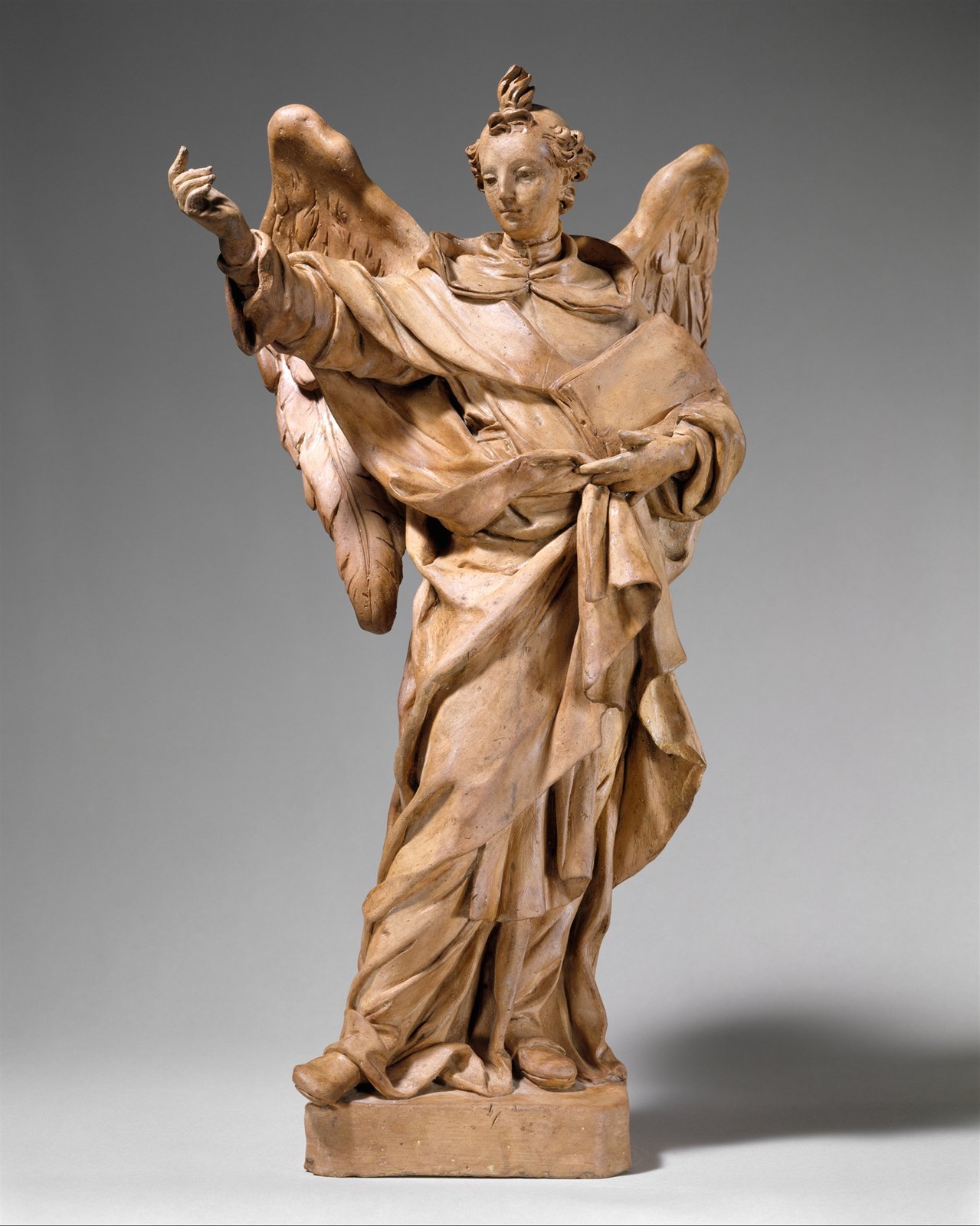
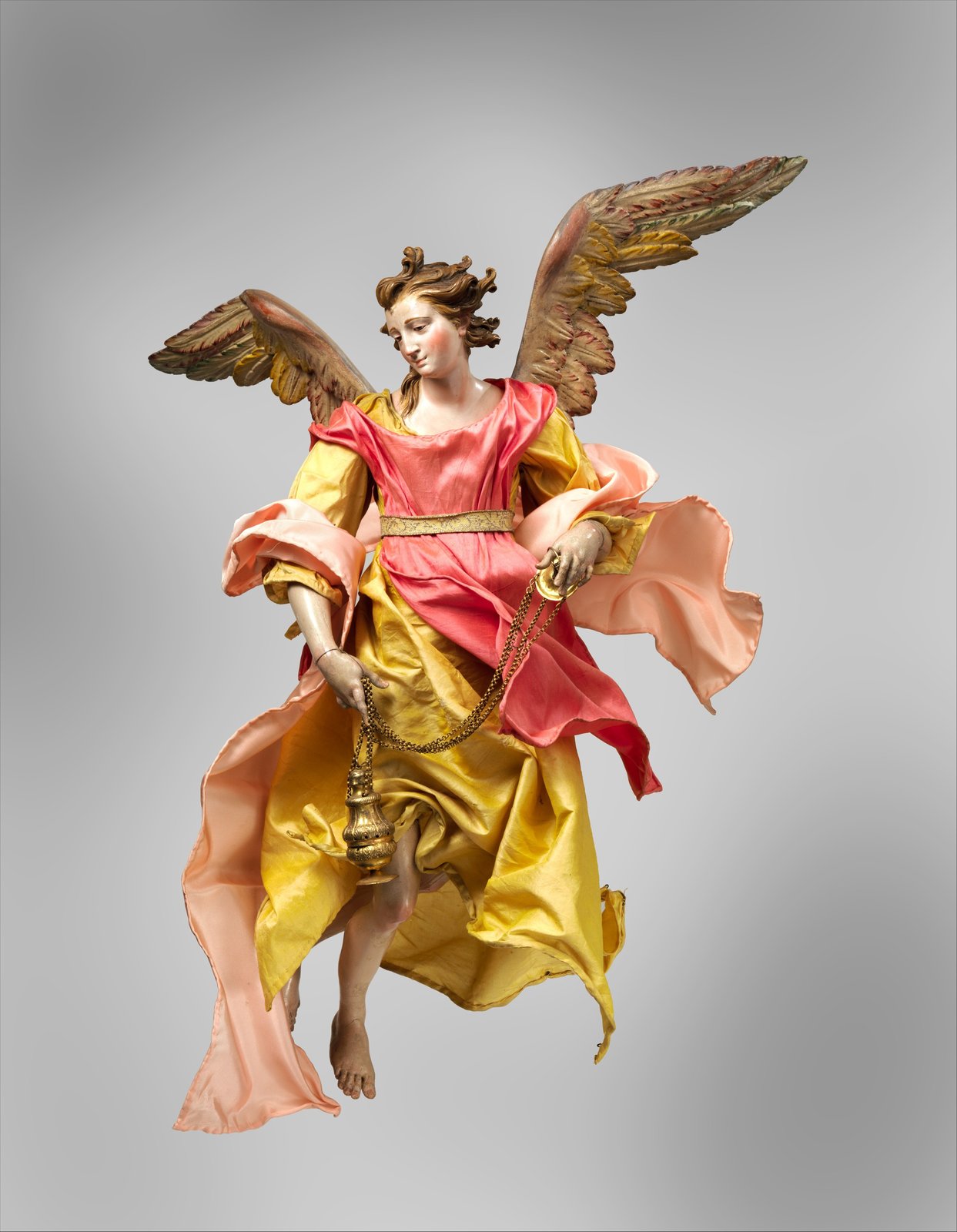
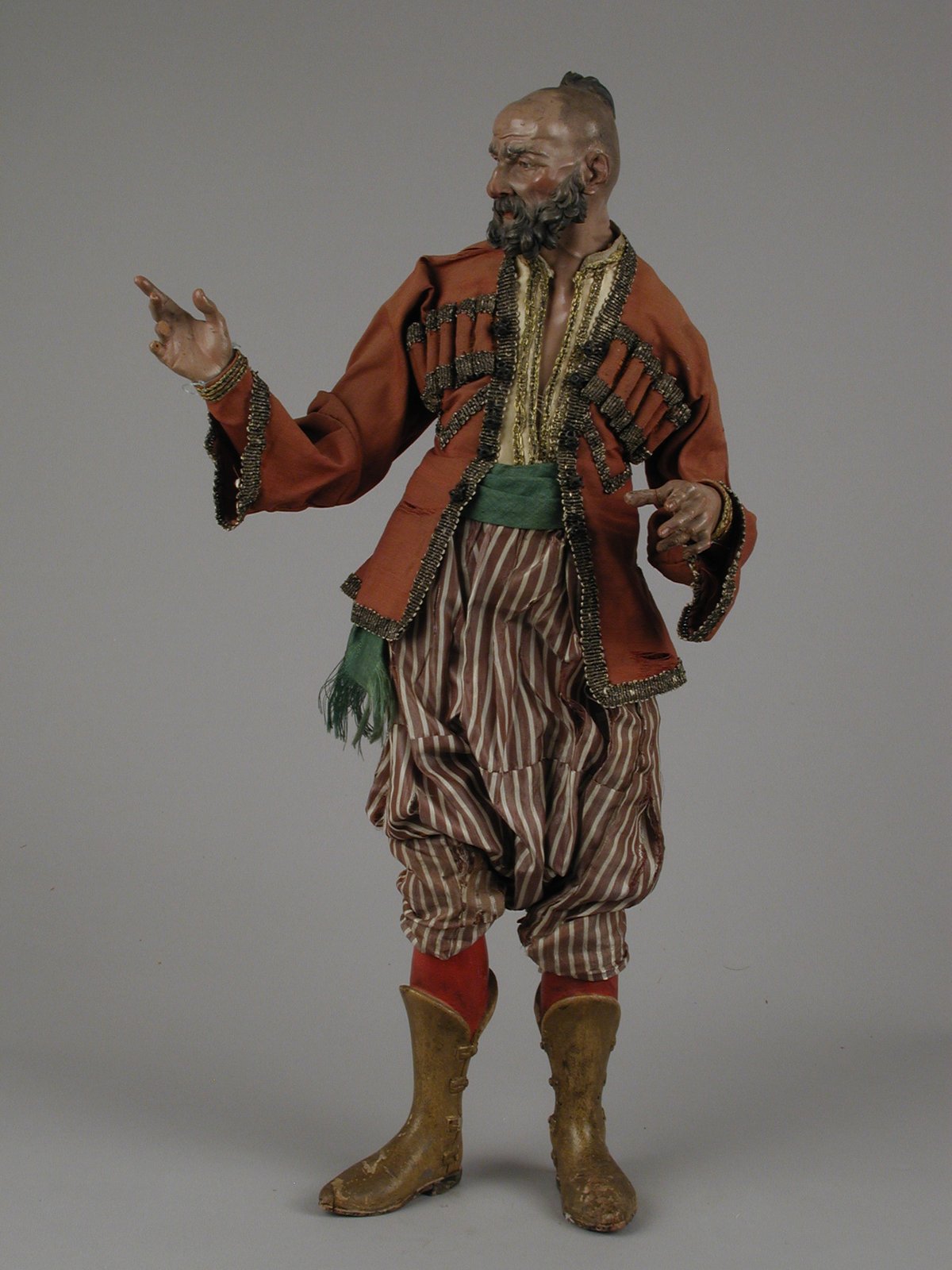
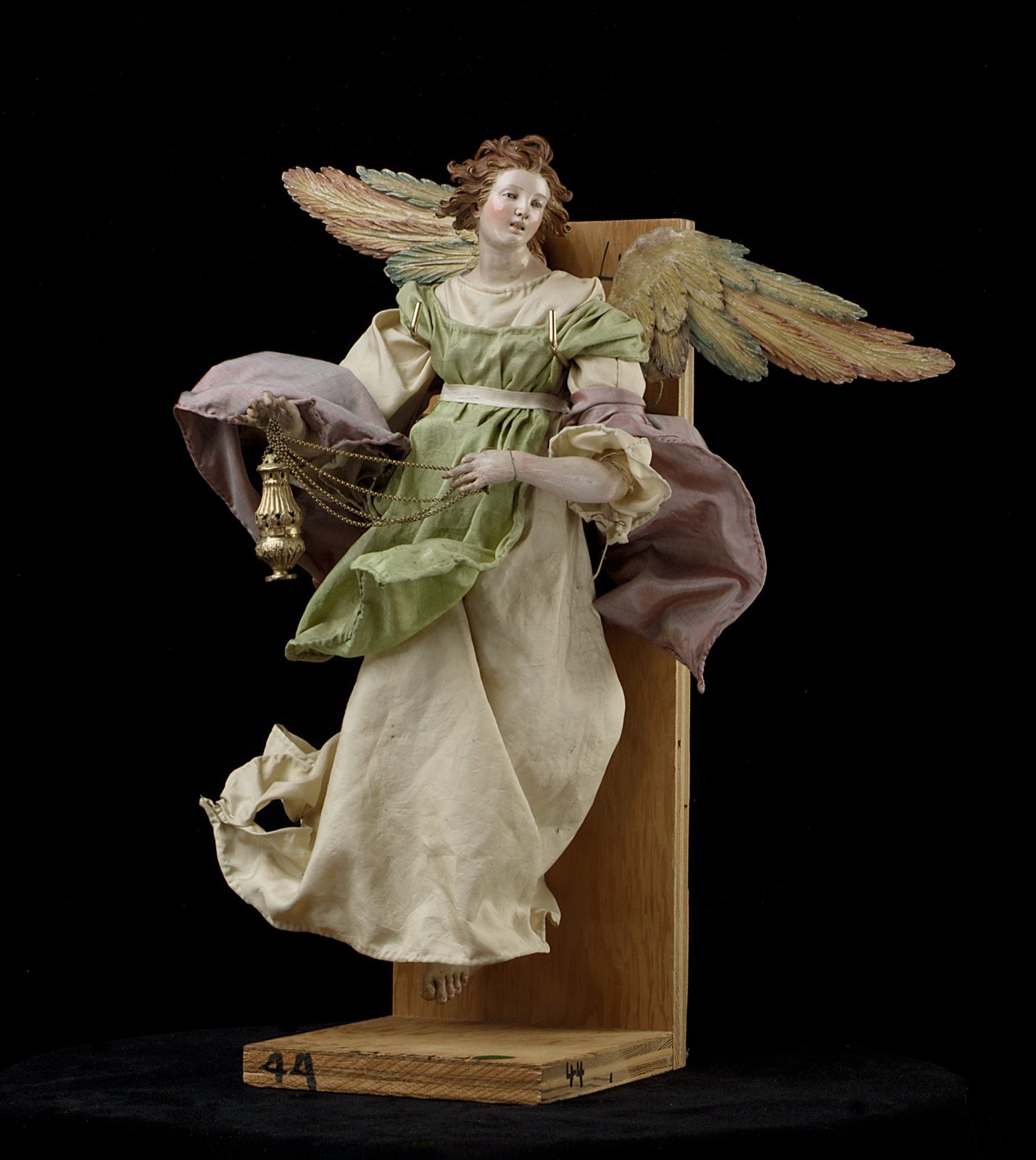
The crèche figures are built differently. The Met’s records describe them as polychromed terracotta heads, with wooden limbs and wings, on bodies of wire wrapped in tow and dressed in real fabrics. One king’s attendant carries silk and satin garments with metallic thread and a brass dagger in a velvet sheath. Only the head and hands are sculpted; the costume does the rest. Treccani records that the writer Pietro Napoli Signorelli, in 1811, singled out his heads of shepherds and his angels for praise.
What to look at: drapery, gesture and colour
One surface, two readings. In the veil, the same plane is both the cloth and the body underneath. Look for where the folds are deepest: those are the places the sculptor wants you to stop.
Diagonal gesture. In the Saint Vincent Ferrer model, one arm rises to the upper left while the drapery falls in long curves to the lower right. The whole figure reads as a single S-shaped movement, even at under 38 centimetres tall, the height The Met gives.
Edges that flutter. The crèche angels have sashes and hems that kick out sideways, so the silhouette never settles into a column. On a plain ground, that broken outline is what carries the motion.
A warm, limited palette. Measured from The Met’s scan of the flying angel above, the main hues are a coral red (#b05836), a pale gold (#f0cd87), a soft salmon (#d99062), an ochre (#b1864b) and a deep brown (#6d421e). The terracotta model gives a quieter set from the museum’s scan: #cca17f, #b48a69 and #59381f. These are colours of the photographs, measured from the museum’s scans of these objects, not the original pigments. You can test them in the colour palette generator.
How designers can borrow from Giuseppe Sanmartino
- Use a veil layer. A semi-transparent overlay, frosted panel or vellum wrap can hide detail while keeping the form underneath readable. Sanmartino’s rule holds: the layer should follow the shape it covers, not float over it.
- Let folds point. Crease lines in fabric, paper or a layout lead the eye. Arrange them so they converge on the thing that matters.
- Prototype small. The 1750 terracotta model is a reminder that gesture and drapery can be settled at a small scale. A thumbnail sketch or a paper maquette can do the same job before you commit to the full-size piece.
- Mix built and found materials. The crèche figures combine a modelled head with real silk, wire and metal. In packaging, set design and window display, one finely made element can carry a figure built mostly from off-the-shelf parts.
- Break the silhouette. A flying sash or an extended arm keeps a static object from looking stiff. In icons and illustrations, one off-axis element can do the same.
For the wider context, see our guides to Baroque art and Rococo design. For an earlier sculptor of carved marble drapery, working in Rome, see our guide to Gian Lorenzo Bernini.
Where to see his work
The Veiled Christ stands at the centre of the nave of the Cappella Sansevero in Naples, which runs it as a museum. In Naples, Treccani and Finestre sull’Arte also place his sculpture in the Certosa di San Martino and the Girolamini church, and further south in Taranto Cathedral. In New York, The Met holds the 1750 terracotta model and its crèche figures; the museum’s crèche is a seasonal display, so check its current programme before visiting. More public-domain sculpture and decorative art is in the MGD museum inspiration collection.
Frequently asked questions
What is Giuseppe Sanmartino known for?
The marble Veiled Christ of 1753 in the Cappella Sansevero, Naples, in which the shroud covering the figure is carved from the same block of marble.
Is the veil of the Veiled Christ really marble?
Yes. The Museo Cappella Sansevero cites a 1752 payment document and the patron’s letters describing a veil of marble carved from the same block, and dismisses the legend of an alchemical process.
Did Giuseppe Sanmartino make Neapolitan crèche figures?
Several crèche figures at The Met are catalogued as by or attributed to him. Treccani notes that these attributions rest on style, since such figures were not signed or documented.
Can I use images of his work?
The four objects shown here are flagged public domain by The Met’s Open Access API. Photographs of works in other collections may carry their own terms, so check each source.