Guadalajara International Book Fair Brand Guidelines
The university-run FIL at Expo Guadalajara since 1987.
Aa
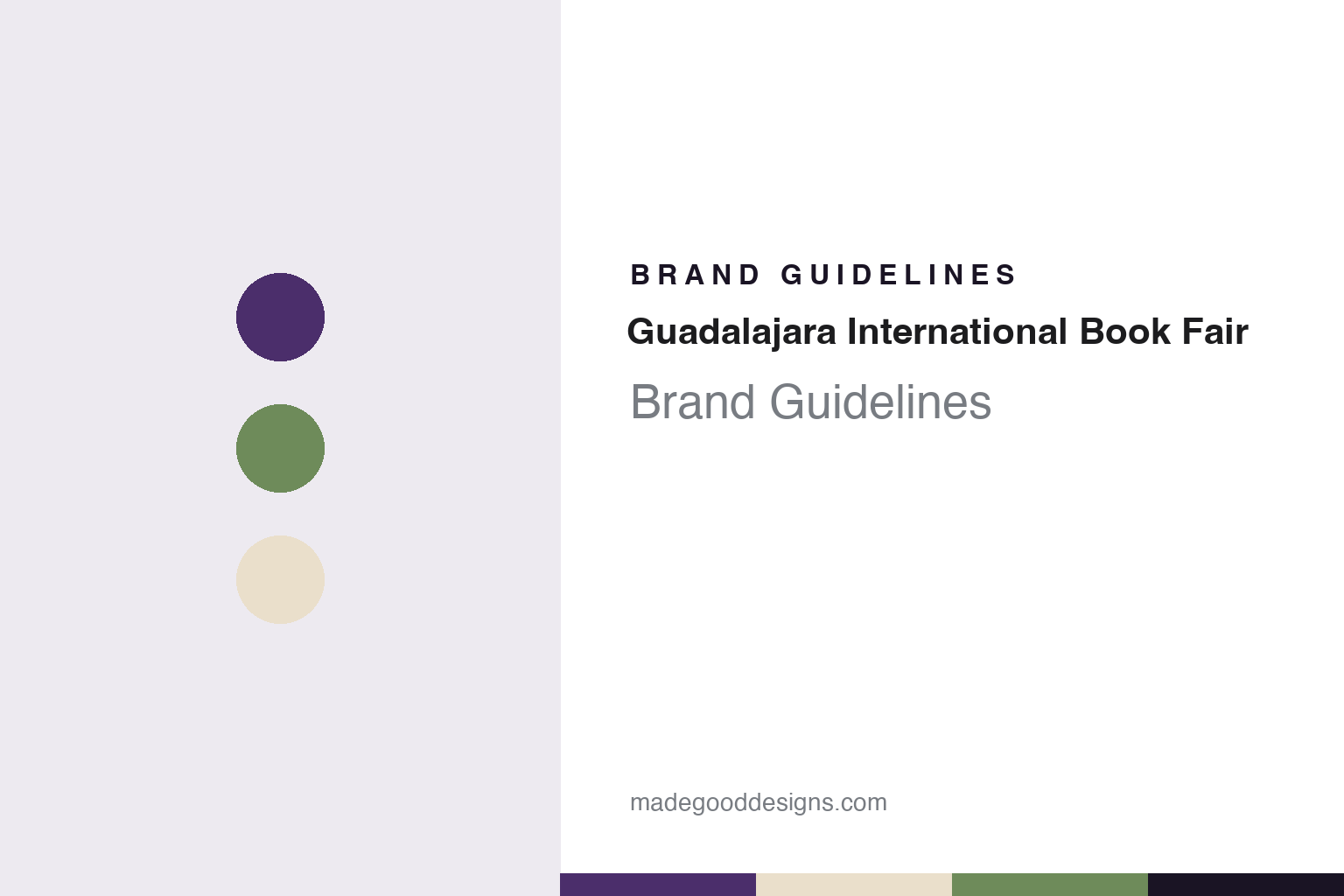
Two constants: a jacaranda violet, sand and agave green palette and an open grotesque sans register. Abstract homage — not a Guadalajara International Book Fair product or mark; no logo, poster or pavilion is reproduced.
A university fair
Nine days from the last Saturday of November.
The Guadalajara International Book Fair — in Spanish the Feria Internacional del Libro de Guadalajara, shortened to FIL or FIL Guadalajara — is held each year in Guadalajara, the capital of the Mexican state of Jalisco. It was created in 1987 and is organised by the University of Guadalajara, English and Spanish Wikipedia say, and the Mexico City newspaper Crónica repeated in October 2023 that the fair was founded by the university and has been held since 1987. Its main venue is Expo Guadalajara, the city’s convention and exhibition centre.
The calendar follows a simple rule. The fair opens on the last Saturday of November and runs for nine days, into the first week of December, according to both Wikipedia editions. In 2025 that meant 29 November to 7 December, as Publimetro reported in June 2025. Spanish Wikipedia records that the 2020 edition was held online.
The university stays close to the fair. The 2026 programme was presented on 8 October 2026 in the Paraninfo Enrique Díaz de León, the university’s historic assembly hall, with the university’s rector general, Karla Planter Pérez, alongside the fair’s president, José Trinidad Padilla López, and its director general, Marisol Schulz Manaut, the Tijuana weekly Zeta reported. Spanish Wikipedia adds that some professional activities take place in other venues, such as nearby hotels and the university’s own centres.
Colour
Trade days, public days and a guest of honour.
FIL Guadalajara serves two audiences at once. Spanish Wikipedia lists the professionals it is built for — rights agents, librarians, distributors, publishers, writers, illustrators, booksellers, reading promoters, scouts and translators — alongside a reading public that comes to meet authors and buy new books. Many professional activities are held from Monday to Wednesday of the fair, in morning and afternoon hours closed to the general public, the same article says, and some require registration. A rights hall, the Salón de Derechos, sits on that trade side; for 2026 the fair listed 100 tables there and 117 training activities for professionals, Zeta reported.
Around the trade, the fair runs a public programme of readings, book presentations, forums and concerts. Spanish Wikipedia names strands such as Centroamérica Cuenta, Latinoamérica Viva and a Festival de Letras Europeas, and notes that several regional strands began after a country or region had been guest of honour, as with Brazil, Catalonia and Quebec. An international colloquium of librarians is held within the fair, and the fair presents its own annual prizes, among them the FIL Prize for Literature in Romance Languages, begun in 1991 as the Juan Rulfo prize for Latin American and Caribbean literature, both Wikipedia editions say.
Since 1993 each edition has had a guest of honour, a country, region or city that sends a delegation of writers, publishers, researchers and artists. La Razón listed past guests in March 2025, from New Mexico and Los Angeles to Catalan culture, Andalusia, Germany, India, Sharjah, the European Union and Spain; Crónica reported that the European Union was the guest in 2023. In 2025 the guest was Barcelona, under the motto “Vindran les flors” (“The flowers will come”), taken from a story by Mercè Rodoreda. Publimetro reported in June 2025 that the Barcelona pavilion, designed by Fàbric and Santiago de León, was to recreate a Catalan public square of more than 1,000 square metres with a bookshop and an auditorium; the Catalan daily Ara described it on opening day, 29 November 2025, as a plaza at the entrance to the fair.
For 2026 Italy was named guest, for the second time after 2008, La Razón reported. In July 2026 Publishing Perspectives reported that Italian officials had announced a programme of 61 authors and 33 publishers under a line taken from Umberto Eco, “The world speaks to us like a great book,” with a pavilion holding a bookshop, exhibitions and concerts.
Typography
How international book fairs present themselves.
International book fairs usually take their names from two things: the host city and the words book fair. Many are known by a form in the local language, and some by a short acronym or nickname that readers and the trade use more often than the full title, so that a single name can appear in several versions on posters, badges and press releases.
Most of these fairs serve two audiences. Trade days are set aside for publishers, rights agents, booksellers, distributors, librarians and translators, who come to meet, buy and sell translation rights and attend professional programmes. Public days follow or run alongside, when readers come to browse the stands, buy books and attend author talks, readings and signings, often with separate programmes for children and young readers.
Behind each fair sits an organiser. Some are run by universities, some by foundations set up by writers’ and publishers’ associations, some by state book bodies and some by exhibition companies that run fairs in their own halls. Inside the venue, halls are usually arranged by country and by publisher, with a rights centre for the trade and, at many fairs, a pavilion for a guest of honour: a country, region or city that brings its own writers, publishers and programme for one edition.
Visually, these fairs tend to keep a name and a wordmark from one year to the next while the edition poster, the annual theme or the guest pavilion changes. This guide describes those identities plainly, as dated sources describe them; the colours and type shown here are our own interpretation, and no logo, poster or pavilion is reproduced.
Aa
An open grotesque sans — three letters that cover a whole fair. (Specimen set in Archivo, a sans STAND-IN; NOT the Guadalajara International Book Fair logo.)
FIL Guadalajara
Three letters and a changing guest.
The fair’s name works in two forms. In full it is the Feria Internacional del Libro de Guadalajara; in everyday use it is simply the FIL, or FIL Guadalajara, the short form used by both Wikipedia editions and by the Mexican and Spanish press cited here. Sub-programmes take the same prefix — FIL Niños for children and FIL Joven for young readers, as Spanish Wikipedia records, and FIL Pensamiento for debates, as Publimetro reported in 2026 — so the three letters act as an umbrella for everything held under the fair’s roof.
The scale of the halls is part of how the fair describes itself. For its 40th edition the fair gave figures of 43,000 square metres of exhibition space and some 2,800 imprints from 60 countries, Zeta reported in October 2026; English Wikipedia gives Expo Guadalajara’s floor space as 40,000 square metres. Publishers’ stands, the rights hall and the guest pavilion share that floor during the nine days.
Each edition then adds its own layer. A guest-of-honour motto and pavilion change every year: Rodoreda’s flowers for Barcelona in 2025, and an Umberto Eco line chosen for Italy’s turn in 2026. Those yearly layers sit on top of a name, a venue and a date that stay the same.
For a design guide, the FIL shows how a fixed acronym, a fixed hall and a fixed late-November slot can carry a different guest each year. Compare the Buenos Aires International Book Fair, whose 50th edition in 2026 included a tribute joined by fairs including Guadalajara and Frankfurt, Noticias reported in October 2025, and the Frankfurter Buchmesse, also named among them. For this guide we use a jacaranda violet, sand and an agave green with a sans, an unofficial interpretation; no product or logo is reproduced.
Explore & save
Keep Guadalajara International Book Fair’s identity on hand — save it to a board in the Made Good inspiration library.
Guadalajara International Book Fair identity set
Pin the jacaranda violet, sand and agave green palette and the open grotesque sans register to your own board.
Source & notes
Frequently Asked Questions
What font can I use to match the Guadalajara International Book Fair look?
This guide describes Guadalajara International Book Fair’s type as “An open grotesque sans — three letters that cover a whole fair”. Its type specimen is set in Archivo from Google Fonts as a stand-in; Archivo is not Guadalajara International Book Fair’s own lettering.
What colours are in the Guadalajara International Book Fair palette?
This guide’s Guadalajara International Book Fair palette is Jacaranda violet #4B2E6B, Ink #1A1424, Sand #EADFCB, Agave green #6E8B5A and Paper #F8F5EF. The tones are the guide’s own unofficial interpretation, not official Guadalajara International Book Fair hex codes.
When was Guadalajara International Book Fair founded?
Guadalajara International Book Fair was founded in 1987, in Guadalajara, Jalisco, Mexico.