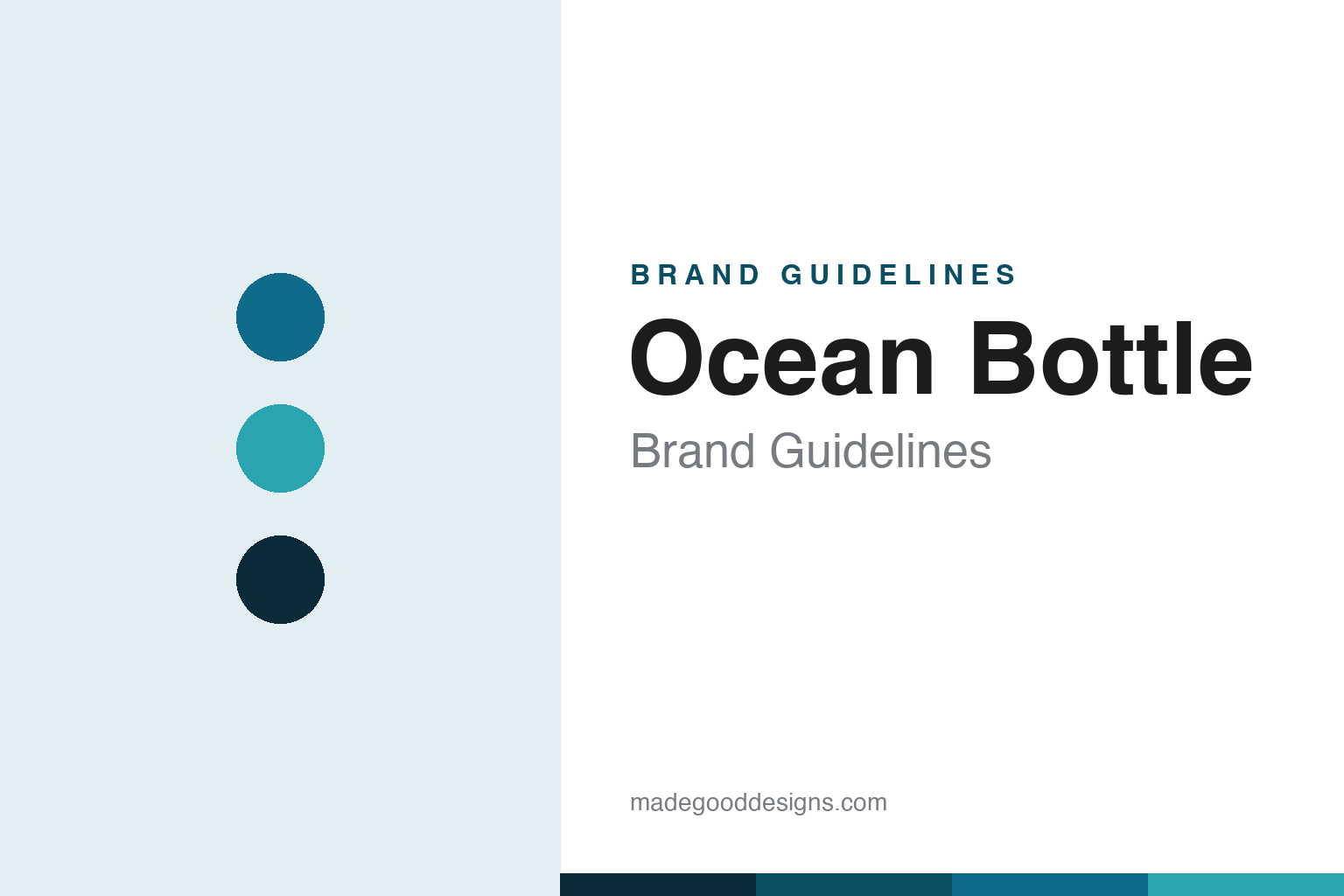
Ocean Bottle Brand Guidelines
A bottle with a mission — every sale funds ocean-bound plastic collection, wrapped in modern, purposeful design.
Aa
Two constants: a purposeful ocean-blue-and-teal palette and a clean, modern sans. Abstract homage — not the Ocean Bottle wordmark.
A bottle with a mission
Ocean Bottle funds plastic collection.
Ocean Bottle is a lesson in building the mission into the product. It was founded by Nick Doman and Will Pearson (both born in 1994 — a young founding team) in London; the company was incorporated in 2018 and publicly launched around 2019 (so “founded 2018, launched 2019” is the honest framing). The core idea isn’t a feature of the bottle — it’s a social mission tied to every sale: buying an Ocean Bottle funds the collection of ocean-bound plastic. (Two honest notes: the impact claim must be quoted precisely, and no official brand hex or typeface is published.)
The impact claim, in the brand’s own words: “Every bottle or flask we sell funds the equivalent removal of 1,000 ocean-bound plastic bottles, in weight. This equates to 11.4 kg.” Precision matters here — it’s 1,000 plastic bottles in weight (about 11.4 kg), not 1,000 physical bottles retrieved, and always attributed to Ocean Bottle. The mechanism: collection is funded through partners and local coastal collectors who are paid a fair income for gathering low-value, hard-to-recycle ocean-bound plastic near coastlines (the brand currently names partners including CleanHub). It’s a plastic-for-income model that turns each purchase into measurable action.
The bottle itself carries the story: made with a minimum of 67% recycled materials (including recycled stainless steel and ocean-bound plastic sourced from the Philippines), with a modular dual-lid design, fully disassemblable for recycling and backed by a long warranty. It was developed with the studio K8 in Oslo and is a certified B Corp (citing a B Impact score of 107.6, well above the 80-point bar). A major channel is corporate and branded gifting — companies buy custom Ocean Bottles as sustainable merchandise. The identity is modern and purposeful, with an ocean-blue palette and the tagline “The World’s Most Needed Reusable Water Bottle.” A bottle with a mission.
Colour
Ocean Bottle lives in ocean blues and teals. Click a swatch to copy the hex.
Ocean Bottle’s identity reads through ocean blues, teals and clean white — a purposeful, on-theme palette that literally evokes the sea it exists to protect. The colours feel modern, calm and mission-led, fitting a brand whose whole reason to exist is funding ocean-bound plastic collection; they signal environmental purpose and trust rather than fashion novelty. It’s a clean, contemporary scheme that keeps the focus on the impact story and the recycled-material product. The honest caveat: Ocean Bottle publishes no official brand hex, so the ocean-blue and teal here are an original, unofficial interpretation, not first-party values.
The lesson is an on-theme palette can reinforce a mission. Ocean Bottle’s blue-and-teal world literally looks like its cause. For designers, it’s a reminder that colour can make a brand’s purpose immediately legible. The takeaways: match the palette to the mission (ocean blues for an ocean cause); keep it clean and modern so the impact story leads; and treat specific hexes as unofficial when no brand spec is published.
Typography
The wordmark is a clean, modern sans — purposeful and contemporary.
Ocean Bottle’s identity carries a clean, modern, purposeful spirit — a contemporary sans-serif wordmark whose even letterforms read as trustworthy, mission-led and current. The clean type matches a social-impact brand built on a clear, measurable promise, and the restraint keeps the focus on the cause and the recycled-material product. Set against an ocean-blue-and-teal palette, the type feels purposeful and modern — exactly the credible, mission-driven personality Ocean Bottle cultivates. It’s clean and contemporary rather than rugged or ornate, mirroring the purposeful product. Because the exact wordmark face isn’t publicly documented, the honest description is “a clean modern sans spirit,” not a named font. The type behaves like the brand: purposeful, modern and credible.
Aa
A clean modern sans spirit — purposeful and contemporary. (Specimen set in Space Grotesk, a clean modern sans in the spirit of the Ocean Bottle identity; the real face is undocumented.)
Impact as the product
Ocean Bottle sells measurable impact.
Ocean Bottle is a lesson in making measurable impact the product. Plenty of brands claim to be “sustainable”; Ocean Bottle built its entire proposition around a specific, quantified promise — every bottle funds the collection of 1,000 ocean-bound plastic bottles in weight (about 11.4 kg) — delivered through a real mechanism (paying coastal collectors to gather plastic). That precision is the differentiator: it turns a vague good intention into a concrete, attributable outcome a buyer can point to, which is exactly why the brand thrives in corporate gifting, where companies want quantifiable ESG impact from their merchandise. The product reinforces the story (recycled steel and ocean-bound plastic, B Corp certification, a 107.6 impact score), so the object and the mission are one. The honest discipline is in the wording — “in weight,” “equivalent,” always attributed — because an impact brand lives or dies on the credibility of its claims. It’s proof that a specific, measurable mission, built into the product and stated precisely, can be a genuine differentiator and business model. Quantify the impact, and the mission becomes the product.
For designers and brand-builders, Ocean Bottle offers a clear takeaway: a specific, measurable mission can be the product itself. The lessons: quantify the impact precisely and attribute it honestly (1,000 bottles in weight ≈ 11.4 kg, via coastal collectors); back it with a matching product and credentials (recycled materials, B Corp, the 107.6 score); and find the channel that values it (corporate gifting). It’s also a reminder to keep the facts precise — Ocean Bottle was founded by Nick Doman and Will Pearson (incorporated 2018, London), funds ocean-bound plastic collection through partners including CleanHub, and is a certified B Corp. Ocean Bottle sells measurable impact — proof that a quantified mission can be the product.
Explore & save
Keep Ocean Bottle’s identity on hand — save it to a board in the Made Good inspiration library.
Ocean Bottle identity set
Pin the ocean-blue palette and the modern-sans spirit to your own board.