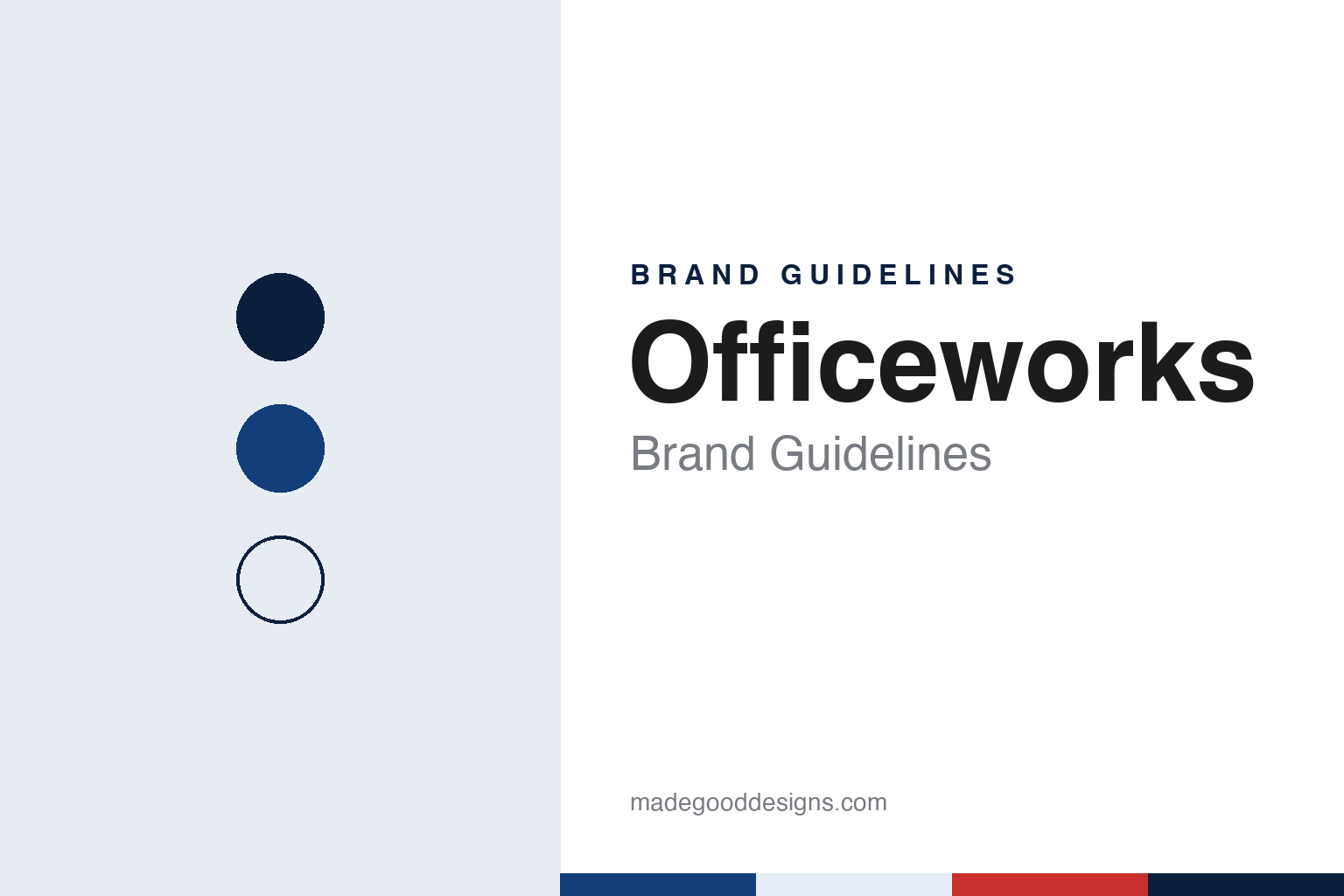
Officeworks Brand Guidelines
A 1994 Richmond store, Wesfarmers and a blue-and-red dash mark.
Aa
Two constants: an Officeworks deep blue and dash red palette and a Retail sans register. Abstract homage — not an Officeworks asset or mark; no logo, sign or product is reproduced.
Richmond, 1994
A Coles Myer chain built on a warehouse format.
Officeworks began as a chain inside one of Australia’s large retail groups. English Wikipedia says it was established in 1994 by Coles Myer, and that its store concept was modelled on the American chain Office Depot. The first store opened in the inner Melbourne suburb of Richmond on 16 June 1994; the Wesfarmers website, read in November 2026, also dates the opening of Officeworks’ doors to Richmond in 1994. Its head office is in Chadstone, in Melbourne’s south-east, English Wikipedia says.
The chain grew through the late 1990s and early 2000s. Coles Myer bought the computer retailer Harris Technology in 1999 and made it a subsidiary of Officeworks; in December 2002 it bought Viking Australia, a subsidiary of Office Depot, which was merged with Officeworks Direct and became the business-supplies arm later called Officeworks Business, according to English Wikipedia. The same source says the 100th store opened in late 2006 in South Yarra, a few kilometres from the original Richmond site.
Ownership changed in 2007. When Wesfarmers, the Perth conglomerate that also owns Bunnings, bought the Coles Group that year, it took over a set of retail businesses that ABC News listed in April 2014 as the Coles supermarkets, the department stores Target and Kmart, and Officeworks, which it called an office supply “category killer.” English Wikipedia says Officeworks and Harris Technology were placed in Wesfarmers’ home improvement and office supplies division.
The Bunnings connection ran through management too. The Sydney Morning Herald reported in April 2016 that the Officeworks managing director at the time had worked at Bunnings for almost 30 years before taking charge of Officeworks after the 2007 acquisition, and that, following Bunnings’ purchase of the British chain Homebase in February 2016, Officeworks was no longer part of the home improvement division and reported instead to Wesfarmers’ finance director.
Colour
Paper, technology and Print & Create.
Officeworks sells to households, students and small businesses as much as to offices. English Wikipedia describes its stores as aimed at the small office, the home office and families with children at school, and lists departments that include Print & Create — formerly Print, Copy & Create and Printworks — for printing, copying, laminating, photobooks, business cards and name badges, and Technology, once called Techworks, for computers, headphones and other electronics.
The range keeps widening. In April 2016 The Sydney Morning Herald reported that every year Officeworks had to find room for between 1,000 and 2,000 new products, from drones to 3D printing, in a network of about 160 stores. The same report described a spread from about 4,000 lines in its smallest store, a 200-square-metre site in central Sydney, to about 12,000 in its biggest, a 2,700-square-metre store at Browns Plains in Queensland, against an average store size of about 1,200 square metres. English Wikipedia records a “3D Experience” centre with printers and scanners at the Russell Street store in central Melbourne from June 2015.
Services have been added through purchases. English Wikipedia says Officeworks bought Geeks2U, a home technology support business, in 2019, and in February 2022 took a 21 per cent stake in World’s Biggest Garage Sale, a Brisbane organisation that repairs and resells unwanted goods. In December 2024 Inside Retail reported that Officeworks had acquired Box of Books, a digital education company used by more than 200 Australian schools for e-books, digital resources, textbooks and stationery, as part of its business-to-business growth.
As of November 2026, the Wesfarmers website described Officeworks as operating a network of 173 stores across Australia, a website of about 40,000 products and a national call centre, alongside Print & Create, Geeks2U and Box of Books. English Wikipedia’s state-by-state tally, dated June 2026, puts most of its stores in Victoria and New South Wales, with smaller networks in Queensland, Western Australia, South Australia, the ACT, Tasmania and the Northern Territory.
Typography
Retail identity in Australia and New Zealand.
Australian and New Zealand department, discount and specialty retailers present themselves first through the shop front. Many chains grew by buying older local stores and then putting their own name over the door, so a single fascia in a city mall or a regional town often carries several earlier businesses behind it. Myer, for example, renamed the Grace Bros stores of New South Wales in 2004, two decades after buying the chain. Store names are usually plain: a founder’s surname, a description of what is sold, or a short set of initials.
The calendar does much of the talking. Department stores mark Christmas with window displays, and in Melbourne the Myer windows on Bourke Street have been documented by State Library Victoria since their start in 1956. Discount and specialty chains lean instead on printed and online catalogues, seasonal sales with their own names and colour-coded sale signs, published on the companies’ own channels. Loyalty programmes, cards and apps carry the same name and colours as the stores.
Own-label ranges sit beside the brands a retailer stocks. Many groups sell products under house names, or own fashion and homewares labels that also trade as separate shops, and present them in their own sections of the store and website. A pattern, a single colour or a capitalised wordmark often does the work of recognition: David Jones adopted a black-and-white houndstooth in 1967 so that its packaging would not need the name.
Behind the fascias sit corporate pages. These usually give a founding story and name the founders, the parent group and, for listed companies, the exchange and investor pages with dated announcements. Changes of owner, administrations and store closures appear there and in the business press, which is often the clearest record of how a shop name has passed from one owner to the next.
Aa
A plain retail sans for a blue-and-red sign. (Specimen set in Figtree, a sans STAND-IN; NOT the Officeworks logo.)
Officeworks
Blue ground, red dashes.
The Officeworks identity has been redrawn more than once. English Wikipedia says the chain rebranded in 2008, revising its logo, staff uniforms and the names of its store departments, in a move that presented it as a low-cost warehouse in the manner of its sister company Bunnings.
The more recent change came in 2022. Mumbrella reported on 13 February 2022 that a television campaign called Start Something, made by the agency AJF, showed for the first time a refreshed logo that kept the blue background and red dashes of the old one, as part of a wider refresh of the brand across every channel. The report said stores at Chadstone, Box Hill and Cranbourne were among the first to carry the new logo, in what was then a 167-store network; Campaign Brief carried the same details, quoting Officeworks’ marketing head as saying that customers saw the chain as more than a destination for office supplies and back-to-school shopping.
On 8 March 2022 Mumbrella reported that the refreshed identity had been carried out by the design consultancy Principals, and that Officeworks linked it to changes in the way people work, learn, create and connect. English Wikipedia describes the result as a new lettermark, a darker blue and red dashed accents, introduced with a rebuilt smartphone app that lets customers check stock and prices and find the aisle a product sits in.
The constants are easy to read in that history: a blue field, a red accent drawn as a dash rather than a block, and a warehouse-scale store network named in plain words for what each department does. The brand sits in the Wesfarmers portfolio beside Bunnings and Kmart Australia, and its 2008 and 2022 changes both kept the chain recognisable while adjusting how it presented its range.
For a design guide, Officeworks shows how a retailer can refresh a mark several times while holding on to one colour pairing and one graphic device. Compare Wesfarmers, its Perth parent, and Bunnings, the sister chain whose warehouse format it followed. For this guide we use a deep blue, an ink blue and a dash red with a sans, an unofficial interpretation; no product or logo is reproduced.
Explore & save
Keep Officeworks’s identity on hand — save it to a board in the Made Good inspiration library.
Officeworks identity set
Pin the Officeworks deep blue and dash red palette and the Retail sans register to your own board.