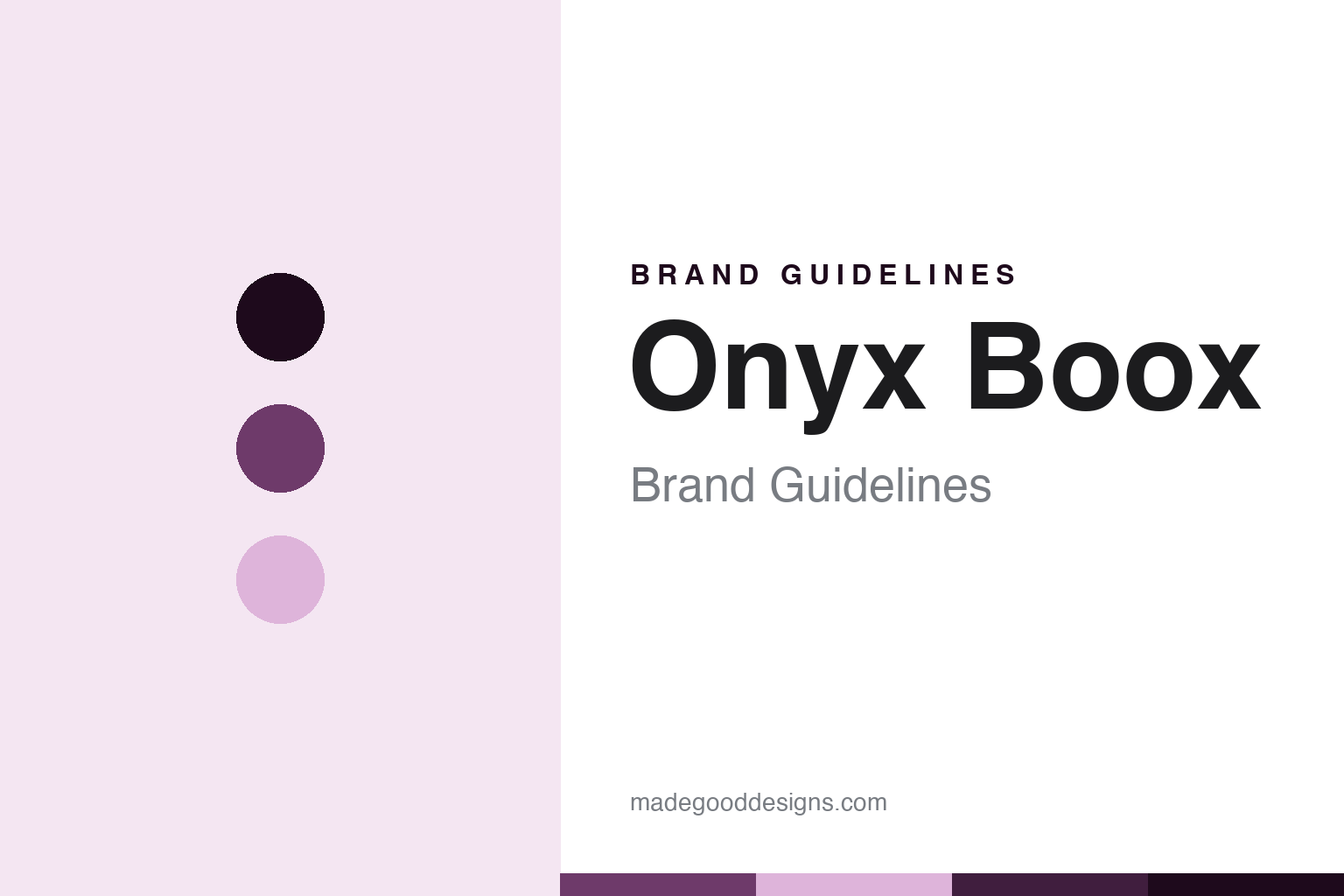
Onyx Boox Brand Guidelines
The open Android e-paper tablet.
Aa
Two constants: a prosumer-plum palette and a versatile-sans register. Abstract homage — not an Onyx Boox product or mark; no device, screen or logo is reproduced.
The open Android e-paper tablet
Onyx Boox is the Chinese maker whose Android e-paper devices run any app, from Kindle to Libby.
Onyx Boox brings the paper-like-screen round its versatile-open node — the brand that turned e-paper into a general-purpose device by running Android on it. Its maker is Onyx International, a Chinese company in Guangzhou, established in 2008. Onyx makes and sells the devices, under the BOOX brand, and its answer to a round about who owns these devices and how open they are is the most open of all: run any app you like.
Its identity is the open Android e-paper tablet. The Android openness, the wide range of devices and the install-anything versatility are the story here. A tablet, versatile. The open Android e-paper tablet.
(Honest notes, so the ownership, the range and the open-source criticism are framed accurately. Onyx sells the devices as its heroes — the Note series for writing, the larger Tab series, the compact Page, Leaf and Poke readers, and the phone-sized Palma — with colour models using E Ink Kaleido, and we report its language as the brand’s own. On ownership: Onyx International is a privately held Chinese company in Guangzhou, established in 2008, whose first e-reader shipped in 2009. On the differentiator, which is the whole point: since 2013 its devices run the Android operating system, with recent models offering the Google Play Store, so they install third-party apps — the Kindle app, Kobo, Libby, browsers and note tools — making them the versatile, open answer to the closed Kindle and Kobo. On where it is made: China. On a real criticism we note neutrally: because its devices use the Linux kernel under the GPL licence, Onyx has been criticised since around 2020 for declining to release its kernel source modifications on request, which critics call a licence violation; we state that plainly, without declaring a legal verdict. Its designs, the BOOX and Onyx names and the device-line names are IP we describe but do not reproduce; Kaleido and E Ink are third-party marks; there is no official brand hex; these tones are an unofficial interpretation.)
Colour
Onyx Boox lives in a prosumer plum. Click a swatch to copy the hex.
Onyx Boox’s identity is versatile, open and power-user — a prosumer plum, an ink, a pale mauve, a deep plum, and a paper. The palette leans prosumer plum and pale mauve: a distinctive, technical register that nods to a power-user device rather than a loud logo colour. It signals the open Android e-paper tablet — versatile, capable and unrestricted. The honest caveat: with no published brand hex, these values are an original, unofficial interpretation, not first-party colours.
The lesson is a prosumer plum signals a versatile, power-user identity. Onyx Boox’s world is an e-paper screen running whatever app you want. For designers, it is a reminder that a distinctive prosumer plum and a soft pale mauve can carry a device brand — a technical tone held as colour, not a product shot. Because these tones can fail as small text, keep type dark and let the colour live in the accents, palette and band. The takeaways: name Onyx International as the private Chinese maker; date it to 2008; lead with Android openness; note the GPL criticism neutrally; and keep BOOX and Onyx distinct.
Typography
The register is a versatile sans — versatile, capable, unrestricted.
Onyx Boox’s identity carries a versatile, capable, unrestricted spirit — a power-user device, not a locked appliance. A versatile sans captures the mood: clean, modern and confident, the register of an e-paper screen that behaves like a real computer. Set in a prosumer-plum palette, the versatile sans feels versatile and capable — exactly the personality Onyx Boox carries. It behaves like a made, engineered thing rather than a loud logo, mirroring an e-ink dot matrix and an app grid. (Onyx Boox’s real devices and the names are things we describe but do not reproduce, and the exact typeface is not ours to use.) Because it is not ours to use, the honest description is “a versatile-sans brand,” shown here in a stand-in. The type behaves like the brand: versatile, capable and unrestricted.
Aa
A versatile-sans brand — versatile and capable. (Specimen set in Manrope, a versatile-sans STAND-IN; NOT the Onyx Boox logo or any product.)
The paper-like screen
Onyx Boox stands for the open Android e-paper tablet.
Onyx Boox brings the round its versatile-open node. A prosumer-plum palette, a versatile sans and a 2008 founding make one thing — the open Android e-paper tablet — the whole identity: versatile, open and power-user. The Android openness is the pitch, and the install-anything versatility is the proof. The point is the brand that made e-paper a general-purpose device, in a round about who owns these devices and how open they are.
Put to work, the identity is the brand told straight, the openness led with and the criticism handled honestly. A maker in this spirit would name Onyx International as the private Chinese maker, date it to 2008, and lead with Android openness. A reader in this spirit would keep the facts right: Onyx Boox sells the Note, Tab, Palma and reader lines as its heroes; its maker is Onyx International, a private Chinese company from 2008; its devices run Android and install any app; it is made in China; and it faces a documented open-source-licence criticism. Onyx Boox sits third in the round, after Kobo. The honest editorial moves are to name Onyx International, to date it to 2008, to lead with Android openness, to note the GPL criticism neutrally, and to keep BOOX and Onyx distinct.
For designers and brand-builders, Onyx Boox continues the paper-like screen: make openness the whole capability — and note a real criticism neutrally. The lessons: turn a single-purpose screen into a general-purpose device; make “runs any app” the differentiator against closed rivals; note a documented licence criticism without a verdict; distinguish a product brand from its company; and never reproduce a logo. It is also a reminder to stay precise: Onyx Boox is the Chinese maker whose Android e-paper devices run any app, from Kindle to Libby — with the palette here an unofficial interpretation. The hook is that inversion: while Kindle and Kobo each lock you toward their own store, Onyx Boox puts Android on e-paper so you can install all of them at once — the Kindle app, Kobo, Libby, a browser — the most open device in the round, shadowed by an unresolved argument over releasing its kernel source. Read that way, Onyx Boox is less a reader than an open computer on e-paper: versatile, capable, unrestricted. The lesson for a brand is that openness and honest disclosure reinforce each other, and noting the criticism keeps the story earned. Onyx Boox made the-open-Android-e-paper-tablet the identity — proof that versatility carries a round.
Explore & save
Keep Onyx Boox’s identity on hand — save it to a board in the Made Good inspiration library.
Onyx Boox identity set
Pin the prosumer-plum palette and the versatile-sans register to your own board.