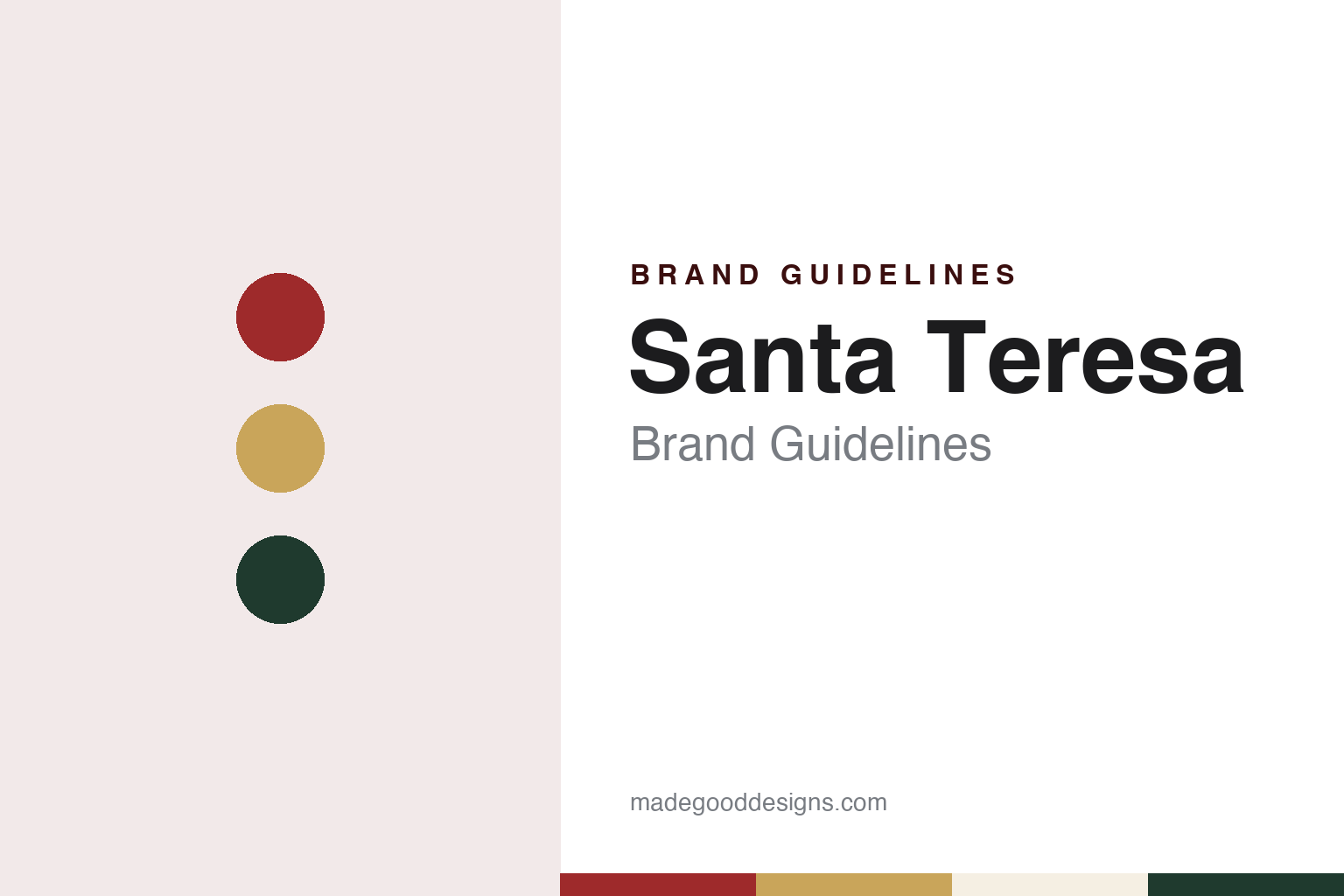
Santa Teresa Brand Guidelines
The Vollmer family rum from a 1796 hacienda in Aragua.
Aa
Two constants: a wax-seal red, rosette gold and cane-field green palette and a classical serif register. Abstract homage — not a Santa Teresa product or mark; no label, logo, seal or bottle is reproduced.
An estate in the Aragua valleys
A colonial hacienda, a family and the first registered rum brand.
Santa Teresa is made on a working estate. English Wikipedia says Hacienda Santa Teresa, in El Consejo in the Aragua valleys of northern Venezuela, was named in 1796 by Count Martín Tovar Ponte, later a signer of the country’s Act of Independence, in honour of its patron saint. Spanish Wikipedia says the estate distilled cane spirit in a simple still from its early years, and the company takes 1796 as its founding date.
The family that still runs it arrived through the independence wars. Spanish Wikipedia tells how Francisca “Panchita” Ribas, a niece of the patriot general José Félix Ribas, survived the fighting and later married Gustav Julius Vollmer, a German merchant who had come from Hamburg in 1826. Their son, Gustavo Julio Vollmer Ribas, and his wife Ana Gertrudis Boulton bought Hacienda Santa Teresa in 1885, the article says, and installed a copper still brought from Cologne to make rum on a larger scale. English Wikipedia, citing El Nacional in 2017, adds that production grew in the 1890s with the arrival of the Great Venezuela Railway nearby.
The name became a trademark in 1909. Spanish Wikipedia says the family registered Ron Santa Teresa that year as the first rum brand in Venezuela, and The Spirits Business described the company in 2017 as the country’s oldest rum producer and the first to register a rum brand there. The estate passed to Alberto Fernando Vollmer Boulton in the early twentieth century and, from 1947, to the brothers Gustavo and Alberto Vollmer Herrera, who modernised the distillery. Spanish Wikipedia says the company C.A. Ron Santa Teresa was formed in 1955 and launched Gran Reserva in 1958, which became its emblem; the premium Selecto followed in 1983. Spanish Wikipedia says the brothers Alberto and Henrique Vollmer, of the fifth generation, steered the company through a new financial crisis at the start of this century; Alberto C. Vollmer is now its president.
Colour
A solera, a cross, a rosette and a seal of wax.
The rum that carries the estate’s date is also its best-known bottle. To mark the hacienda’s bicentenary, Spanish Wikipedia says, the company released Santa Teresa 1796 in 1996, made by the solera method, the fractional blending of older and younger spirit long used for sherry and brandy, and which Spanish Wikipedia calls the first rum made entirely that way. The 1796 has collected trade recognition since: Spanish Wikipedia notes its listing among Wine Enthusiast’s top 100 spirits in 2018 and a gold medal at the Los Angeles International Spirits Competition in 2019.
The bottle itself was redrawn in 2019. The Venezuelan news site Analítica reported in June 2019 that the new 1796 presentation set the Cruz de Aragua, a landmark cross on the estate, into the back of the glass, and carried a new Hacienda Santa Teresa logo, the brand’s rosette with a longer ageing line, and a wax seal applied by hand so that each bottle differs slightly. The regional paper Notitarde had reported a new image for the wider range in June 2018.
The estate is part of the identity too. English Wikipedia says Hacienda Santa Teresa has offered guided tours since 1989, with a rum route that takes in the Tovar house, a rum museum, the cane fields, the Aragua cross, the distillery and the old railway station of El Consejo. The same places — the cross, the house and the cane — reappear on the 2019 bottle.
Typography
Design and documentation.
The seven brands in this group are all rum names: Planteray, Don Q, Pampero, Santa Teresa, Rhum Clément, Rhum J.M and Damoiseau. Rum brands in general sit at many different points in the trade, from family houses that still carry a founder’s name to labels that now belong to much larger drinks groups, and a single brand can be sold everywhere from a corner shop to a cocktail bar.
A rum brand’s identity is usually carried less by a single bottle than by a label, a name and the place it promises, because the company behind the name may have changed hands, moved its production or grown far beyond the place where it started. That makes the questions behind each name worth asking plainly: who started it, who owns it now, and where its rum is actually distilled, aged and bottled.
Each guide separates what independent sources record from what the company says about itself — its founding story, its owners over time, where its rum is made and how its labels have changed — and marks plainly what rests only on the company’s own word.
Aa
A classical serif for a colonial estate and a dated bottle. (Specimen set in Cormorant Garamond, a serif STAND-IN; NOT the Santa Teresa logo.)
Santa Teresa
A rugby project, a distribution deal and a family that kept control.
Santa Teresa is also known for a social programme. English Wikipedia, citing Mundo Deportivo in 2017, says Proyecto Alcatraz began in 2003 after an armed robbery at the estate in which a security guard was badly hurt. Instead of handing over a captured member of the gang, the company offered him three months of work on the hacienda; more members followed, and Alberto Vollmer added rugby training to the arrangement. The programme, run with the Fundación Santa Teresa, has since taken in more than two hundred participants, English Wikipedia says, and the Spanish paper El Debate reported on it again in May 2024.
Abroad, the rum travels with a partner. The Spirits Business reported on 10 January 2017 that Ron Santa Teresa had signed an exclusive international distribution agreement with Bacardi, covering every market outside Venezuela, while the privately owned company kept distribution at home. In August 2024 Bacardi’s travel-retail arm introduced a Santa Teresa Bicentenario rum to duty-free shoppers, GTR Magazine reported.
That partnership has prompted one recurring question. In September 2024 posts on social media claimed the Vollmer family had sold the company to Bacardi; the Venezuelan news site El Diario rated the claim false on 17 September 2024, quoting a company statement that Ron Santa Teresa was not for sale and describing Bacardi as its international distributor since 2017.
For a design guide, Santa Teresa shows how a date, a place and a few physical details — a cross, a rosette, a seal of wax — can carry a rum from one estate in Aragua to markets around the world. Compare Pampero, the Venezuelan rum that LexLatin places second to Santa Teresa in the market of 1954, and Flor de Caña, another family-run Latin American rum built around its estate. For this guide we use wax-seal red, rosette gold and cane-field green with a classical serif, an unofficial interpretation; no product or logo is reproduced.
Explore & save
Keep Santa Teresa’s identity on hand — save it to a board in the Made Good inspiration library.
Santa Teresa identity set
Pin the Santa Teresa wax-seal red, rosette gold and cane-field green palette and the classical serif register to your own board.