Savannah Bee Brand Guidelines
The honey house on a conservation mission.
Aa
Two constants: a honey-amber palette and a honey-sans register. Abstract homage — not a Savannah Bee product or mark.
The honey house on a conservation mission
Savannah Bee is Ted Dennard’s Georgia honey house of varietal honeys, built on a conservation mission.
Savannah Bee closes the good pantry with honey — the Georgia honey house, founded by the beekeeper Ted Dennard, that bottles varietal honeys and pairs them with a conservation and bee-education mission. Savannah Bee makes honey, and its answer to a round about the pantry is a beekeeper’s house with a cause: a range of varietal honeys, honeycomb and honey products, from a brand built around protecting bees. A brand, honey.
Its identity is the honey house on a conservation mission. Savannah Bee’s varietal honeys, its beekeeper founder and its bee mission are the story here. A brand, honey. The honey house on a conservation mission.
(Honest notes, so the story stays precise. Savannah Bee Company, at savannahbee.com, bottles varietal honeys, with Tupelo as its flagship, plus raw honeycomb, flavoured and hot honeys, and honey-based body care. It was founded by Ted Dennard, a beekeeper, who began selling Tupelo honey in the late nineteen-nineties and formally launched the company in 2002 in Savannah, Georgia, so we date it to 2002. On where it comes from, a theme of this round, it is a sourced and blended honey house, bottling honey from a network of beekeepers around the world, so we do not overclaim single-origin or say the honey is only from the brand’s own hives, and varietal names denote a floral source, not a single estate. On its mission, which we attribute to the brand, it is conservation and bee-education led, including a nonprofit, the Bee Cause Project, that grants hives to schools, framed as the brand’s own stated mission rather than audited impact. On ownership, it is independent and privately held, founder-led. On claims, its raw-honey and body-care wellness language is the brand’s own marketing, reported neutrally. Its name and packaging are IP we describe but do not reproduce; there is no official brand hex; these tones are an unofficial interpretation.)
Colour
Savannah Bee lives in a honey amber. Click a swatch to copy the hex.
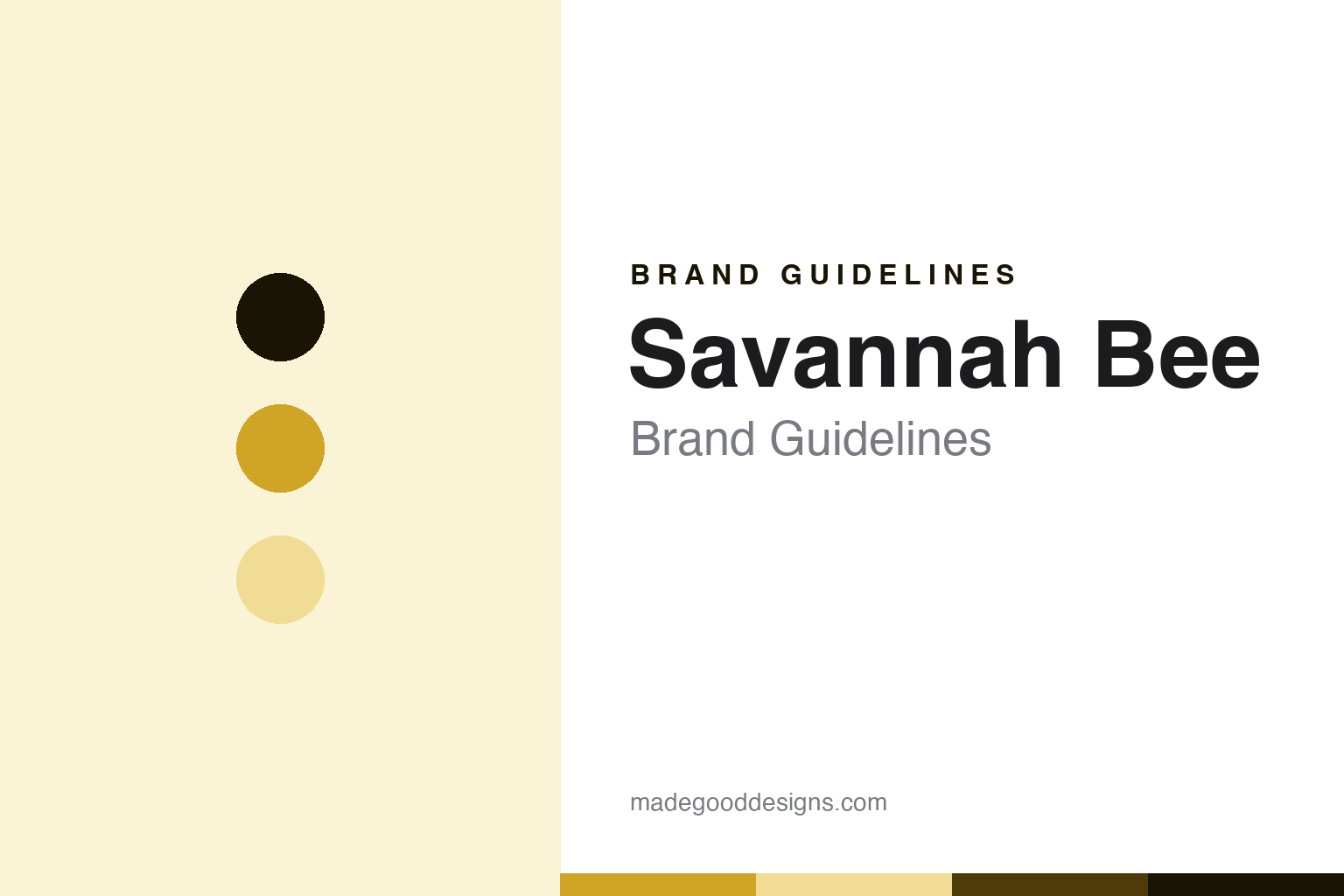
Savannah Bee’s identity is honey, warm and mission-led — a honey amber, an ink, a comb, a deep amber, and a paper. The palette leans honey amber and comb: a warm, golden register that nods to varietal honey and a honeycomb rather than a loud palette. It signals a honey house. The honest caveat: with no published brand hex, these values are an original, unofficial interpretation, not first-party colours.
The lesson is a honey amber signals a warm, mission-led identity. Savannah Bee’s world is a warm, made object. For designers, it is a reminder that a honey amber and a soft comb can carry a pantry brand — the tone of honey. Because these tones can fail as small text, keep type dark and let the colour live in the accents, palette and band. The takeaways: bottle varietals; pair a mission; be honest about sourcing; and treat any single hex as unofficial.
Typography
The register is a honey sans — warm, mission-led, plain.
Savannah Bee’s identity carries a warm, mission-led, plain spirit — a honey house, not a fashion. A honey sans captures the mood: clean, warm and confident, the register of a beekeeper’s brand. Set in a honey-amber palette, the honey sans feels warm and mission-led — exactly the personality Savannah Bee carries. It is a house rather than a logo, mirroring a comb and honey. (Savannah Bee’s real packaging is a thing we describe but do not reproduce, and the exact typeface is not ours to use.) Because it is not ours to use, the honest description is “a honey-sans pantry,” shown here in a stand-in. The type behaves like the brand: warm, mission-led and plain.
Aa
A honey-sans pantry — warm and mission-led. (Specimen set in Manrope, a honey-sans STAND-IN; NOT the Savannah Bee logo.)
The good pantry
Savannah Bee stands for the honey house on a conservation mission.
Savannah Bee closes the good pantry with honey. A honey-amber palette, a honey sans and a bee mission make one thing — the honey house on a conservation mission — the whole identity: honey, warm and mission-led. The varietal honeys are the substance, and the conservation cause is the meaning. The point is a beekeeper’s house of varietal honeys, built around protecting bees.
Put to work, the identity is a honey house told straight, as design. A maker in this spirit would bottle varietals, pair a mission, and be honest about sourcing. A reader in this spirit would keep the facts right: Savannah Bee bottles varietal honeys, Tupelo above all, plus honeycomb, flavoured honeys and body care; it was founded by the beekeeper Ted Dennard, formally in 2002, in Savannah, Georgia; it is a sourced and blended house, bottling honey from beekeepers worldwide, not a single-origin producer; and its Bee Cause conservation mission is the brand’s own. Savannah Bee closes the round as the honey entry in the pantry, and its founder-led, mission-driven story sits with the others. The honest editorial moves are to date it to 2002, to say sourced-and-blended not single-origin, to attribute the conservation mission, and to report wellness claims neutrally. The lesson Savannah Bee teaches is that a honey house with a cause can be a whole identity, and being honest about sourcing keeps it credible.
For designers and brand-builders, Savannah Bee closes the good pantry: bottle varietals — and be honest about sourcing. The lessons: build a house around varietal honeys; pair a product with a genuine mission; say sourced-and-blended when that is the model, not single-origin; report wellness claims as your own marketing; and never reproduce packaging. It is also a reminder to stay precise: Savannah Bee is Ted Dennard’s Georgia honey house of varietal honeys, built on a conservation mission — with the palette here an unofficial interpretation. Read that way, Savannah Bee is less a jar than a house: a honey house with a cause, closing the round on the sweet shelf. The lesson for a brand is that a house and honest sourcing reinforce each other, and saying sourced-and-blended keeps the story earned. Savannah Bee made the-honey-house-on-a-conservation-mission the identity — proof that a mission can close a round.
Explore & save
Keep Savannah Bee’s identity on hand — save it to a board in the Made Good inspiration library.
Savannah Bee identity set
Pin the honey-amber palette and the honey-sans register to your own board.