Sharjah Architecture Triennial Brand Guidelines
An architecture triennial that made a reused school its permanent home.
Aa
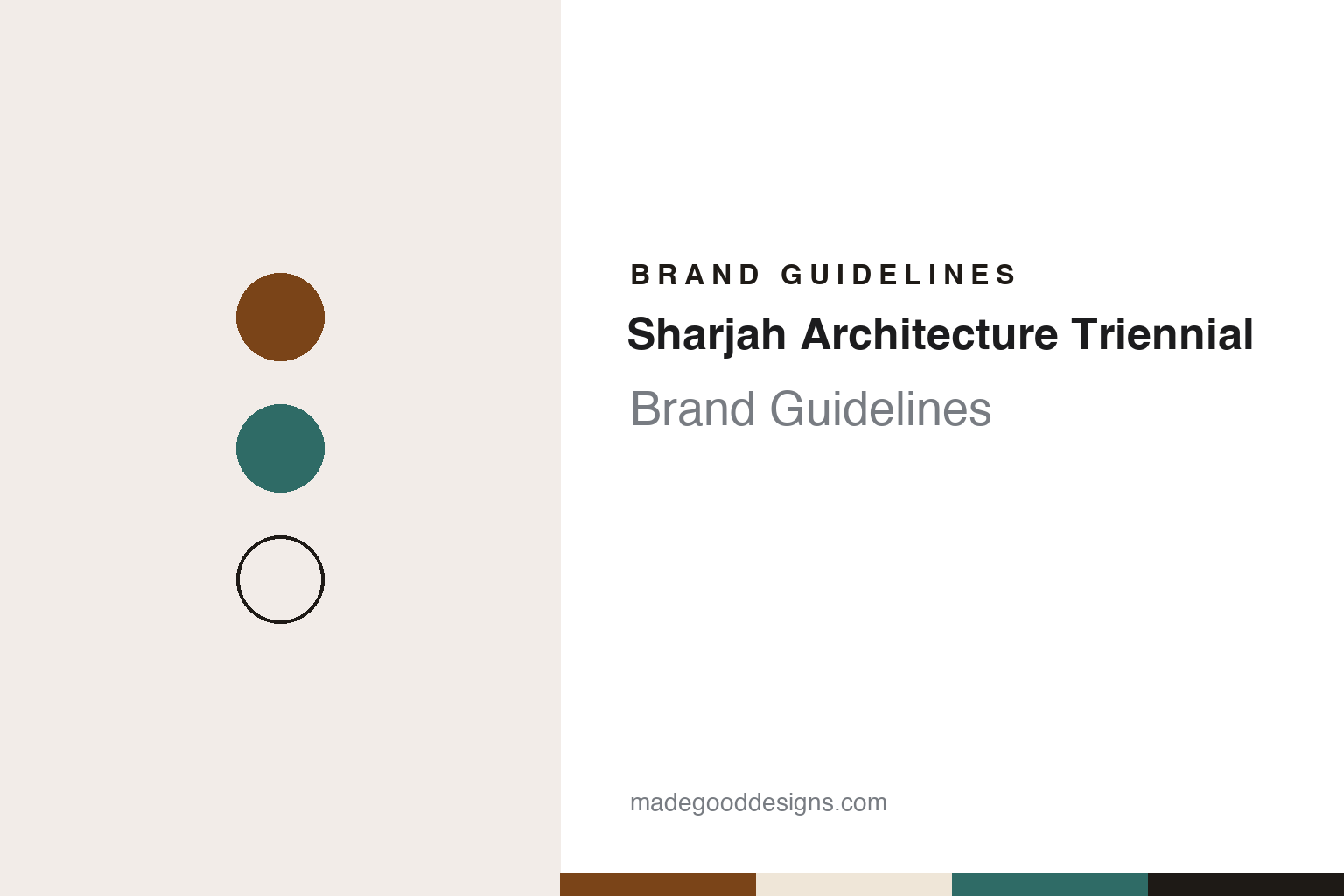
Two constants: a Sharjah Architecture Triennial ochre, plaster and teal palette and a Warm serif register. Abstract homage — not a Sharjah Architecture Triennial asset or mark; no logo, poster or installation is reproduced.
Rights of Future Generations
A triennial announced in 2018.
The Sharjah Architecture Triennial is an exhibition and public programme about architecture and urbanism, held in the emirate of Sharjah, in the United Arab Emirates. It was announced in May 2018. The National reported on 10 May 2018 that the new triennial had named the curator of its inaugural edition, to be held in November 2019, and that the initiative was led by the chairman of the Sharjah Urban Planning Council. Wallpaper* later wrote that the triennial’s founder had set up that council in 2014.
The format was described from the start. As the name implies, The National wrote, the triennial would hold an exhibition and a series of events every three years, alongside an ongoing programme of public events bringing together architects, public institutions, urbanists and the public. The paper reported that the model was the Sharjah Art Foundation, which had grown from a biennial event into a biennial complemented by exhibitions and events for the public in the UAE; an adviser to the triennial called the foundation “a sister programme.” The two are separate events: the Sharjah Biennial is the foundation’s art exhibition, while the triennial is devoted to architecture and the city.
Details of the first edition were presented at a launch event at the Venice Architecture Biennale at the end of May 2018, Dezeen reported on 4 June 2018. Its title was Rights of Future Generations, and it was curated by the dean of the School of Architecture at the Royal College of Art in London. Dezeen wrote that the three-month edition would look at architecture in North and East Africa, the Middle East and South Asia, and that it would set collective entitlements, such as rights to natural resources and a benign environment, beside individual rights such as education and housing.
Colour
Two reused buildings.
The first triennial ran from 9 November 2019 to 8 February 2020, with an opening weekend of performances, forums and summits from 9 to 11 November, according to the triennial’s announcement of June 2019. It named two recently decommissioned public buildings as its main venues. The first, the Al Qasimiyah School, is based on a mid-1970s federal design for an elementary school; the triennial says twenty-six such schools were built across Sharjah City and in the towns of Dibba Al-Hisn, Khor Fakkan and Kalba. Renovated for the occasion, the school became the triennial’s permanent headquarters, with a library, a café and exhibition spaces, the announcement says.
The second venue was the old Al Jubail Vegetable Market, a curved arcade built in the early 1980s beside the city’s central bus station and decommissioned when a new market opened in 2015. The triennial presented both choices as a commitment to adaptive reuse, working with existing structures in the city rather than starting from a blank slate. Wallpaper*, reviewing the edition, described a programme built around how present decisions about urban development have long-term consequences for the generations that follow.
The second edition opened in November 2023. Titled The Beauty of Impermanence: An Architecture of Adaptability, it was curated by the Nigerian architect Tosin Oshinowo and, Dezeen reported on 10 November 2023, focused on strategies of reuse and re-appropriation often driven by scarcity in the Global South. Oshinowo told the magazine that around 30 per cent of the participants came from Africa, 30 per cent from South America and 15 per cent from the Gulf region.
In a round-up published on 16 November 2023, Dezeen counted 29 contributors and noted that the curator had commissioned many full-scale works of architecture rather than pinned-up drawings; she told the magazine that the exhibition included installations, films and built projects about experience. One of the new structures, a canopy made from former telegraph poles, shaded the restaurant inside the Al Qasimiyah School, which remained one of the main venues, on the same site as an installation from the first edition.
Typography
Design and documentation.
Architecture biennials, triennials, festivals and open-house events usually take their names from the city that holds them. Most combine the place with words such as architecture, urbanism, biennale, triennial, festival or open house, and many are shortened to an acronym or a few initials, so that the name works as a date in the calendar as much as a title.
The bodies behind them vary. Some are hosted by city governments or public agencies acting in an institutional role; others are run by architecture centres, professional institutes, foundations, non-profit organisations or media and events companies. Several share an organiser with a permanent architecture centre or exhibition hall in the same city, and some work in partnership with a neighbouring city or a network of sister events abroad.
What they share is a programme spread across a city rather than gathered in one hall. Exhibition halls, reused industrial buildings, stations, plazas and parks hold curated exhibitions and installations, while talks, tours, workshops and, in open-house events, buildings opened to the public for a weekend or a week, often with volunteer guides, carry the programme into the streets. Biennials and triennials tend to work with a director or curatorial team and a yearly theme; festivals and open-house events often depend on many independent hosts.
Visual identity follows the same pattern. A steady name or wordmark carries from edition to edition, while each director or curator brings a new title, key visual and set of venues. This guide describes each event from its own first edition, using dated sources for organisers, venues, dates and themes, and sets an unofficial palette and type stand-in beside it; no logo or key visual is reproduced.
Aa
A warm serif — one name, a new title for each edition. (Specimen set in Fraunces, a serif STAND-IN; NOT the Sharjah Architecture Triennial logo.)
SAT03
Architecture Otherwise.
The third edition, known as SAT03, is curated by the anthropologist Vyjayanthi Rao, with an associate curator based in London and Cape Town. The curators were announced in May 2025, and on 1 July 2025 ArchDaily reported the theme, Architecture Otherwise: Building Civic Infrastructure for Collective Futures, to be explored through site-specific installations, exhibitions, performances, workshops and public programmes across the city and the wider emirate, with month-long residencies for selected participants. Dezeen reported on 2 July 2025 that Rao is a visiting professor at the Yale School of Architecture and that the two curators had worked together on an exhibition at the Lisbon Architecture Triennale in 2022. As with the two earlier editions, the magazine wrote, the focus is the Global South, in particular southern and western Asia and Africa, and the Al Qasimiyah School remains the triennial’s headquarters.
The triennial’s announcement of July 2026 gives the opening date of SAT03 as 14 November 2026 and lists 32 participants, whose practices span architecture, anthropology, urbanism, art, design and education. Its projects are presented through new installations, films, archives, workshops, performances and lectures spread across the city and the emirate.
The name itself is plain: the city, the discipline and the rhythm, shortened to SAT, with each edition numbered — SAT03 for the third. Each edition then carries a long title of its own, chosen by its curator: Rights of Future Generations, The Beauty of Impermanence and Architecture Otherwise. The sources used here describe themes, venues and curators rather than a logo or a house typeface, so the colours and type on this page are our own. Our palette is a choice of our own: a warm courtyard ochre, a pale plaster and a deep teal, with a near-black ink for text.
For a design guide, the Sharjah Architecture Triennial shows an event that keeps one steady name and one permanent home while each curator renames the edition. Compare Sharjah Biennial, the art exhibition of the foundation that The National named as the model, and Lisbon Architecture Triennale, where the third edition’s curators worked together in 2022. For this guide we use a warm ochre, a plaster white and a deep teal with a serif, an unofficial interpretation; no product or logo is reproduced.
Explore & save
Keep Sharjah Architecture Triennial’s identity on hand — save it to a board in the Made Good inspiration library.
Sharjah Architecture Triennial identity set
Pin the Sharjah Architecture Triennial ochre, plaster and teal palette and the Warm serif register to your own board.
Source & notes
Frequently Asked Questions
What font can I use to match the Sharjah Architecture Triennial look?
This guide describes Sharjah Architecture Triennial’s type as “A warm serif — one name, a new title for each edition”. Its type specimen is set in Fraunces from Google Fonts as a stand-in; Fraunces is not Sharjah Architecture Triennial’s own lettering.
What colours are in the Sharjah Architecture Triennial palette?
This guide’s Sharjah Architecture Triennial palette is Courtyard ochre #7A4418, Ink #1E1A16, Plaster #EFE6D8, Arcade teal #2F6B66 and Paper #FAF7F2. The tones are the guide’s own unofficial interpretation, not official Sharjah Architecture Triennial hex codes.
Where is Sharjah Architecture Triennial based?
Sharjah Architecture Triennial is based in Al Qasimiyah School.