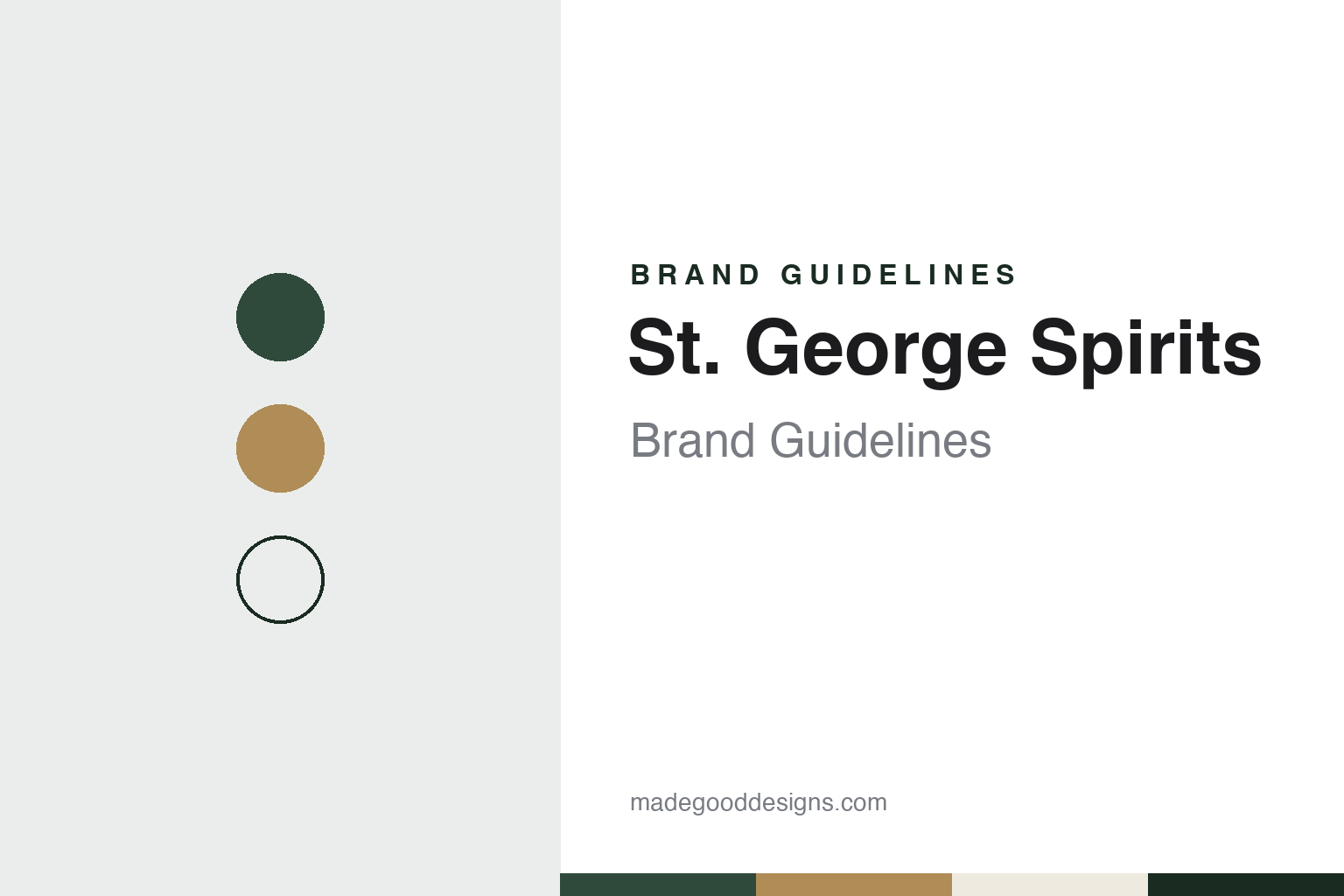
St. George Spirits Brand Guidelines
The Alameda hangar distillery founded by Jörg Rupf in 1982.
Aa
Two constants: a Douglas-fir green, brass and hangar white palette and a bookish serif register. Abstract homage — not a St. George Spirits product or mark; no label, logo or bottle is reproduced.
An eau-de-vie distillery
A German lawyer, California fruit and a Navy hangar.
St. George Spirits is a distillery in Alameda, California, on the eastern side of San Francisco Bay. It was founded in 1982 by Jörg Rupf as an eau-de-vie distillery, making clear, unaged fruit brandies, English Wikipedia records, citing the Fort Worth Weekly (2019). ABC7 in San Francisco reported in 2019 that Rupf was a German lawyer from the Black Forest, from a family of brewers and distillers, who had served as a magistrate in Bavaria before the fruit of Northern California drew him back to found the company. The Alameda Journal, marking the distillery’s 30th year in December 2012, noted that even the company could not pin down an exact founding date.
In 1996 Rupf hired Lance Winters, a brewer who, ABC7 reported, had served eight years in the Navy and brought a homemade whiskey with him as his résumé. The two began distilling single malt whiskey the following year, and the first was released in 2000, English Wikipedia says. Dave Smith, a former English teacher who had learned winemaking from his brother, joined in 2005, the company says, and became head distiller. When Rupf retired in 2010, Winters and Smith took over the company, ABC7 reported.
The building is part of the story. In 2004 St. George moved into a large former Navy hangar at the old Alameda Naval Air Station, English Wikipedia says; the Alameda Journal identified it in 2012 as Hangar 21, and ABC7 described it in 2019 as a 65,000-square-foot space, with views on clear days of the Bay Bridge, the Golden Gate Bridge and the San Francisco skyline. The 2012 profile listed what the hangar holds: custom copper stills, barrels, a tasting room and a laboratory.
Colour
Hangar One, absinthe and three gins.
The distillery’s best-known early creation is no longer its own. Hangar One vodka was created in 2001, with Rupf overseeing production and Ansley Coale of Craft Distillers handling design and marketing, English Wikipedia says, citing just-drinks (2006) and the San Francisco Business Times (2007). Proximo Spirits bought the brand in April 2010, Shanken News Daily reported, and St. George went on producing it in Alameda until 2014; Eater SF reported in May 2014 that the two were parting ways, and the vodka is now made at a separate Hangar 1 distillery in Alameda.
Absinthe gave St. George its next headline. After the United States effectively lifted its ban on the spirit in 2007, the distillery released Absinthe Verte, which the company calls the first legal American absinthe released after the ban. Selling absinthe had been illegal but distilling it had not, the company says, so it had been working on the spirit during the ban; English Wikipedia, citing The New York Times (2007), says the recipe had been in development for 11 years.
In September 2011 the distillery released three gins at once — Terroir, Botanivore and Dry Rye — the San Francisco Bay Guardian reported. Terroir was built around Bay Area foraging, and the company describes it as “a forest in your glass,” with Douglas fir, bay laurel and sage; Smith has recalled early tasters warning that it smelled and tasted like trees. Botanivore, the “botanical eater,” uses a long list of botanicals, and Dry Rye is made on a base of pot-distilled rye, a gin the company pitches at whiskey drinkers. Three vodkas followed in 2015, and in 2016 Bruto Americano, a California bitter in the Italian amaro style, English Wikipedia says.
Typography
Design and documentation.
The seven brands in this group are all craft whiskey, gin and tequila names: Tequila Ocho, Fortaleza, High West, Westland, Balcones, St. George Spirits and Empress 1908. Craft spirits brands in general sit at many different points in the trade, from small distilleries that still carry a founder’s name to labels that now belong to much larger drinks groups, and a single brand can be sold everywhere from a local bottle shop to a bar list far from home.
A craft spirits brand’s identity is usually carried less by a single bottle than by a label, a name and the place it promises, because the company behind the name may have changed hands, moved its production or grown far beyond the place where it started. That makes the questions behind each name worth asking plainly: who started it, who owns it now, and where its spirit is actually distilled and bottled.
Each guide separates what independent sources record from what the company says about itself — its founding story, its owners over time, where its spirit is made and how its labels have changed — and marks plainly what rests only on the company’s own word.
Aa
A bookish serif for a distillery that names its spirits after places and plants. (Specimen set in Fraunces, a serif STAND-IN; NOT the St. George Spirits logo.)
Run from the hangar
Two distillers who took over from the founder.
St. George is run by the people who make its spirits. The 2012 Alameda Journal profile described Winters as owner and master distiller. In April 2025, reporting that Skurnik Wines & Spirits would distribute St. George across California from 1 April 2025, Wine Industry Advisor listed Winters as president and master distiller and Smith as head distiller. The distillery’s reach goes well beyond California: by 2018 its spirits were sold in markets including Canada, the United Kingdom, France, Germany, Australia and Singapore, English Wikipedia says, with Maverick Drinks distributing in the UK since 2013. Smith told ABC7 in 2019 that the Bay Area’s produce and its cocktail and food scenes inspire the distillery’s spirits, and Winters said the team aims to make things that have not been done before.
The name invites confusion. St. George Spirits is unrelated to St George’s Distillery in Norfolk, England, the home of the English Whisky Company, which English Wikipedia explicitly distinguishes from it, and to the many other businesses named after the saint. Its own product names lean on place and plant rather than on the saint: Terroir, Botanivore, Dry Rye and Absinthe Verte.
For a design guide, St. George Spirits shows how a distillery can build an identity from its address and its ingredients: a Navy hangar on the bay, fruit brandy as a starting point, and gins named for the forest and for botanicals. Compare it with Balcones, another American craft distillery whose identity is tied to a building and a local grain, and The Botanist, the Islay gin built on foraged botanicals. For this guide we use Douglas-fir green, brass and hangar white with a serif, an unofficial interpretation; no product or logo is reproduced.
Explore & save
Keep St. George Spirits’s identity on hand — save it to a board in the Made Good inspiration library.
St. George Spirits identity set
Pin the St. George Spirits Douglas-fir green, brass and hangar white palette and the bookish serif register to your own board.


