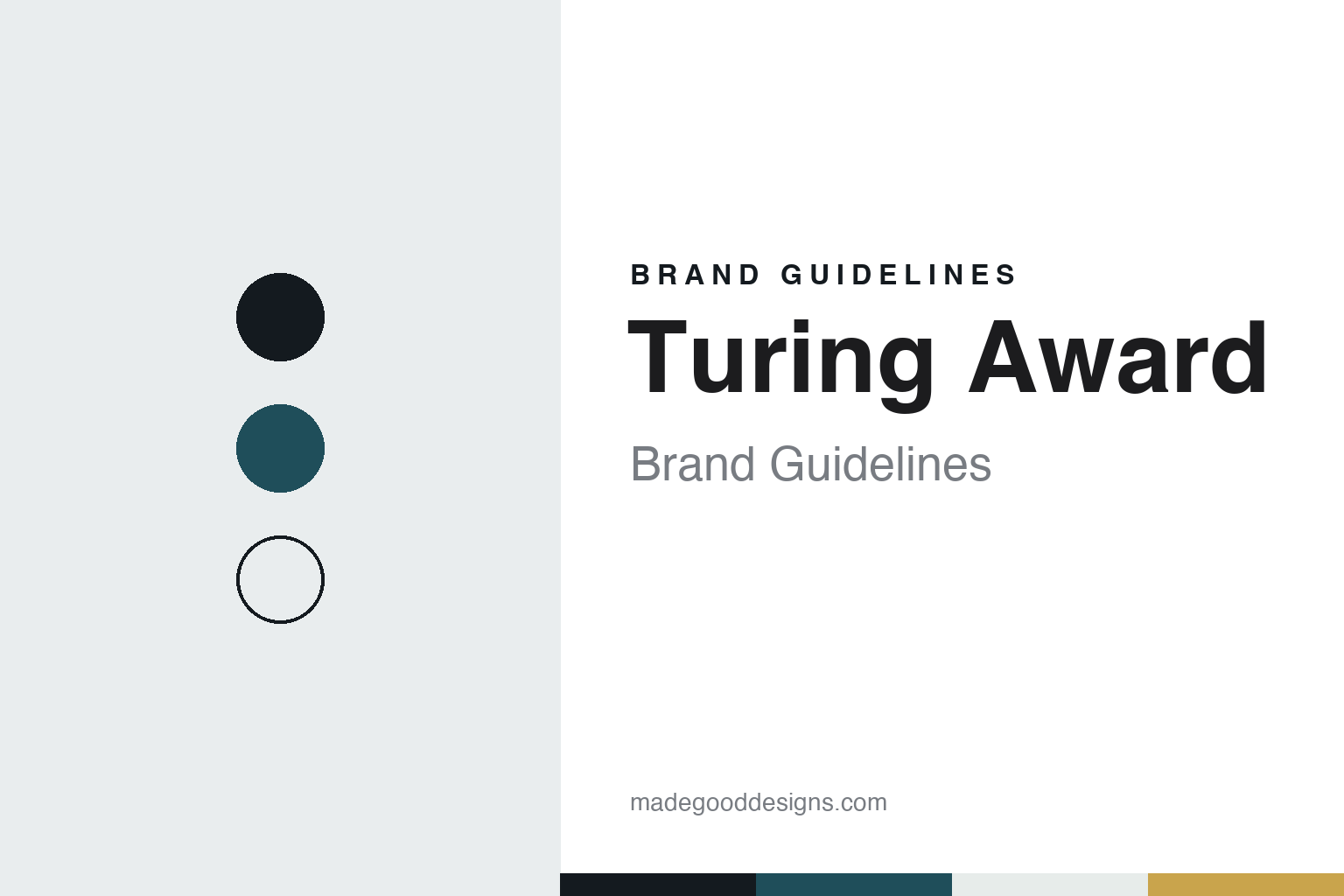
Turing Award Brand Guidelines
A learned society’s yearly computing prize, named for Alan Turing.
Aa
Two constants: an ink, teal and cream palette and a technical sans register. Abstract homage — not an ACM or Turing Award mark; no logo, trophy or certificate is reproduced.
ACM A.M. Turing Award
A learned society’s yearly prize.
The Turing Award is given by the Association for Computing Machinery, the international learned society for computing that English Wikipedia says was founded on 15 September 1947 and is headquartered in New York City. Its full name is the ACM A.M. Turing Award, and it is presented once a year for what English Wikipedia, following the association’s wording, calls “contributions of lasting and major technical importance to computer science.” A November 2014 report in The New York Times, quoted by the University of Washington’s computer science school, described the ACM as “the professional organization that administers the award.”
The award was first given in 1966, The Register reported in July 2007, and NBC News wrote in November 2014 that it was created that year “for major contributions of lasting import” to computing. It takes its name from Alan Turing, whom The Register described as a British mathematician and cryptographer; English Wikipedia adds that he was a reader in mathematics at the University of Manchester.
German Wikipedia sets out the process in general terms. Any individual may nominate a candidate, but a nomination must include the nominee’s curriculum vitae, a supporting statement of 200 to 500 words and at least three substantial letters of support from people in the field. Long-term influence is taken into account, though the nominee should have made an outstanding individual contribution, and the nominations are reviewed by a committee that usually includes several earlier recipients. The award is presented for the previous year.
Colour
Intel, then Google.
Sponsorship is the part of the award’s history that changed most. According to The Register in July 2007, the semiconductor maker Intel joined as a funder in 2002, and in July 2007 the ACM announced that Google had joined Intel in funding the award. English Wikipedia says that joint support from Intel and Google ran from 2007 to 2013.
In November 2014 the ACM announced a new funding arrangement under which Google would support the award on its own; NBC News reported the announcement, which was made on a Thursday, and English Wikipedia dates Google’s sole support to 2014 onward. In the New York Times report quoted by the University of Washington, Google’s vice president for engineering said the company hoped the change would give greater public prominence and recognition to the importance of computer science.
Through these changes the formal name stayed the same. In each of the reports cited here, the ACM is named as the body making the announcement and the companies are named as funders, and the title of the award, ACM A.M. Turing Award, carries the society’s initials and the namesake rather than a sponsor’s name.
Typography
How the prizes present themselves.
Science, mathematics and innovation prizes present themselves through a small set of recurring elements. The first is the name behind the prize. Most are run by an institution — an academy, a foundation, a learned society, a union of national bodies or a royal foundation — and many carry a namesake as well: a scientist, a mathematician or a benefactor whose name stands in the title, sometimes alongside the initials of the society that awards it.
The second is an object. Many of these prizes hand over a medal, a sculpture or a diploma, and some describe that object in detail: its metal, its size, the figure on its face and the words of its inscription. A medal designed once and struck again for each new round can become the most stable part of a prize’s identity.
The third is the structure. Prizes are divided into fields or categories, and candidates usually reach them through nomination by invitation or by named nominators rather than open entry. A selection committee or panel then decides, as each organiser describes it, and some keep the names of their committee members private until the announcement.
Finally there is the calendar. Each prize has its own rhythm — yearly, every two years or every four — with an announcement date and a ceremony in a named city, often in the same hall or at the same congress each time. This guide looks at how each prize sets out those elements: its organiser and namesake, its fields, its process, its object and its cycle.
Aa
A technical sans for a computing society’s prize. (Specimen set in IBM Plex Sans, a sans STAND-IN; NOT the ACM logo or any Turing Award lettering.)
The year
An announcement, then a June banquet.
The award follows a yearly rhythm in two steps, as German Wikipedia describes it: an announcement, then presentation at the annual ACM Awards Banquet. Reporting one such announcement in March 2018, The Stanford Daily wrote that a banquet would follow in San Francisco on 23 June, where the recipients would formally receive the prize.
Anniversaries have been marked in the same city. The University of California, Berkeley’s electrical engineering and computer sciences department reported that the Turing Award 50th Anniversary celebration was held at the Westin St. Francis in San Francisco on 23 and 24 June 2017, with panel discussions on deep neural networks, quantum computing and the end of Moore’s Law, led by faculty members and past recipients.
The centenary of Alan Turing’s birth was marked the same way. German Wikipedia says that in June 2012 recipients of the award met in San Francisco for the ACM Turing Centenary Celebration, with talks and panel discussions on themes such as information, data and security in a networked future. Beyond the banquet, German Wikipedia says recipients give a Turing Award Lecture at an ACM conference of their choosing, setting out their views and experience in central areas of computing.
English Wikipedia gives the association’s motto as “Advancing Computing as a Science & Profession,” and German Wikipedia describes the award as going to people who have made particular contributions to the development of computer science. Those two phrases set the tone the award speaks in: professional, technical and plainly worded.
Because no trophy or emblem is documented in the sources used here, the identity in this guide is carried by the name and by our own choices: a dark ink for text, a deep teal as the working accent, a pale cream for grounds and a small brass note for emphasis, set in a technical sans that suits a society for computing professionals. In use, the teal works for headings and rules, the ink for body text and the cream for large panels, while the brass should stay a small accent, for a date, a year or a single label, so that the page reads as a calm document rather than a stage set. A monospaced face for figures such as years and dates is a natural companion.
For a design guide, the Turing Award shows how a long-running prize can hold one name steady while its funders change around it. Compare Google, the award’s supporter since 2007 and sole funder since 2014, and the Fields Medal, the mathematicians’ medal from the International Mathematical Union. For this guide we use ink, a deep teal and a cream with a brass accent and a sans, an unofficial interpretation; no product or logo is reproduced.
Explore & save
Keep Turing Award’s identity on hand — save it to a board in the Made Good inspiration library.
Turing Award identity set
Pin the Turing Award ink, teal and cream palette and the technical sans register to your own board.
Source & notes
Frequently Asked Questions
What font can I use to match the Turing Award look?
This guide describes Turing Award’s type as “A technical sans for a computing society’s prize”. Its type specimen is set in IBM Plex Sans from Google Fonts as a stand-in; IBM Plex Sans is not Turing Award’s own lettering.
What colours are in the Turing Award palette?
This guide’s Turing Award palette is Terminal ink #141A1F, Deep teal #1F4E5A, Punch-card cream #E7ECEA, Brass #C9A44C and Paper #F7F8F6. The tones are the guide’s own unofficial interpretation, not official Turing Award hex codes.