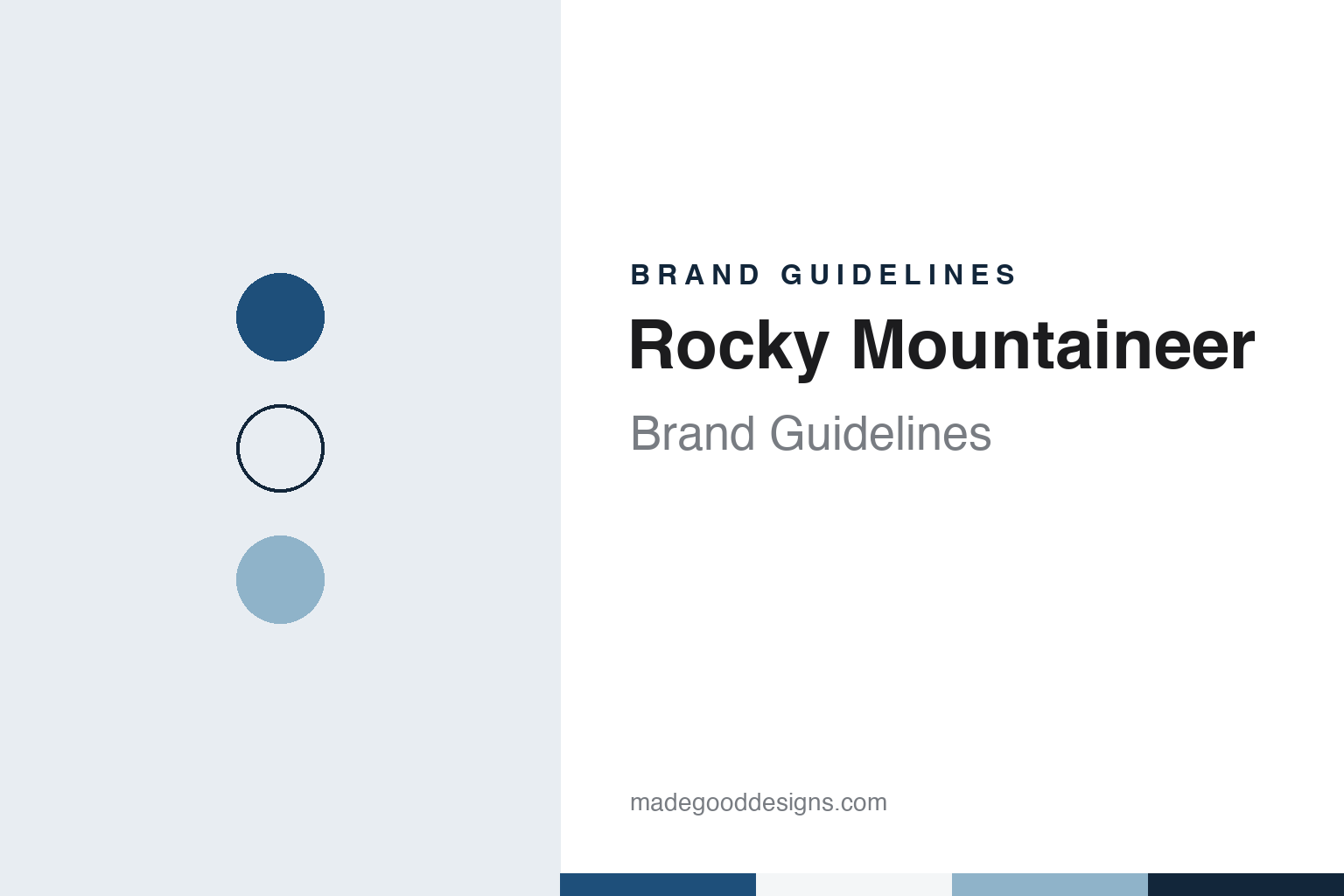
Rocky Mountaineer Brand Guidelines
The daylight rail-tour company of Vancouver.
Aa
Two constants: a blue and white palette and a plain sans register. Abstract homage — not a Rocky Mountaineer asset; no logo, goat emblem or carriage is reproduced.
A VIA train sold
From Canadian Rockies by Daylight to a private company.
Rocky Mountaineer started as a state railway idea. English Wikipedia says the concept came from Harry Holmes, a railway engineer, and Pat Crowley, a tourism entrepreneur, both of Jasper, who took a plan for an all-sightseeing train to VIA Rail before Expo 86 in Vancouver. VIA launched it in 1988 as Canadian Rockies by Daylight, a weekly train usually made up of an F40PH-2 locomotive and former Canadian National coaches, running from June to October, that left Vancouver in the morning, stopped overnight in Kamloops so passengers slept in a hotel, and went on to Banff over Canadian Pacific track or Jasper over Canadian National track, Railfan & Railroad reported in its December 2025 issue.
In 1989 VIA renamed the train Rocky Mountaineer, a nod to a Canadian Pacific daylight train called the Mountaineer that had ended in the 1960s, according to Railfan & Railroad. After federal funding for VIA was cut back, the government put the route up for sale; English Wikipedia says marketing began on 12 November 1989, with three bidders left in the final round.
The winner was Peter Armstrong, a Vancouver businessman who, Railfan & Railroad says, had held the contract to bus passengers to the train’s inaugural run in 1988. His company, Mountain Vistas Railtour Services, part of his Armstrong Hospitality Group, took over the route, the Rocky Mountaineer name, a dozen coaches and two baggage cars in spring 1990; English Wikipedia dates the sale to March and the magazine to April. The business was soon renamed the Great Canadian Railtour Company. Its first outing, a media train in late April 1990, ran with locomotives borrowed from VIA and with Armstrong and friends working as car hosts in rented tuxedos, the magazine reports.
Colour
A blue and white train with a goat on the nose.
The private service began on 27 May 1990, English Wikipedia says; Railfan & Railroad dates the inaugural weekly departures to 27 and 28 May. Two routes left Vancouver together and split at Kamloops: First Passage to the West to Banff and Calgary, and Journey Through the Clouds to Jasper. The magazine reports that the leased former Santa Fe B23-7 locomotives of the first years kept their previous owner’s colours for the opening season and were then repainted in a blue and white scheme with the company’s goat logo on the nose. When the magazine’s writer rode the train in Utah in 2025, it still appeared as a thin blue and white line against the red landscape.
The coaches define the product. English Wikipedia lists two service levels. GoldLeaf uses bi-level glass-dome coaches, 16 built by Colorado Railcar and ten by Stadler, with seating upstairs under wrap-over windows and a dining room on the lower level. SilverLeaf uses single-level dome coaches, 18 of them rebuilt from older coaches, with meals served at the seat. Trains run only in daylight, from April to October, and every journey includes hotel nights at the overnight stops, so the company sells no sleeping cabins.
The route map has changed over time. English Wikipedia lists a day trip to Whistler that ended after the 2015 season, a Coastal Passage from Seattle that ended after 2019, and Rainforest to Gold Rush, which ran from North Vancouver to Jasper with overnights in Whistler and Quesnel. Railfan & Railroad photographed that train in Cheakamus Canyon in August 2024.
Typography
Design and documentation.
Luxury, sleeper and scenic trains sell a journey rather than a seat, and their identities are built to match. A train’s name is often its strongest asset: some revive the names of older services, others are named after a route, a region or a landscape. Operators publish these names with crests, monograms and lettering that echo railway signwriting, and many give a train its own livery, so that the colour of the carriages becomes part of the brand. The Venice Simplon-Orient-Express, for example, runs in a blue-and-gold livery, National Geographic Traveller reported in 2018.
Inside, the identity moves into materials. Carriage interiors carry marquetry, glass, upholstery and fittings, and on trains that use restored rolling stock the pages on history and individual carriages, with their build years and builders, become a large part of what the operator publishes. Newer interiors are often credited to named designers, studios and craft workshops.
The printed and digital pieces around a journey do much of the remaining work. Menus, cabin cards, tickets, luggage labels and welcome letters repeat the same names and lettering; route maps and timetables show where a train runs, how many nights a journey takes and which stations it stops at; and dress codes, music and dining arrangements are described as part of the experience.
Behind the names sit owners and operators that change over time: state railways, regional railway companies, private operators and international hotel groups. This guide states those owners and operators plainly, with dates, and attributes descriptions of carriages, suites and routes to the operator or to a named, dated source. It does not cover fares, and it makes no record claims.
Aa
A plain, open sans for a daylight train. (Specimen set in Barlow, a sans STAND-IN; NOT the Rocky Mountaineer logo.)
Rocky Mountaineer
Into Colorado and Utah, then a new name there.
The company crossed the border in 2021. English Wikipedia says Rockies to the Red Rocks was announced in November 2020 and began on 15 August 2021, running on Union Pacific track between Denver and Moab with a night in Glenwood Springs. Railfan & Railroad rode it in August 2025 and described the run over the former Denver & Rio Grande Western, including the Cane Creek line near Moab, which the writer says had never before carried a regular passenger train. The magazine notes a red carpet embroidered with the Rocky Mountaineer name at boarding, two GP40-3 locomotives and on-board hosts giving commentary on the landscape.
In March 2025 the company announced that its American train would be rebranded Canyon Spirit, the Deseret News and KSL.com reported on 23 March 2025. The same report named Armstrong Collective as the parent company, with Tristan Armstrong as chief executive, and said the route would be extended to Salt Lake City over three days, with nights in Glenwood Springs and Moab. The Points Guy reported that the two-day Denver to Moab journey would continue and that coach and first-class services would be called Signature Experience and Premier Upgrade. English Wikipedia says Canyon Spirit took over the route on 21 April 2026 and sometimes still uses the Rockies to the Red Rocks name.
In Canada the company, owned by the Great Canadian Railtour Company and based in Vancouver, runs First Passage to the West, with a stop at Lake Louise, and Journey Through the Clouds, English Wikipedia says. The journeys are sold end to end, with Lake Louise the only intermediate stop where passengers may board or leave, and coach transfers link stations and hotels. In its December 2025 issue Railfan & Railroad put the operation, across two countries, at more than 100 pieces of rolling stock and more than 2,000 route miles.
For a design guide, Rocky Mountaineer shows how a tour train can build its identity on a simple livery, an animal emblem and named routes rather than on sleeping cars. Compare VIA Rail, which first ran the train, and the Glacier Express, another daylight panoramic train. For this guide we use a mountain blue, white and a pale glacier tone with a sans, an unofficial interpretation; no product or logo is reproduced.
Explore & save
Keep Rocky Mountaineer’s identity on hand — save it to a board in the Made Good inspiration library.
Rocky Mountaineer identity set
Pin the mountain blue and white palette and the plain sans register to your own board.
Source & notes
Frequently Asked Questions
What font can I use to match the Rocky Mountaineer look?
This guide describes Rocky Mountaineer’s type as “A plain, open sans for a daylight train”. Its type specimen is set in Barlow from Google Fonts as a stand-in; Barlow is not Rocky Mountaineer’s own lettering.
What colours are in the Rocky Mountaineer palette?
This guide’s Rocky Mountaineer palette is Mountain blue #1E4F7A, Slate ink #12263A, Glacier #8FB3C9, Snow white #F4F6F7 and Paper #F8F9FA. The tones are the guide’s own unofficial interpretation, not official Rocky Mountaineer hex codes.
Who founded Rocky Mountaineer?
Rocky Mountaineer was founded by Peter Armstrong. Rocky Mountaineer is known for GoldLeaf and SilverLeaf glass-dome coaches.