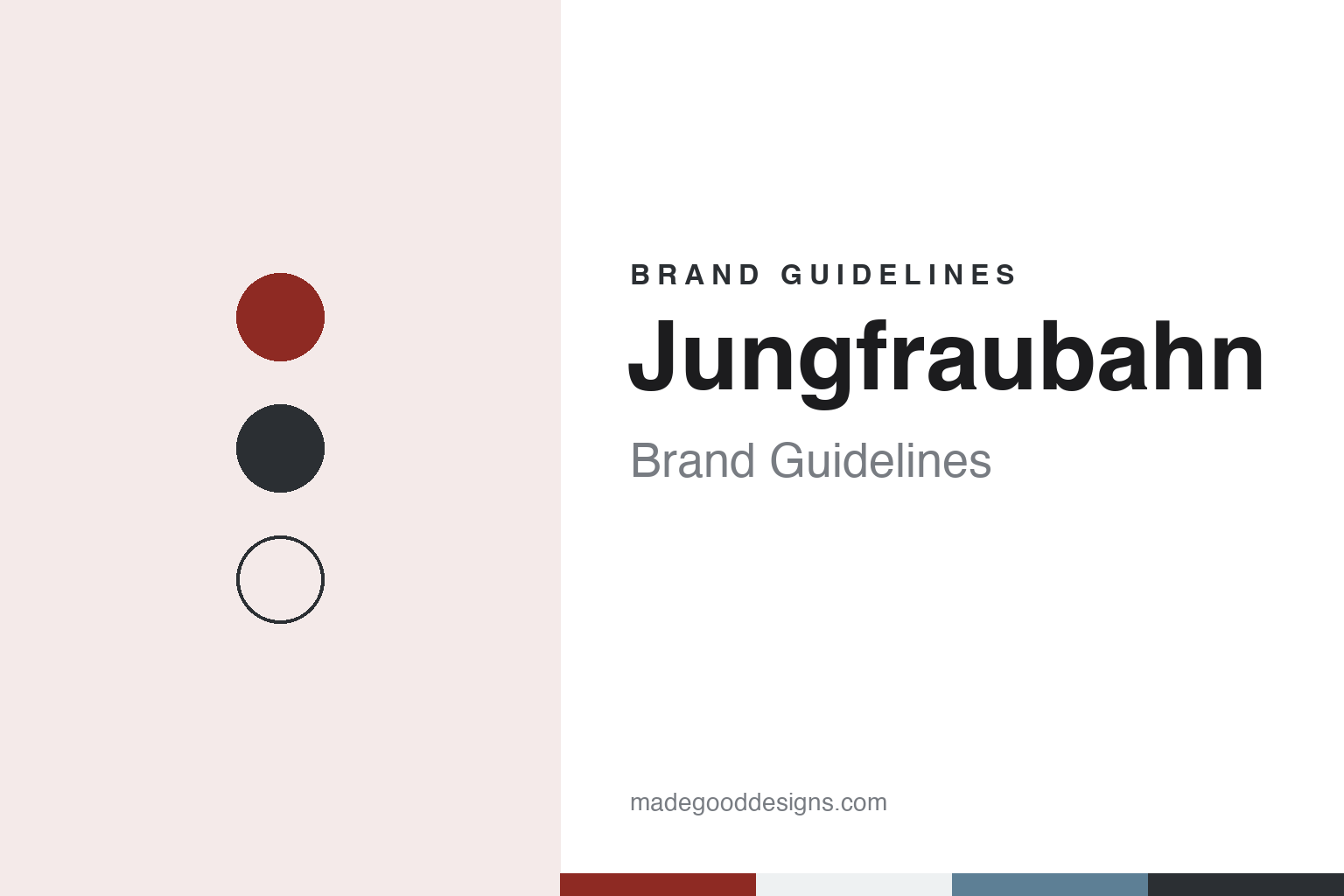
Jungfraubahn Brand Guidelines
The rack railway tunnelled through the Eiger to the Jungfraujoch.
Aa
Two constants: a railcar red, rock grey and glacier white palette and an Alpine sans register. Abstract homage — not a Jungfraubahn asset; no train, logo or sign is reproduced.
From Kleine Scheidegg
A concession of 1894 and sixteen years of tunnelling.
The Jungfraubahn, in English the Jungfrau Railway, is a metre-gauge rack railway in the Bernese Alps. It runs from Kleine Scheidegg, at 2,061 metres, to the Jungfraujoch, the saddle between the Mönch and the Jungfrau at 3,454 metres, and English Wikipedia gives its length as about 9.3 kilometres, with roughly four-fifths of the line inside tunnels cut through the Eiger and the Mönch. The railway takes its name from the Jungfrau itself, the 4,158-metre peak that was the original goal of the project.
The idea came from the industrialist Adolf Guyer-Zeller. German Wikipedia says he submitted his concession application on 20 December 1893, after watching a Wengernalpbahn train climb towards Kleine Scheidegg, and received the concession on 21 December 1894. Ground was broken on 27 July 1896. The open-air section to Eigergletscher went into service on 19 September 1898, according to German Wikipedia; National Geographic, in December 2020, likewise dated the railway’s opening to 1898.
The line then advanced in stages inside the mountain: to Rotstock in 1899, to Eigerwand, a station in the Eiger’s north face, on 28 June 1903, and to Eismeer on 25 July 1905, which served as the temporary terminus. The planners then settled on the Jungfraujoch, rather than the summit, as the end of the line. The breakthrough came on 21 February 1912, and the station at the Jungfraujoch was inaugurated on 1 August 1912, sixteen years after construction began.
Technically the railway chose its own path. German Wikipedia notes that although it meets the Wengernalpbahn at Kleine Scheidegg, it used a wider gauge, the Strub rack rather than the Riggenbach system, and electric power instead of steam. It still runs on three-phase current, collected through twin overhead wires and two pantographs on each train, with the rails as the third phase. Power comes from the company’s own hydroelectric plant at Lütschental, German Wikipedia says.
Colour
Red trains, panoramic windows and a summit complex.
The railway grew into a destination of its own. English Wikipedia lists the opening of the “house above the clouds” at the Jungfraujoch in 1924, a research station in 1931 and the Sphinx Observatory in 1937, the year a snowblower was bought and year-round operation began. The company moved its offices from Zürich to Interlaken in 1942. In 1951 the last adhesion section, between Eismeer and the Jungfraujoch, was converted to rack operation. Panoramic windows were installed at Eigerwand and Eismeer in 1972, a new mountain house opened on 1 August 1987 and a new station hall in 1991.
Passenger numbers rose steadily. German Wikipedia, citing Eisenbahn-Magazin in 2012, gives 77,000 passengers in 1912 and 765,000 in 2011. Der Spiegel, in a travel report published on 9 April 2012, gave the same 765,000 for the previous year and described “the red train” pausing for five minutes at Eigerwand, where three panoramic windows look out from the north face towards Grindelwald. It also noted that the Jungfraujoch is marketed as “Top of Europe”, a name the paper pointed out more strictly belongs to the higher Mont Blanc massif.
The rolling stock today is made up of twin-unit motor coaches. English Wikipedia says each train carries up to 230 people and that units delivered since 1992, numbered 211 to 224, use variable-speed drives rather than directly fed three-phase motors. With the timetable of 11 December 2016, German Wikipedia says, the railway introduced a half-hourly service, stopped serving Eigerwand and cut the ascent to 35 minutes; Eismeer remains the one intermediate viewing stop. Until the end of 2009 the railway also kept a sled-dog kennel at Eigergletscher. An earlier Rowan train with locomotive He 2/2 no. 1 is preserved at the Verkehrshaus, the Swiss Museum of Transport in Lucerne.
Typography
Mountain railways and their graphics.
Mountain railways, funiculars and cable cars present themselves through a small set of public materials: the line’s name, the operator’s logo and the livery of its cabins and railcars, all as the operators publish them. Many lines carry the name of a summit or a station rather than the name of the company, so a single identity often has to cover a railway, a cableway, a restaurant and a viewing platform at once.
Much of that identity is met on the ground. Valley and summit stations, platform signs, timetables, tickets and souvenir graphics repeat the same names and colours, and railcars and cabins often appear in the operator’s own photography against snow, rock and sky. Station names and altitudes are a recurring part of that signage, as the operators print them.
Engineering is a large part of the story these companies tell. Operators and the sources cited in each guide name the rack systems, rope systems, builders and cabin makers behind a line, and the dates on which sections opened, were rebuilt or received new rolling stock. Owners and operators are described plainly here: a listed holding company, a long-established local company or a subsidiary of a larger transport group, with dates taken from dated sources.
Each guide in this series sets out what can be checked about one line: when it opened, who runs it, which renewals and new sections have followed and how its name and graphics appear today. History pages and line-renewal announcements from the operators are cited as company statements, and independent reporting is named where it is used. The palettes and typefaces shown are unofficial interpretations, not the operators’ own.
Aa
A clear Alpine sans for summit signage. (Specimen set in Archivo, a sans STAND-IN; NOT the Jungfraubahn logo.)
Jungfraubahn
A railway inside a holding company and a regional alliance.
The line belongs to Jungfraubahn AG, a subsidiary of Jungfraubahn Holding AG of Interlaken. German Wikipedia says the holding company was founded in 1994 and its shares were listed on the Swiss stock exchange two years later. In 2022 its group included the Wengernalpbahn, the Firstbahn, the Lauterbrunnen–Mürren mountain railway and the Harderbahn, while Jungfraubahnen Management AG has acted since 2000 as operator for the group’s railways and for the Berner Oberland-Bahnen. In June 2025 Oliver Hammel became chief executive, succeeding Urs Kessler, German Wikipedia says. Through the holding company the railway is part of the “Jungfrau Top of Europe” marketing alliance with the separately owned Berner Oberland-Bahn and Schynige Platte-Bahn.
The latest change came from the valley. Jungfrau Railways said in May 2020 that its V-Cableway project, including the new Eiger Express tricable gondola and a terminal at Grindelwald Grund with public transport links, a car park and shops, would open on 5 December 2020. National Geographic, writing on 1 December 2020, said the Eiger Express had been in planning since December 2012, would carry visitors from Grindelwald to Eigergletscher in about 15 minutes and connect them directly with the final cogwheel section of the Jungfraubahn. The magazine also reported that a third of Grindelwald’s residents had raised objections before the project was approved. English Wikipedia confirms the cableway opened to the public on 5 December 2020.
For a design guide, Jungfraubahn shows how a railway’s identity can rest on a destination name, a train colour and a sequence of stations rather than on the trains alone. Compare Schilthorn, another Bernese Oberland summit reached by cable car, and Gornergrat Bahn, the rack railway above Zermatt. For this guide we use a railcar red, rock grey and glacier white with a sans, an unofficial interpretation; no product or logo is reproduced.
Explore & save
Keep Jungfraubahn’s identity on hand — save it to a board in the Made Good inspiration library.
Jungfraubahn identity set
Pin the Jungfraubahn railcar red, rock grey and glacier white palette and the Alpine sans register to your own board.
Source & notes
Frequently Asked Questions
What font can I use to match the Jungfraubahn look?
This guide describes Jungfraubahn’s type as “A clear Alpine sans for summit signage”. Its type specimen is set in Archivo from Google Fonts as a stand-in; Archivo is not Jungfraubahn’s own lettering.
What colours are in the Jungfraubahn palette?
This guide’s Jungfraubahn palette is Railcar red #8E2A23, Eiger rock #2B2F33, Glacier white #EEF1F2, Aletsch blue #5D7F95 and Snowfield #F8F9F9. The tones are the guide’s own unofficial interpretation, not official Jungfraubahn hex codes.
When did Jungfraubahn open?
Jungfraubahn opened on 1 August 1912, in Kleine Scheidegg to Jungfraujoch.
Who owns Jungfraubahn?
Jungfraubahn is owned by Jungfraubahn AG, part of Jungfraubahn Holding AG.