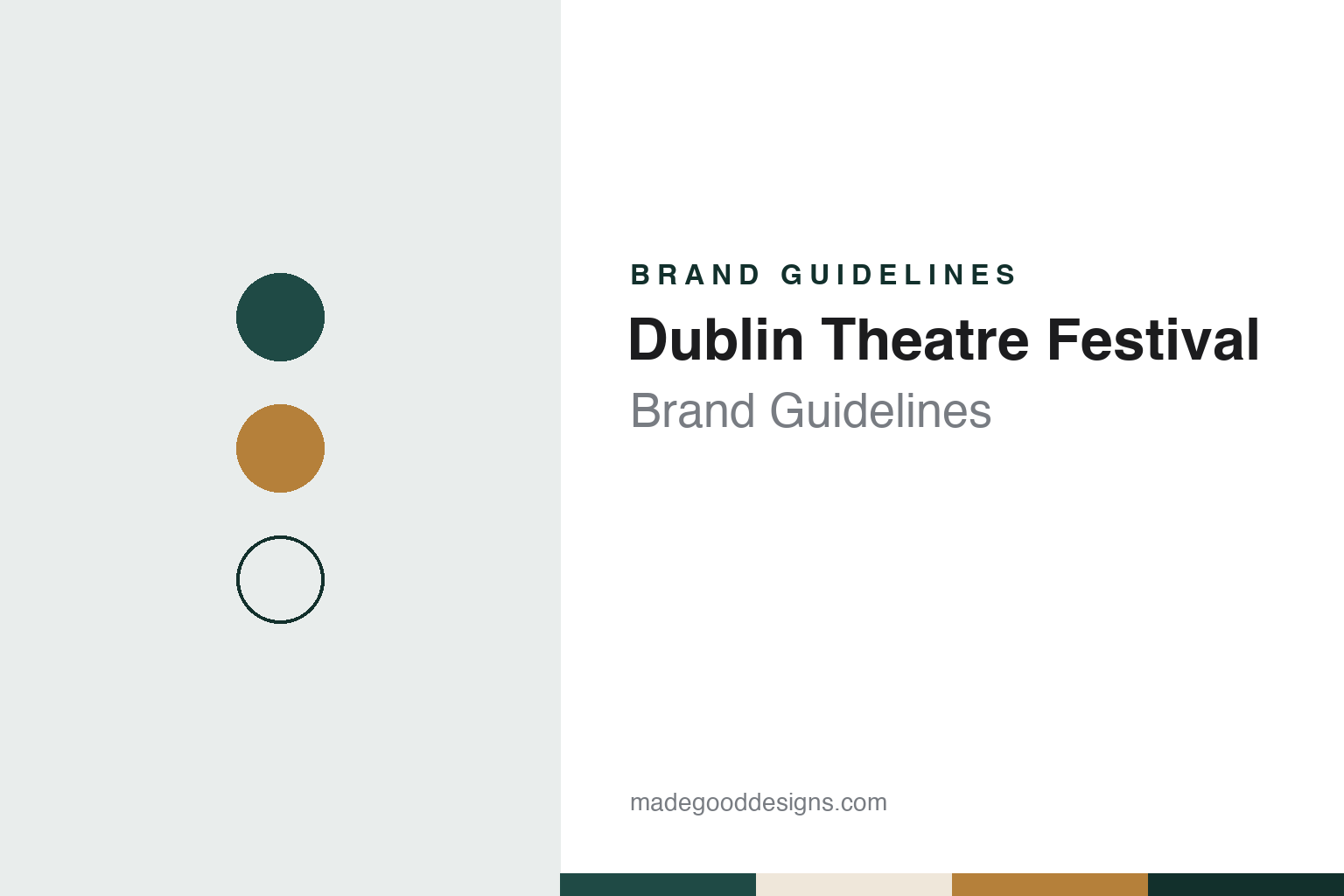
Dublin Theatre Festival Brand Guidelines
An autumn season of Irish and international theatre in Dublin, every year since 1957.
Aa
Two constants: a Liffey green, cream and ochre palette and a Playbill serif register. Abstract homage — not a Dublin Theatre Festival poster or mark; no logo or artwork is reproduced.
An autumn season
Brendan Smith’s festival, 1957.
Dublin Theatre Festival began in 1957. English Wikipedia credits its founding to Brendan Smith, a theatre producer who also ran the Olympia Theatre in Dublin and an acting academy under his own name. In the 1950s, it says, the Irish Tourist Board was interested in supporting events in the “shoulder months” either side of the summer season, and the first festival opened in May 1957. It has since become an autumn festival.
From the start it mixed two kinds of programme: international theatre brought to Dublin, set alongside Irish productions and new Irish plays. English Wikipedia notes that, unlike Edinburgh’s festivals, opera, music and dance have not been a major part of the programme; Dublin’s is a festival of theatre. It has, Wikipedia says, produced a season every autumn with the exception of two years.
The festival’s own website describes the organiser as Dublin Theatre Festival Company Limited by Guarantee, a company registered in Ireland, incorporated in July 1959, with charitable objects, trading under the festival’s name. It lists the Arts Council of Ireland as its principal funder. Smith led the festival until 1983, according to Wikipedia, and was followed by a line of directors through the 1980s, 1990s and 2000s.
Colour
Venues across the city.
The festival does not own a theatre. Each autumn it spreads across the city’s existing stages, and the venue list is part of how it presents itself. When The Irish Times reported the 2025 programme in July of that year, it listed productions at the Abbey Theatre, the Gate Theatre and the Gaiety, at Project Arts Centre and Smock Alley, at the Samuel Beckett Theatre and the O’Reilly Theatre, and further out at the Civic in Tallaght, Axis in Ballymun, Draíocht in Blanchardstown and the Pavilion in Dún Laoghaire. That edition ran from 25 September to 12 October, with 29 productions over 18 days and nights, the paper reported, and included a Theatre for Children programme curated by The Ark, Dublin’s cultural centre for children, and a new talks strand, Dublin Theatre Festival Thinks.
The size of the rooms matters. In 2012 The Irish Times described the Gaiety’s 1,000-seat auditorium as able to “make or break” the festival’s box office, and reported that the festival was taking a production into the 2,000-seat Bord Gáis Energy Theatre which it had not used before. The 2012 edition, the festival’s 55th year, ran from 27 September to 14 October with 30 productions, the paper said, under the tagline “Your city, your stories.”
Directors have shaped each era. Willie White was appointed artistic director and chief executive in 2011, after nine years as director of Project Arts Centre, two doors down the street from the festival’s office, The Irish Times reported in July 2012. The same article said the previous director’s five years had begun with an expanded programme for the 50th anniversary and had been supported in part by a title sponsorship with Ulster Bank, which had since ended; it credited that period with initiatives including a professional development programme, The Next Stage, public workshops called In Development, and ReViewed, a platform for revivals of Irish productions. Of White’s first programme of 30 shows, 10 were international, the paper noted. White ran the festival from 2012 to 2024, stepping down after thirteen years in the role, RTÉ reported in 2025.
In October 2024 The Irish Times reported that Róise Goan, who had headed Dublin Fringe Festival from 2008 to 2013 and was then artistic co-ordinator of the Viernulvier arts centre in Ghent, Belgium, would become artistic director and chief executive in February 2025. Her first festival opened on 25 September 2025, RTÉ reported, with productions across the city’s theatres. The Irish Times reported that her first programme brought companies from nine countries, among them Peru, France, Poland, Belgium, India and Spain, and added an access guide with information on accessible performances and travel to venues.
Typography
Design and documentation.
International arts and theatre festivals usually present themselves through a place and a season before anything else. Many take the simplest possible name, a city followed by the word “festival”; others add a season, a language or a coined word, and the open-access events that grow up beside them often borrow the word “fringe” or “Off”. The name tends to stay fixed for decades, while almost everything else about the festival changes from one edition to the next.
Behind most of these names sits a non-profit body rather than a company: an association, a foundation, a trust or a company limited by guarantee, often with a board on which a city, a region or a national arts body takes an institutional seat. A director or artistic director, appointed for a set term, shapes each programme, and the festival’s character can shift noticeably when that post changes hands.
The programmes themselves are usually spread across a city. Theatre, dance, music and visual art share the dates, and the venues range from established theatres and concert halls to courtyards, cloisters, chapels, quarries, warehouses and streets. Two models sit side by side. A curated festival invites every production it shows; an open-access fringe lets any company register and find its own venue, so the programme grows from the bottom up and the organiser mainly coordinates listings, ticketing and information.
Visually, this makes a festival identity unusually changeable. The fixed elements are often few: the name, the dates and sometimes a signature venue or ritual. Around them, a new programme, poster or campaign image is made for each edition, often commissioned from a visual artist or a design studio, so that the festival looks different every year while remaining recognisable by its place in the calendar and in the city.
Aa
A playbill serif — the voice of a printed theatre programme. (Specimen set in Fraunces, a serif STAND-IN; NOT the Dublin Theatre Festival logo.)
Dublin Theatre Festival
“Your city, your stories.”
The festival’s identity is tied to the city in its name. Its website describes the city of Dublin, its people and its stories, as the heart of the festival, and the 2012 tagline “Your city, your stories” said the same thing in four words. The festival also uses a short form, DTF, in its own copy and in press coverage; The Irish Times used it in 2025 when naming programme strands such as “DTF Thinks.”
Its calendar is fixed and recognisable: late September into the middle of October, about two and a half weeks. The festival’s website gives the 2026 edition as 24 September to 11 October 2026. Around that core, the website lists further strands — Theatre for Children, Festival+, artistic development work and audience engagement — and a Friends scheme with priority booking, which The Irish Times mentioned in 2012 and again in 2025.
Dublin Theatre Festival is also separate from Dublin Fringe Festival, a different organisation founded in 1995, according to a board biography on the festival’s website; the two share a city and, in Goan’s case, a former director, but not a programme.
For a design guide, Dublin Theatre Festival shows how an event without a building of its own can build an identity from a city, a season and a list of stages. Compare Edinburgh International Festival, which English Wikipedia sets beside Dublin’s when describing its programme, and Holland Festival, another European city festival of theatre and performance. For this guide we use a deep green, a cream and an ochre with a serif, an unofficial interpretation; no product or logo is reproduced.
Explore & save
Keep Dublin Theatre Festival’s identity on hand — save it to a board in the Made Good inspiration library.
Dublin Theatre Festival identity set
Pin the Dublin Theatre Festival green, cream and ochre palette and the Playbill serif register to your own board.
Source & notes
Frequently Asked Questions
What font can I use to match the Dublin Theatre Festival look?
This guide describes Dublin Theatre Festival’s type as “A playbill serif — the voice of a printed theatre programme”. Its type specimen is set in Fraunces from Google Fonts as a stand-in; Fraunces is not Dublin Theatre Festival’s own lettering.
What colours are in the Dublin Theatre Festival palette?
This guide’s Dublin Theatre Festival palette is Liffey green #1F4A45, Stage ink #12302C, Programme cream #EFE7DA, Footlight ochre #B5803A and Paper #F8F6F1. The tones are the guide’s own unofficial interpretation, not official Dublin Theatre Festival hex codes.
When was Dublin Theatre Festival founded?
Dublin Theatre Festival was founded in 1957, in Dublin, Ireland.
Who founded Dublin Theatre Festival?
Dublin Theatre Festival was founded by Brendan Smith in 1957.