Buenos Aires International Book Fair Brand Guidelines
From the author to the reader, at La Rural since 1975.
Aa
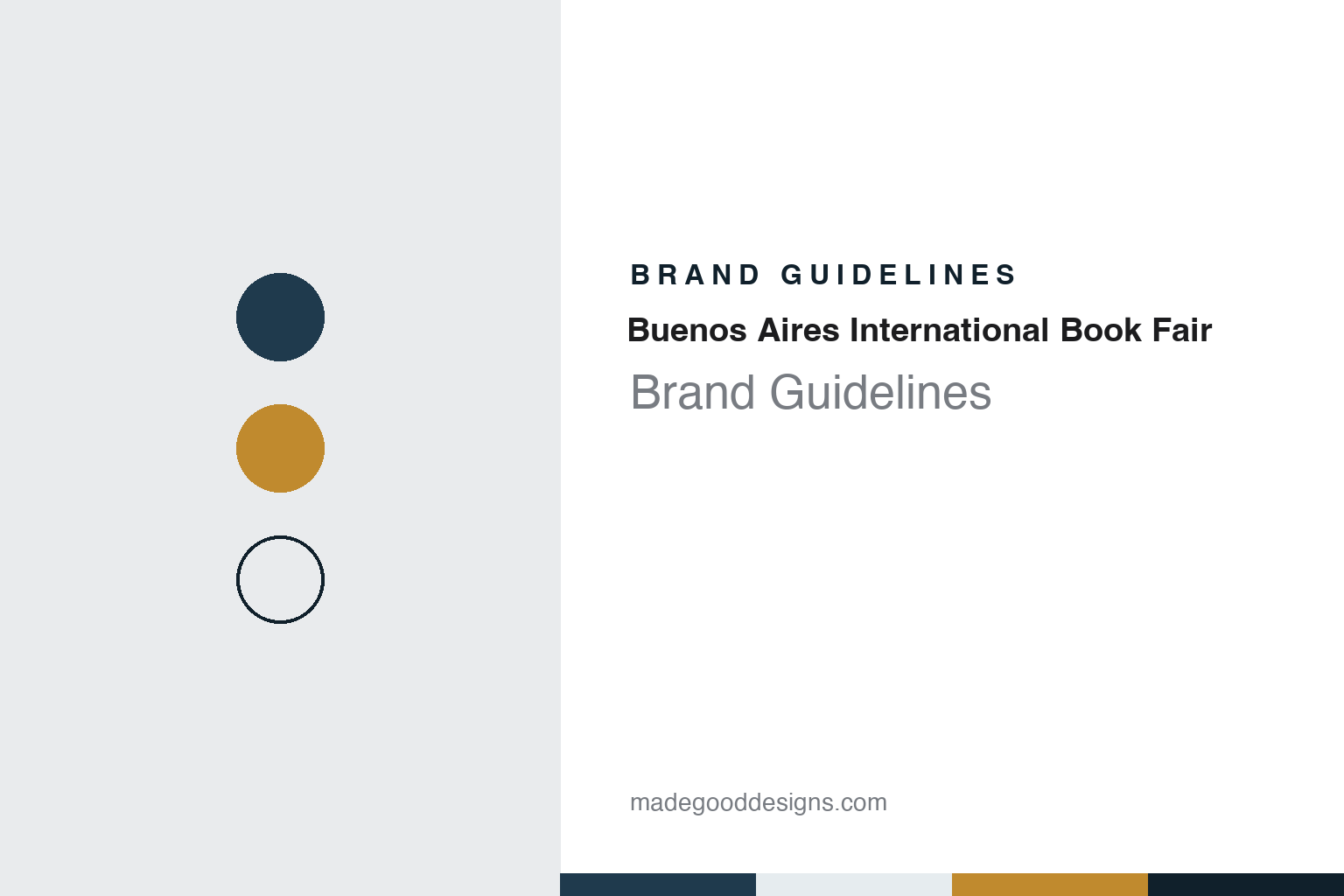
Two constants: a river blue, mist and ochre palette and a bookish serif register. Abstract homage — not a Buenos Aires International Book Fair product or mark; no logo, poster or pavilion is reproduced.
Del autor al lector
From street fairs to an indoor exhibition.
The Buenos Aires International Book Fair — the Feria Internacional del Libro de Buenos Aires — is held each year in the Argentine capital, running for about three weeks from late April into May. Its first edition ran from 1 to 17 March 1975 under the name Exposición Feria Internacional de Buenos Aires – Desde el Autor al Lector, Spanish Wikipedia says, and the motto “Del autor al lector” (“From the author to the reader”) has been kept ever since, the magazine Noticias wrote in October 2025.
The fair grew out of a writers’ campaign. Between 1971 and 1974 the Sociedad Argentina de Escritores (SADE), the Argentine writers’ society, organised 35 itinerant book fairs on Calle Florida, in city neighbourhoods and in cities such as Neuquén and La Plata, with poetry readings, music, ballet and theatre on open-air stages, Spanish Wikipedia says. In 1974 SADE called together the authors’ society Argentores, the publishers’ chambers, the printing-industry federation and the booksellers’ federation to hold an indoor fair instead. The first edition, at the Centro de Exposiciones de la Ciudad de Buenos Aires in Recoleta, had 116 exhibitors from seven countries on 7,500 square metres, according to both English and Spanish Wikipedia.
The organiser took its present form later. For several years the fair was run by an informal partnership of those bodies, which in 1985 became the Fundación El Libro, a non-profit civil foundation made up of the same organisations, Spanish Wikipedia says; English Wikipedia describes the foundation as established by SADE. The foundation also organises a children’s and young people’s book fair. Its president is Christian Rainone, chosen in 2024 after Alejandro Vaccaro, the Buenos Aires Times reported in April 2025, and its director general is Ezequiel Martínez, Infobae reported in October 2025.
Colour
La Rural, professional days and a guest.
The fair is now held at La Rural, the exhibition grounds of the Sociedad Rural Argentina in Palermo, which English Wikipedia puts at nearly 45,000 square metres. Spanish Wikipedia says the fair opens on the fourth Thursday of April, with stands spread over halls named after Argentine writers and several pavilions for national and foreign publishers, countries, Argentine provinces and institutions. The Ocre pavilion is one of them: Argentina’s national culture secretariat ran family activities outside it in 2026, its press office said in May 2026.
The public fair is preceded by professional days. Spanish Wikipedia names the Jornadas de Profesionales del Libro, international education days and a national meeting of librarians, aimed at publishers, translators, booksellers and others in the trade; English Wikipedia describes the same meetings and conferences of editors, publishers, translators and booksellers ahead of the public opening. In 2026 the national culture secretariat described training sessions on internationalisation and technology within the fair’s professional days.
The fair has also been a political stage. The 2020 fair was moved online and there was no fair in 2021; the in-person fair returned in 2022, English Wikipedia says.
Recent editions have had an invited guest. In 2025, the 49th edition, from 24 April to 12 May, had Riyadh as Guest City of Honour, the first Arab city in that role, under the theme “Books Across Borders,” the Buenos Aires Times reported. For the 50th edition the fair replaced its guest city with a guest country, and Peru was the first, under the slogan “Caminos que nos unen” (“Paths that unite us”), Infobae and the Buenos Aires Times reported.
Typography
How international book fairs present themselves.
International book fairs usually take their names from two things: the host city and the words book fair. Many are known by a form in the local language, and some by a short acronym or nickname that readers and the trade use more often than the full title, so that a single name can appear in several versions on posters, badges and press releases.
Most of these fairs serve two audiences. Trade days are set aside for publishers, rights agents, booksellers, distributors, librarians and translators, who come to meet, buy and sell translation rights and attend professional programmes. Public days follow or run alongside, when readers come to browse the stands, buy books and attend author talks, readings and signings, often with separate programmes for children and young readers.
Behind each fair sits an organiser. Some are run by universities, some by foundations set up by writers’ and publishers’ associations, some by state book bodies and some by exhibition companies that run fairs in their own halls. Inside the venue, halls are usually arranged by country and by publisher, with a rights centre for the trade and, at many fairs, a pavilion for a guest of honour: a country, region or city that brings its own writers, publishers and programme for one edition.
Visually, these fairs tend to keep a name and a wordmark from one year to the next while the edition poster, the annual theme or the guest pavilion changes. This guide describes those identities plainly, as dated sources describe them; the colours and type shown here are our own interpretation, and no logo, poster or pavilion is reproduced.
Aa
A bookish serif — a motto kept since 1975. (Specimen set in Libre Baskerville, a serif STAND-IN; NOT the Buenos Aires International Book Fair logo.)
The 50th edition
A new logo and an old motto.
The 50th edition ran from 23 April to 11 May 2026 at La Rural, closing on 11 May with Peru as guest country, Argentina’s national culture secretariat said. Its theme was “memory and future.” Instead of the customary opening speech by a single writer, the edition opened with a conversation between Gabriela Cabezón Cámara, Selva Almada and Leila Guerriero, Infobae reported in October 2025.
The anniversary also brought a visual change. When the 50th edition was launched at the National Library in October 2025, the director general said the website would be renewed and that the logo had changed, Infobae reported, and Noticias described a “rebranding” already visible on the fair’s website. An installation called “50 Ferias Dibujadas” combined live illustration with graphic material from the fair’s own visual history, the Buenos Aires Times reported, alongside a pavilion given over to the anniversary. Through those changes the fair kept its city name, its venue and its 1975 motto.
For a design guide, the Buenos Aires International Book Fair shows how a long-running fair can renew its logo while keeping a motto and a venue. Compare the Guadalajara International Book Fair and the Frankfurter Buchmesse, both named by Noticias in October 2025 among the fairs joining the 50th-anniversary tribute. For this guide we use a river blue, mist and an ochre with a serif, an unofficial interpretation; no product or logo is reproduced.
Explore & save
Keep Buenos Aires International Book Fair’s identity on hand — save it to a board in the Made Good inspiration library.
Buenos Aires International Book Fair identity set
Pin the river blue, mist and ochre palette and the bookish serif register to your own board.
Source & notes
Frequently Asked Questions
What font can I use to match the Buenos Aires International Book Fair look?
This guide describes Buenos Aires International Book Fair’s type as “A bookish serif — a motto kept since 1975”. Its type specimen is set in Libre Baskerville from Google Fonts as a stand-in; Libre Baskerville is not Buenos Aires International Book Fair’s own lettering.
What colours are in the Buenos Aires International Book Fair palette?
This guide’s Buenos Aires International Book Fair palette is River blue #1F3A4D, Ink #10202B, Mist #E6ECEF, Ochre #C08A2E and Paper #F7F6F2. The tones are the guide’s own unofficial interpretation, not official Buenos Aires International Book Fair hex codes.
When was Buenos Aires International Book Fair founded?
Buenos Aires International Book Fair was founded in 1975, in Buenos Aires, Argentina.