Festival du Livre de Paris Brand Guidelines
The Paris book fair that left the exhibition halls for the Grand Palais.
Aa
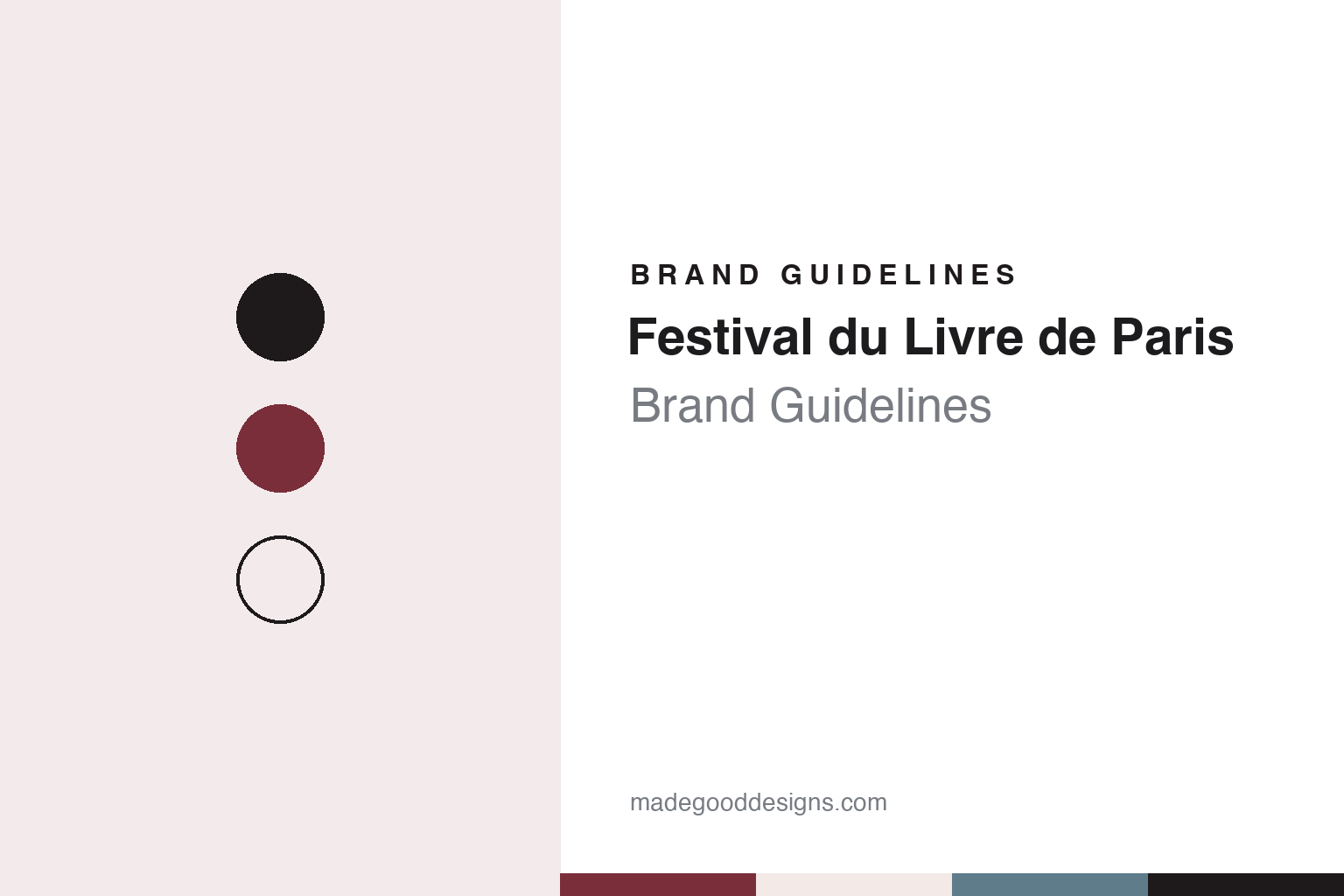
Two constants: a bordeaux and zinc blue palette and a Literary serif register. Abstract homage — not a Festival du Livre de Paris asset; no logo, poster or signage is reproduced.
Salon du livre
A publishers’ fair under the Grand Palais dome.
The Festival du Livre de Paris began as the Salon du livre de Paris. The festival’s own website calls itself the heir of the Salon du Livre, whose first edition was held in 1981 under the glass dome of the Grand Palais. French Wikipedia says the fair was created by the Syndicat national de l’édition (SNE), the French publishers’ association, and that it stayed at the Grand Palais, in the 8th arrondissement, until 1993.
It then spent most of its history in an exhibition centre. From 1994 the fair was held at Paris Expo Porte de Versailles, in the 15th arrondissement, French Wikipedia says, and for years it was run jointly by Paris Livres Événements, a subsidiary of the SNE, and the exhibition company Reed Expositions France. In later years it was marketed as Livre Paris.
Publishing Perspectives described that arrangement in a report of 18 March 2021, when the SNE and Reed Expositions France announced together that there would be no 2021 edition. The magazine noted that the fair normally took place in March, shortly after the London Book Fair, at the Porte de Versailles, and that it combined a public fair with a professional programme; in 2019 that programme included a session at which publishers presented books with screen rights available to film and television producers, run with SCELF, the French society for literary adaptation rights. The 2020 edition did not take place either.
Colour
A new name in 2022.
The break came in 2021. Livres Hebdo reported on 29 June 2021 that Vincent Montagne, president of the SNE, had told the association’s general meeting on 24 June that from 2022 the fair would change both its name and its format, with the Grand Palais Éphémère on the Champ-de-Mars as its centre. The same report said the SNE would create a wholly owned events subsidiary to run it, and that the contract with Reed Expo, organiser of the most recent fairs, had come to an end and had not been renewed.
The new event opened as the Festival du Livre de Paris from 22 to 24 April 2022 at the Grand Palais Éphémère, the temporary hall on the Champ-de-Mars, a short walk from the Eiffel Tower. ActuaLitté, the French book-news site, described the change in its 2022 coverage: a new name, new dates in April, a new venue, free entry and themed spaces, forty years after the first Salon, now under the full control of the SNE. The festival’s site calls 2022 its first edition and says Indian literature was the guest that year.
The festival stayed at the Grand Palais Éphémère until 2024 and returned to the Grand Palais in 2025, French Wikipedia says. Its website lists the guests of honour of the new format: India in 2022, Italy in 2023, Québec in 2024, Morocco in 2025 and, in 2026, not a country but comics, la bande dessinée.
The festival describes itself as organised by the company Paris Livres Événements, a subsidiary of the SNE. For 2026 — the fifth edition in the new format — it reported more than 121,000 visitors over three days and an evening opening, 1,800 authors, 3,000 signing sessions, twelve stages and 450 publishing houses, under a travel theme.
The format still mixes trade and public. The festival’s Friday programme of professional meetings, open to all, brings the book trade together, the organiser says, alongside a children’s village, an adaptation gallery for books on screen, school visits and a public dictation contest held in the neighbouring Palais de la Découverte.
Typography
Design and documentation.
International book fairs usually take their names from two things: the host city and the words book fair. Many are known by a form in the local language, and some by a short acronym or nickname that readers and the trade use more often than the full title, so that a single name can appear in several versions on posters, badges and press releases.
Most of these fairs serve two audiences. Trade days are set aside for publishers, rights agents, booksellers, distributors, librarians and translators, who come to meet, buy and sell translation rights and attend professional programmes. Public days follow or run alongside, when readers come to browse the stands, buy books and attend author talks, readings and signings, often with separate programmes for children and young readers.
Behind each fair sits an organiser. Some are run by universities, some by foundations set up by writers’ and publishers’ associations, some by state book bodies and some by exhibition companies that run fairs in their own halls. Inside the venue, halls are usually arranged by country and by publisher, with a rights centre for the trade and, at many fairs, a pavilion for a guest of honour: a country, region or city that brings its own writers, publishers and programme for one edition.
Visually, these fairs tend to keep a name and a wordmark from one year to the next while the edition poster, the annual theme or the guest pavilion changes. This guide describes those identities plainly, as dated sources describe them; the colours and type shown here are our own interpretation, and no logo, poster or pavilion is reproduced.
Aa
A literary serif — for a book festival under a glass roof. (Specimen set in Fraunces, a serif STAND-IN; NOT the Festival du Livre de Paris logo.)
Festival du Livre
A name chosen to sound less like a trade show.
The rename is the clearest piece of identity work in the fair’s history. Livres Hebdo reported in June 2021 that the working title was “Festival de tous les livres” — a festival of all books — before the final name, Festival du Livre de Paris, was settled for the first edition in April 2022.
The move of venue went with it. The fair left the halls of the Porte de Versailles for the Grand Palais Éphémère and then the Grand Palais itself, the building where the Salon had started in 1981. The festival’s own “about” page makes that link, describing the event as returning to its original cultural ambition, and it lists guests of honour each year alongside a programme organised by genre, from fiction and non-fiction to young adult and comics.
The organiser credits its design team by name. Its “about” page lists the scenography by AIA – Agence Isabelle Allegret and the design by Eric Laurin and Willem Meerloo, alongside agencies for press relations, the website and ticketing. It does not publish colour values or typefaces, so the palette and type in this guide are our own interpretation.
For a design guide, the Festival du Livre de Paris shows how a change of name and a change of building can reposition a long-running trade fair as a public festival. Compare Viparis, whose Paris venues include Paris Expo Porte de Versailles, where the Salon was held for most of its history, and Göteborg Book Fair, which named Québec as guest of honour in 2026, two years after Paris. For this guide we use a bordeaux and a zinc blue with a serif, an unofficial interpretation; no product or logo is reproduced.
Explore & save
Keep Festival du Livre de Paris’s identity on hand — save it to a board in the Made Good inspiration library.
Festival du Livre de Paris identity set
Pin the Festival du Livre de Paris bordeaux and zinc blue palette and the Literary serif register to your own board.
Source & notes
Frequently Asked Questions
What font can I use to match the Festival du Livre de Paris look?
This guide describes Festival du Livre de Paris’ type as “A literary serif — for a book festival under a glass roof”. Its type specimen is set in Fraunces from Google Fonts as a stand-in; Fraunces is not Festival du Livre de Paris’ own lettering.
What colours are in the Festival du Livre de Paris palette?
This guide’s Festival du Livre de Paris palette is Bordeaux #7A2E3A, Ink #1E1A1C, Pale rose #F3E9E6, Zinc blue #5E7C8A and Paper #FAF7F3. The tones are the guide’s own unofficial interpretation, not official Festival du Livre de Paris hex codes.
When was Festival du Livre de Paris founded?
Festival du Livre de Paris was founded in 1981 (as Salon du livre de Paris), in Paris, France.
Who founded Festival du Livre de Paris?
Festival du Livre de Paris was founded by Syndicat national de l’édition in 1981 (as Salon du livre de Paris).