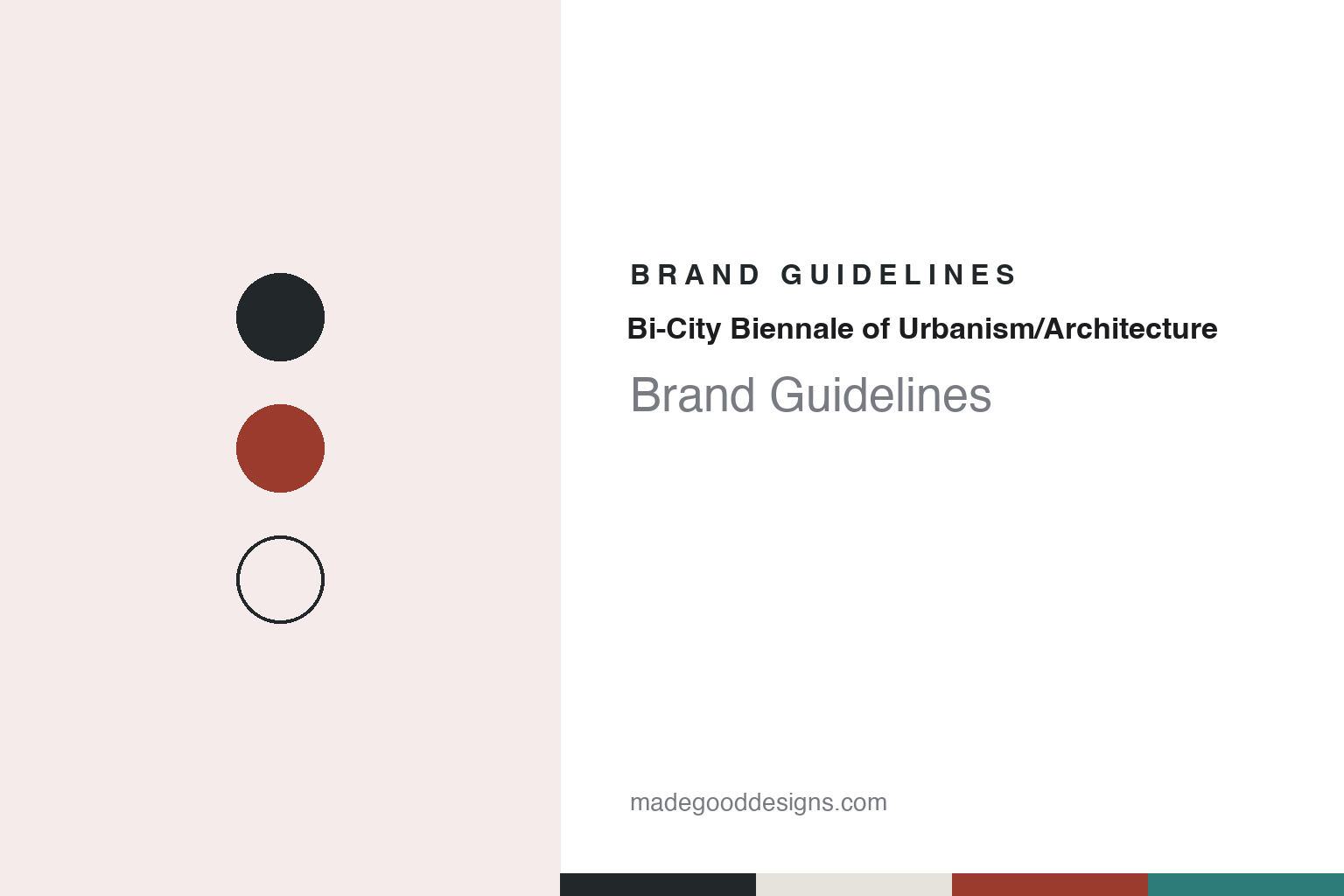
Bi-City Biennale of Urbanism/Architecture Brand Guidelines
A biennale of cities, shared by Shenzhen and Hong Kong.
Aa
Two constants: a brick, concrete and harbour teal palette and a condensed grotesque register. Abstract homage — not a Bi-City Biennale mark; no logo, poster or key visual is reproduced.
City, Open Door!
One biennale, two cities, a backslash.
The Bi-City Biennale of Urbanism\Architecture, written officially with a backslash between its last two words, is a biennale of cities and urbanisation held in Shenzhen, with a partner edition in Hong Kong. English Wikipedia says it was founded in 2005 and has been held every two years since, that the first edition took place in Shenzhen, and that it was originally organised by the Shenzhen Public Art Center. Its short form, used in both cities, is UABB.
The first edition, titled City, Open Door!, ran from 10 December 2005 to 10 March 2006 at the OCT Contemporary Art Terminal, in the southern part of the OCT-LOFT creative district, with the architect Yung Ho Chang as chief curator, according to English Wikipedia. The second, in 2007, returned to OCT-LOFT, this time to its northern part, under the title City of Expiration and Regeneration, and ran from December 2007 to March 2008.
The partner edition began with that second biennale. English Wikipedia, citing a 2007 publication of the Hong Kong Institute of Architects, says the biennale was first staged in Hong Kong in January 2008 with an exhibition called Refabricating City. The same article says the two cities share a similar theme but select their curatorial teams independently, under different procedures and organisations, and hold their exhibitions in different venues with different exhibitors, on similar but slightly differing dates. ArchDaily, in November 2019, described the event as organised by the cities of Shenzhen and Hong Kong, and Dezeen, in January 2020, as held concurrently in the two cities.
The Hong Kong side has its own organisers. In a December 2025 release, the 2025 Hong Kong edition named The Hong Kong Institute of Architects Biennale Foundation as organiser, with The Hong Kong Institute of Architects, The Hong Kong Institute of Planners and the Hong Kong Designers Association as co-organisers. That edition, titled TECHFORMANCE: Technology, Platform and Performance, ran at the Oil Street Art Space in North Point and the East Kowloon Cultural Centre until 24 January 2026 with 25 exhibits, the release said.
Colour
A new site almost every edition.
In Shenzhen the venue has moved with almost every edition. English Wikipedia lists Shenzhen Civic Square as a main venue in 2009, under the theme City Mobilization, and again in 2011, alongside OCT-LOFT. In 2013, under the theme Urban Border, the Shenzhen exhibition moved to the Shekou Industrial Zone in Nanshan District, using the Value Factory, a former float-glass factory, and an old warehouse at the Shekou ferry terminal. In 2015, titled Re-Living the City, it used the Dacheng Flour Factory in Shekou, and in 2017, titled Cities, Grow in Difference, Nantou Old Town in Nanshan.
The 2019 edition, the eighth, took the theme Urban Interactions. ArchDaily reported on 22 November 2019 that it was built from two main sections, Eyes of the City and Ascending Cities, the first set in Shenzhen’s newly opened Futian high-speed railway station. Dezeen reported on 6 January 2020 that the station exhibition gathered work by more than 60 international contributors on how digital technologies are changing urban life, and that the biennale would run until 8 March 2020.
The ninth edition took the main exhibition to Luohu District for the first time. ArchDaily reported on 24 April 2023 that it was titled Urban Cosmologies, opened in December 2022 at GDH City · Jinpi Fang, a former Kingway Brewery industrial site, and ran until March 2023 with more than 200 events. The magazine said the edition kept the principle that “the city is the exhibition site, the exhibition is the practice,” and set its theme against the climate crisis and the relationship between people and nature.
The tenth edition marked the event’s 20th anniversary. Shenzhen Daily reported on 14 January 2026 that the organisers had named Shenzhen Talent Park in Nanshan District as the main venue, linked to the Shenzhen Bay Cultural Square, with a parallel exhibition at the Hetao Science and Technology Innovation Center in Futian District that opened on 15 January. On 30 January 2026 the paper reported the opening of the main venue under the theme City Theater, with 489 works by more than 800 contributors from 21 countries and regions, nine satellite sites across six districts, and a run through March. The edition was curated by the architect Zhu Tao with an artist and a scientist, and a page from Shenzhen University’s Greater Bay Area Innovation Design Lab names a Shanghai culture-technology company as co-curating institution.
At the January 2026 press conference, Shenzhen Daily reported, Zhu described theatre as a form of public space, and said a theatrical approach lets an exhibition remain “unfinished,” open to several possibilities and futures rather than a single answer.
Typography
Biennials, festivals and open houses.
Architecture biennials, triennials, festivals and open-house events usually take their names from the city that holds them. Most combine the place with words such as architecture, urbanism, biennale, triennial, festival or open house, and many are shortened to an acronym or a few initials, so that the name works as a date in the calendar as much as a title.
The bodies behind them vary. Some are hosted by city governments or public agencies acting in an institutional role; others are run by architecture centres, professional institutes, foundations, non-profit organisations or media and events companies. Several share an organiser with a permanent architecture centre or exhibition hall in the same city, and some work in partnership with a neighbouring city or a network of sister events abroad.
What they share is a programme spread across a city rather than gathered in one hall. Exhibition halls, reused industrial buildings, stations, plazas and parks hold curated exhibitions and installations, while talks, tours, workshops and, in open-house events, buildings opened to the public for a weekend or a week, often with volunteer guides, carry the programme into the streets. Biennials and triennials tend to work with a director or curatorial team and a yearly theme; festivals and open-house events often depend on many independent hosts.
Visual identity follows the same pattern. A steady name or wordmark carries from edition to edition, while each director or curator brings a new title, key visual and set of venues. This guide describes each event from its own first edition, using dated sources for organisers, venues, dates and themes, and sets an unofficial palette and type stand-in beside it; no logo or key visual is reproduced.
Aa
A condensed grotesque for a title that carries a slash. (Specimen set in Archivo Narrow, a sans STAND-IN; NOT the Bi-City Biennale logo.)
Bi-City Biennale
A punctuation mark as an identity.
The name is written in several ways. The backslash between “Urbanism” and “Architecture” appears in the titles used by Shenzhen Daily and ArchDaily, while English Wikipedia writes a forward slash. The order of the words varies too: Shenzhen Daily has used both the Bi-City Biennale of Urbanism and Architecture form and a Shenzhen–Hong Kong Urbanism and Architecture Bi-City Biennale form, and each city’s edition adds its own name in brackets.
The edition titles change every two years, and each curatorial team sets its own sections. At the 2026 opening, Shenzhen Daily reported, a section at the main venue called Ten Acts, Ten Realms revisited the themes of all ten biennales through installations, while the Hetao venue held four special pavilions, among them one for the biennale itself and a Hong Kong Pavilion.
The Hong Kong edition of 2025 described its exhibition design in material terms: arcs of bent aluminium extrusion that gave its two venues a shared spatial language, according to its December 2025 release. In Shenzhen the venues themselves have carried much of the visual story, from the OCT-LOFT district to factories, a warehouse, a railway station, a brewery site and a park.
For a design guide, the Bi-City Biennale shows how a single punctuation mark and a moving venue can hold an event together over twenty years, with a new title and a new team every edition. Compare Shanghai Biennale, a contemporary-art biennale held in Shanghai, and Seoul Biennale of Architecture and Urbanism, a city-run architecture biennale in Seoul. For this guide we use a factory brick red, a concrete grey and a harbour teal with a sans, an unofficial interpretation; no product or logo is reproduced.
Explore & save
Keep Bi-City Biennale of Urbanism/Architecture’s identity on hand — save it to a board in the Made Good inspiration library.
Bi-City Biennale identity set
Pin the Bi-City Biennale brick, concrete and harbour teal palette and the condensed grotesque register to your own board.
Source & notes
Frequently Asked Questions
What font can I use to match the Bi-City Biennale of Urbanism/Architecture look?
This guide describes Bi-City Biennale of Urbanism/Architecture’s type as “A condensed grotesque for a title that carries a slash”. Its type specimen is set in Archivo Narrow from Google Fonts as a stand-in; Archivo Narrow is not Bi-City Biennale of Urbanism/Architecture’s own lettering.
What colours are in the Bi-City Biennale of Urbanism/Architecture palette?
This guide’s Bi-City Biennale of Urbanism/Architecture palette is Factory brick #9A3B2E, Ink #22272A, Concrete #E6E3DD, Harbour teal #2E7C7A and Paper #F7F6F3. The tones are the guide’s own unofficial interpretation, not official Bi-City Biennale of Urbanism/Architecture hex codes.