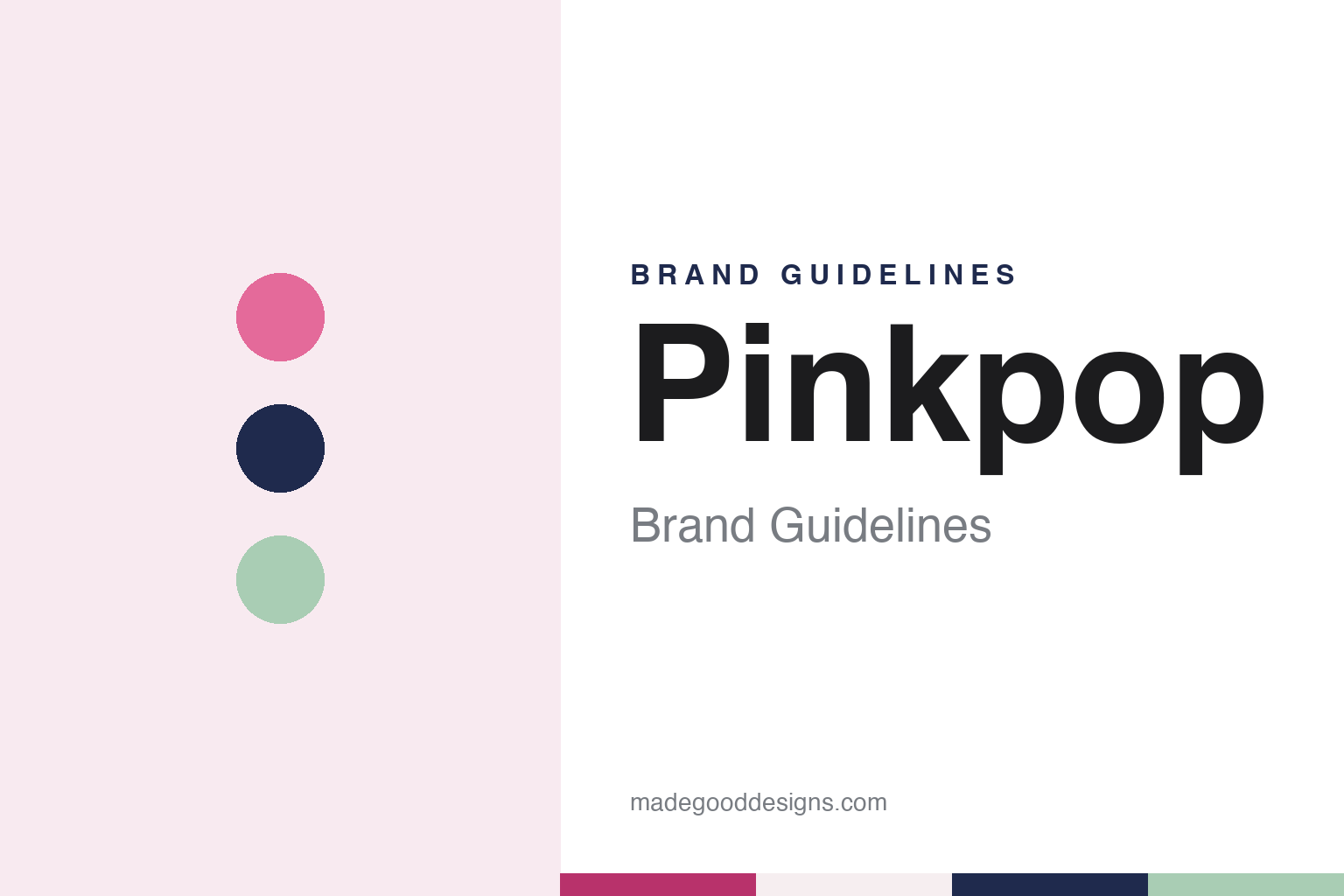
Pinkpop Brand Guidelines
A Whit Monday picnic in Limburg that became a three-day festival with a pink doll for a logo.
Aa
Two constants: a doll pink, night navy and meadow mint palette and a Rounded grotesque register. Abstract homage — not a Pinkpop asset or mark; no logo, poster, artwork or wordmark is reproduced.
From Pinknick to Pinkpop
A Whit Monday picnic, a sports park in Geleen and a new name.
Pinkpop is a three-day pop festival in Landgraaf, in the Dutch province of Limburg. Dutch Wikipedia describes it as a yearly festival that has normally taken place over the Pentecost weekend since 1970, and its name says so: it joins Pinksteren, the Dutch word for Pentecost, with pop.
The festival grew out of a smaller event. In 1969, Dutch Wikipedia says, two of its later founders organised a local pop festival on the Gulperberg, a hill near Gulpen, on Whit Monday, 26 May 1969. Visitors brought their own food, and the mix of picnic and holiday gave it the name Pinknick. Most of the bands were from Limburg.
A year later the plan became larger. Dutch Wikipedia names four founders, among them Jan Smeets, and says the group moved the second edition to a bigger site, the Burgemeester Damen Sportpark in Geleen, and changed the name to Pinkpop. The regional broadcaster L1 Nieuws reported in September 2020 that the first edition took place in Geleen on Whit Monday, 18 May 1970, organised by Smeets, then 25, together with several partners.
The festival stayed in Geleen for its first seventeen editions, until 19 May 1986, Dutch Wikipedia says. In 1987 it was held once at Sportpark De Berckt in Baarlo, while the Geleen sports park was being rebuilt, and it did not return. In 1988 it moved to Megaland, a site at Schaesberg, in the municipality of Landgraaf, where it has been held since. On 15 June 2018, the same article says, the festival organisation and the municipality signed a new twenty-year contract for the Megaland site.
Colour
One day, then two, then three.
For its first quarter-century Pinkpop was a one-day festival on Whit Monday. Dutch Wikipedia says it first sold out in 1976, and that from 1986 the promoter Mojo Concerts took over its programming. L1 Nieuws described Mojo in 2020 as the company responsible for the programming since 1986.
The format changed at the 25th anniversary in 1994, when the festival gained two outdoor stages and one in a tent and added the Sunday before Whit Monday. It has run for three days since 1996. Today Dutch Wikipedia lists four stages: a South Stage and a North Stage facing each other across the field, a Tent Stage in a pink tent behind the North Stage, and Stage 4, added in 2014.
The date has moved too. In 2008 Pinkpop was held outside the Pentecost weekend for the first time, because Pentecost fell early that year. On 1 June 2019 the newspaper AD reported that the festival would not be held at Pentecost for the next ten years and would move to a weekend in June instead; Smeets told the regional broadcaster 1Limburg that “the name is stronger than the date.” In those years the festival runs from Friday to Sunday rather than ending on Whit Monday.
The 2020 and 2021 editions did not take place. On 18 September 2020, L1 Nieuws reported that Smeets had decided to step down as festival director after fifty editions, the fiftieth having been held in 2019. His permanent team continued the organisation together with Mojo, the broadcaster reported, with Smeets available as an adviser. The festival returned on 17–19 June 2022, and the 2026 edition ran on 19–21 June, Dutch Wikipedia says.
Its line-ups have mixed Dutch and international acts; Dutch Wikipedia notes, for example, that The Rolling Stones played Pinkpop in 2014. Since 2022 the festival has opened each year with the winner of a Limburg pop prize, following an earlier band contest whose winner opened the festival from 1999 to 2019.
Typography
Design and documentation.
Music festivals in continental Europe usually take their names from a place or a coined word. Some carry the name of a village, a town, a racetrack or a stretch of seafront; others borrow the name of a youth club or invent a short word of their own, often in the local language. Rock Werchter is named after the Flemish village where it began in 1975; Pukkelpop kept the name of the Leopoldsburg youth house, De Pukkel, where its organisers met. Long names are soon cut down to initials on posters, wristbands and websites — TW for the old Torhout-Werchter, PKP with the year for Pukkelpop.
Behind the names stand different kinds of organiser. Some festivals were started by youth movements or non-profit associations and are still run by their founders; others are produced by promoters and festival companies, a number of which sit inside larger international live-entertainment groups. Municipalities appear in their institutional role, as landowners, planners or partners for transport. The organiser is rarely the face of the festival; its name sits in the small print.
The setting is part of the identity. A typical festival fills a festival park, a meadow, a racetrack, an airfield, a seafront or a farm for one long weekend, with several stages — often a large open-air main stage beside covered halls or tents — and campsites around the grounds. When a festival changes site, the new place name tends to join the dates in the line that sits beside the festival name.
Each year brings a new line-up poster, with headliners in large type above rows of smaller names, and an edition key visual that changes from year to year. Around these, a steady wordmark, the place and the dates hold the identity together, and some festival names have carried a title sponsor’s name for part of their history. This guide looks at how each festival handles that balance, using only what dated sources and the festivals’ own pages show.
Aa
A rounded grotesque — friendly, bold, built for a pink field. (Specimen set in Rubik, a sans STAND-IN; NOT the Pinkpop logo or wordmark.)
Pinkpop
A pink doll, drawn in 1973.
Pinkpop’s identity starts with its name. Dutch Wikipedia explains that the name and the logo play on two readings: Pinkpop is a contraction of Pinksteren and pop music, while the English word pink and the Dutch word pop, meaning doll, together give a pink doll — which is what the logo shows.
The doll has its own history. According to Dutch Wikipedia, it was designed in 1973 by Bert Abell and became the official logo in 1974. The first version showed a doll with its arms and legs stretched forward and wide black hair; in 1999 the logo was simplified so that the body, arms and legs were no longer shown. For years the name was set in white and black letters with a yellow and pink edge, and those colours formed the festival’s house style.
That changed in 2022. Since then, the same article says, the house style has used pastel green, pink and navy blue, and the logo shows the same recognisable doll in navy and white. Pink also lives outside the logo: Dutch Wikipedia describes the colour as central to the festival, with many visitors wearing the official pink cap or pink clothing on the Megaland field, and the Tent Stage housed in a pink tent.
The festival’s own website opens on the dates and the Megaland site and lists its acts by day. Mojo’s role is the programming, as L1 Nieuws described it in 2020, while the festival team runs the event under the Pinkpop name.
For a design guide, Pinkpop shows how a festival can turn a pun on its own date into a lasting emblem, and how a mascot can be simplified and recoloured over fifty years without losing its outline. Compare Lowlands, another Dutch summer festival, and Rock Werchter, held just across the border in Belgium. For this guide we use a doll pink, a night navy and a meadow mint with a rounded sans, an unofficial interpretation; no product or logo is reproduced.
Explore & save
Keep Pinkpop’s identity on hand — save it to a board in the Made Good inspiration library.
Pinkpop identity set
Pin the Pinkpop doll pink, night navy and meadow mint palette and the Rounded grotesque register to your own board.
Source & notes
Frequently Asked Questions
What font can I use to match the Pinkpop look?
This guide describes Pinkpop’s type as “A rounded grotesque — friendly, bold, built for a pink field”. Its type specimen is set in Rubik from Google Fonts as a stand-in; Rubik is not Pinkpop’s own lettering.
What colours are in the Pinkpop palette?
This guide’s Pinkpop palette is Doll Pink #E46A9A, Deep Rose #B8326B, Night Navy #1F2A4D, Meadow Mint #A9CDB4 and Paper #FBF8F7. The tones are the guide’s own unofficial interpretation, not official Pinkpop hex codes.