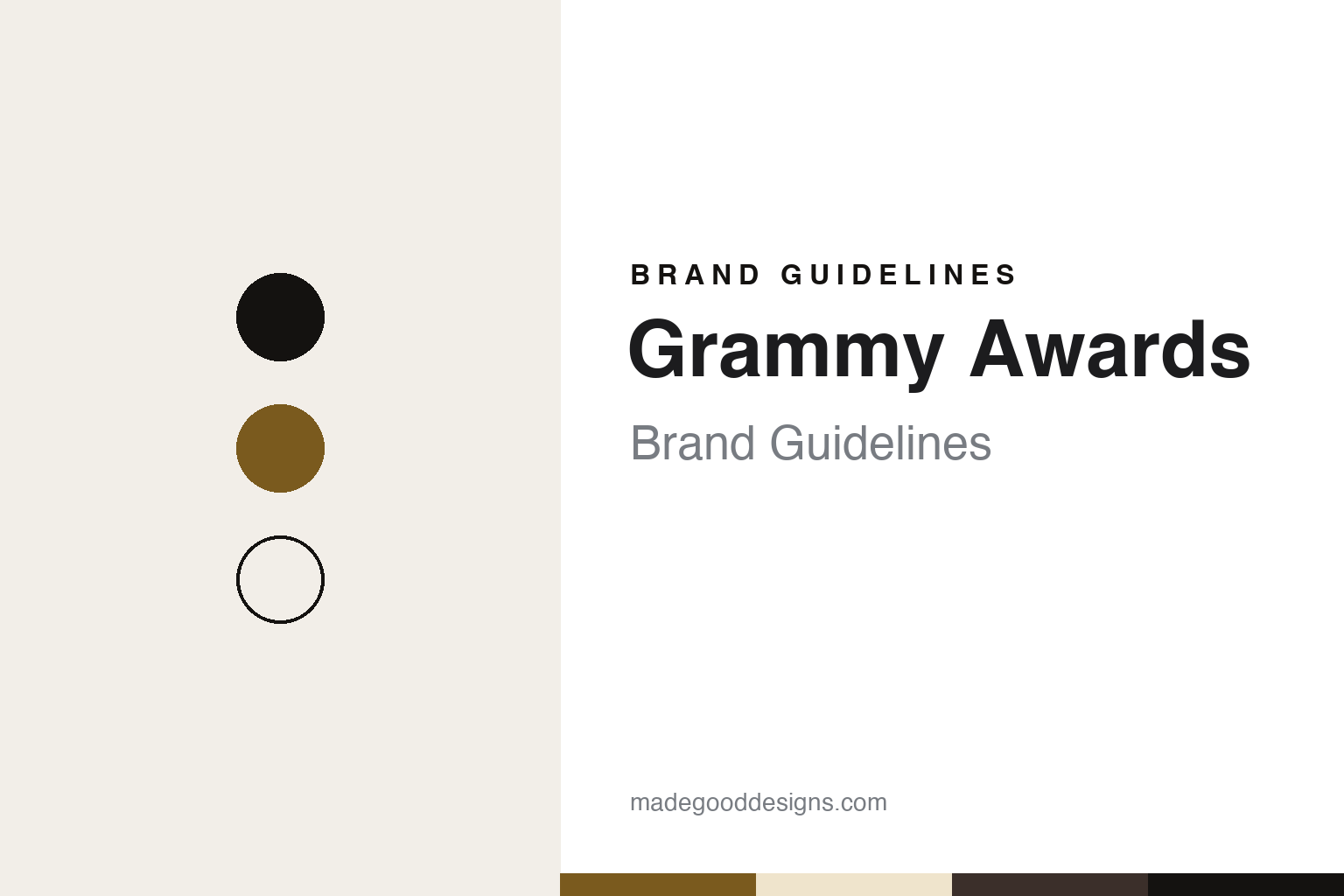
Grammy Awards Brand Guidelines
The Recording Academy’s gilded gramophone since 1959.
Aa
Two constants: a gold, black and cream palette and a ceremonial serif register. Abstract homage — not a Grammy Awards asset; no trophy, logo or mark is reproduced.
A music academy
From a Walk of Fame committee to two hotel ballrooms.
The Grammy Awards are presented by the Recording Academy, the trading name of the National Academy of Recording Arts & Sciences (NARAS), a nonprofit academy of musicians, producers, recording engineers and other music professionals that English Wikipedia dates to 1957. The Academy says it has around 30,000 members today, and it lists the Latin Recording Academy and the Grammy Museum among its related organisations.
English Wikipedia traces the idea to the Hollywood Walk of Fame project of the 1950s. Recording executives on the Walk of Fame committee, compiling names of recording people who might qualify for a star, decided their industry needed awards of its own. One working title was the “Eddie,” after Thomas Edison and the phonograph; the original idea was to call them the “Gramophone Awards.” The name “Grammy” came from a mail-in contest in which, English Wikipedia says, about 300 entrants proposed it, as a short form of Emile Berliner’s gramophone.
The first ceremony was held on 4 May 1959, for recordings of 1958, in two places at once: the Beverly Hilton Hotel in Beverly Hills and the Park Sheraton Hotel in New York, with 28 awards presented. A second ceremony followed later in 1959 and was the first to be televised; the show was not broadcast live until the 13th ceremony in 1971, English Wikipedia says.
For more than a decade the awards were shared between cities on the same day. Chicago joined New York and Los Angeles as a host city in 1962 and Nashville in 1965. The 1971 ceremony at the Hollywood Palladium was the first held in a single location; the 1972 show was at the Felt Forum of Madison Square Garden in New York and the 1973 show at the Tennessee Theatre in Nashville. Since 2000 the ceremony has normally been held at the Los Angeles arena now called Crypto.com Arena, known as the Staples Center until 2021, with New York’s Madison Square Garden hosting in 2003 and 2018 and the MGM Grand Garden Arena in Las Vegas in 2022.
Colour
A General Field, genre fields and two rounds of voting.
The Grammy year runs on a fixed calendar, which the Recording Academy sets out on its awards-process pages. For the 69th awards, recordings had to be released between 31 August 2025 and 28 August 2026; members in good standing and registered media companies could enter them online between 7 July and 21 August 2026. The Academy says around 20,000 entries arrive each year. Its Awards Department checks eligibility, and genre screening committees of more than 300 specialists, the Academy says, place each entry in its proper category without judging its artistic merit.
Voting then runs in two rounds. Voting members, described by the Academy as working creative professionals such as performers, songwriters, producers and engineers, may vote in up to ten categories across three genre fields, plus all six categories of the General Field: Record of the Year, Album of the Year, Song of the Year, the award for a new artist, and Producer of the Year and Songwriter of the Year (Non-Classical). An optional method called Ballot Plus lets eligible members vote in further categories tied to their own work. The independent accounting firm Deloitte & Touche tabulates the ballots. Most categories have five nominees and the General Field eight, except the producer and songwriter awards, which have five; nominations for the 69th awards were announced on 16 November 2026, followed by a final round in December and January before the February ceremony.
The category list has changed many times. On 6 April 2011 the Academy announced an overhaul that cut the categories from 109 to 78 for 2012, and in 2023 it consolidated 26 fields into 11 and moved the producer and songwriter awards into the General Field, English Wikipedia says. The 68th awards, presented on 1 February 2026, had 95 categories. Only about a dozen are handed out during the telecast; most are presented at an afternoon Premiere Ceremony beforehand.
The Latin Grammy Awards are the sister programme. The Recording Academy set up the Latin Recording Academy in 1997, and the first separate Latin Grammys were held in 2000, for works recorded in Spanish or Portuguese, according to English Wikipedia.
Typography
The category.
Film, television, music and theatre awards tend to present themselves through a short name. The formal title of a prize is often long, naming an academy, a society or a person, while the name people use is a single word or a nickname that fits a headline, a poster and a broadcast caption. Many programmes use both, keeping the formal title for rules and records and the short name for everything public.
Behind each name sits an organisation: an academy of practitioners, a society of producers or theatre owners, a union of broadcasters or a company that produces the show. That body writes the rules, sets the categories and decides who votes, and its own name usually appears beside the prize in smaller type, as the signature rather than the headline.
The trophy is the most visible part of the identity. A statuette, a mask, a gramophone, a globe or a medallion can be kept for decades, with changes of material, maker or base. Because the object recurs in every photograph of the ceremony, it works as the visual shorthand for the whole programme.
The year gives these brands their rhythm. An eligibility period, usually a calendar year or a season, is followed by entries, members’ votes or jury rounds, a published list of nominations and a televised ceremony in a named venue. Sister programmes, honorary awards and separate ceremonies for other formats sit around the main event, each described in the same plain, institutional voice as the main categories.
Aa
A ceremonial serif for a gilded trophy. (Specimen set in Playfair Display, a serif STAND-IN; NOT the Grammy Awards logo.)
Grammy Awards
A gramophone cast by hand in the Colorado mountains.
The trophy is the programme’s visual shorthand: a gilded gramophone, horn and turntable in gold on a base. The Recording Academy says the original Grammy mould came from Bob Graves, the first maker of the trophy, under whom John Billings learned casting in Southern California in the 1980s; Billings then moved to Colorado and set up Billings Artworks in the mountain town of Ridgway, which makes every Grammy and Latin Grammy trophy, the Academy reported in December 2018. In May 2017 the Academy wrote that Billings and his staff handcraft trophies for all 83 Grammy categories and 48 Latin Grammy categories of that year, as well as the statuettes for its Special Merit Awards.
English Wikipedia adds that the design was reworked in 1990, replacing the traditional soft lead with a stronger alloy and making the trophy larger, and that Billings developed a trademarked zinc alloy called Grammium. Because engraved trophies are not ready until the results are known, “stunt” trophies are reused on stage each year.
The broadcast has had a long single home. CBS carried the Grammys for 54 years, TV Technology reported on 31 October 2024. The show is held on a Sunday in early February; since 2023, English Wikipedia says, that has been the first Sunday of the month.
The name itself is styled in capitals by the Academy, “GRAMMY,” and the organisers present the programme under two linked words: the Recording Academy as the body, the Grammy as the prize.
For a design guide, the Grammy Awards show how a single object, a small gold gramophone, can carry the whole identity of an awards programme across more than six decades of changing categories and venues. Compare the Emmy Awards, the television prize whose academies also guard a named statuette, and the broadcaster CBS. For this guide we use gold, black and cream with a serif, an unofficial interpretation; no product or logo is reproduced.
Explore & save
Keep Grammy Awards’s identity on hand — save it to a board in the Made Good inspiration library.
Grammy Awards identity set
Pin the Grammy Awards gold, black and cream palette and the ceremonial serif register to your own board.
Source & notes
Frequently Asked Questions
What font can I use to match the Grammy Awards look?
This guide describes Grammy Awards’ type as “A ceremonial serif for a gilded trophy”. Its type specimen is set in Playfair Display from Google Fonts as a stand-in; Playfair Display is not Grammy Awards’ own lettering.
What colours are in the Grammy Awards palette?
This guide’s Grammy Awards palette is Gramophone gold #7A5A1E, Shellac black #141210, Horn cream #EFE4CC, Walnut #3B2F2A and Paper #FAF7F0. The tones are the guide’s own unofficial interpretation, not official Grammy Awards hex codes.