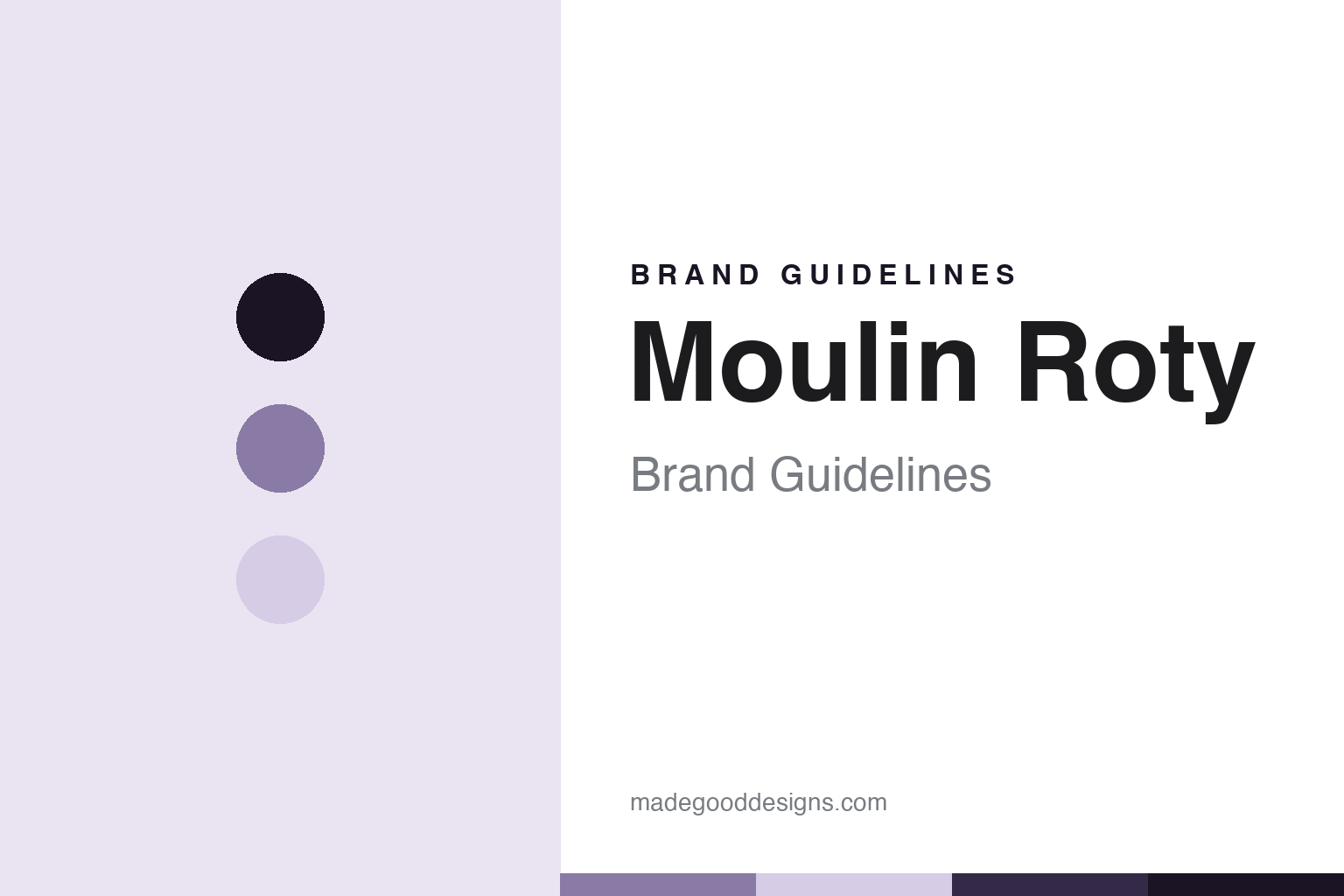
Moulin Roty Brand Guidelines
A toy cooperative from France.
Aa
Two constants: a storybook-lilac palette and a storybook-sans register. Abstract homage — not a Moulin Roty product or mark; no character, illustration or logo is reproduced.
A toy cooperative from France
Moulin Roty is the French soft-toy brand born from a 1972 commune — still a worker cooperative, making design-led, illustrated toys.
Moulin Roty closes the plush round as its cooperative node — a French soft-toy brand born from a 1972 commune in an old mill, still run as a worker cooperative, and design-led through its illustrated characters, a values-owned counterpoint to the billionaires and conglomerates that own its rivals. Its answer to a round about who owns the soft toys and where they are made is an unusual one: owned by its workers, designed in France, made across several countries.
Its identity is a toy cooperative from France. The commune origin, the cooperative ownership and the illustrated design are the story here. Owned by its makers. A toy cooperative from France.
(Honest notes, so the founding, the ownership and the making are framed accurately, with a correction. Moulin Roty sells soft toys and nursery goods as its heroes — the illustrated La Grande Famille characters, comforters and music boxes; we report its language as the brand’s own. On origin: Moulin Roty was founded in 1972 by a group of around twenty friends who bought and renovated an old mill to live communally, a genuine commune, starting with screen-printing and craft goods, and it formally adopted worker-cooperative status in 1980; a workshop fire around 1980 led to a move to Nort-sur-Erdre, though sources disagree on the exact year, which we hedge. On headquarters: Nort-sur-Erdre, in Loire-Atlantique, France. On ownership: Moulin Roty is an independent French worker cooperative, with no external corporate parent, which we do not assert despite loose directory language. On where it is made, corrected: it is designed in France but, by its own account, made across France, Romania, China and Taiwan, so we do not call it made in France only. On products: its emblematic character is Nini the mouse in the La Grande Famille range, which is mouse-led rather than rabbit-led. On safety, attributed: it says its toys comply with the EN71 standard and the CE mark and are tested by an independent French laboratory. On a documented, dated recall: in February 2026 Ireland’s consumer agency recalled a Moulin Roty pull-along toy over a choking hazard, which we attribute. Its illustrated characters and name are IP we describe but do not reproduce; there is no official brand hex; these tones are an unofficial interpretation.)
Colour
Moulin Roty lives in a storybook lilac. Click a swatch to copy the hex.
Moulin Roty’s identity is cooperative-owned, design-led and made across several countries — a storybook lilac, an ink, a pale lilac, a deep plum, and a paper. The palette leans storybook lilac and pale lilac: a soft, illustrated register that nods to a retro French children’s-book aesthetic rather than a loud logo colour. It signals a toy cooperative from France — cooperative-owned, design-led and made across several countries. The honest caveat: with no official brand hex, these values are a storybook, unofficial interpretation, not first-party colours.
The lesson is a storybook lilac signals an illustrated, design-led identity. Moulin Roty’s world is the illustrated soft toy. For designers, it is a reminder that a soft lilac and a pale lilac can carry an illustrated, cooperative brand — a gentle tone held as an accent, not a reproduced character. Because a mid hue can fail as small text, keep type dark and let the colour live in the accents, palette and band. The takeaways: date the founding to 1972 and the commune and the cooperative status to 1980; describe ownership as an independent French worker cooperative; correct the making to France, Romania, China and Taiwan; keep La Grande Famille mouse-led; and attribute the 2026 recall.
Typography
The register is a storybook sans — cooperative-owned, design-led, made across several countries.
Moulin Roty’s identity carries a cooperative-owned, design-led, made-across-several-countries spirit — a workers’ cooperative telling stories. A storybook sans captures the mood: soft, warm and illustrative, the register of a French children’s brand. Set in a storybook-lilac palette, the storybook sans feels gentle and narrative — exactly the personality Moulin Roty carries. It behaves like a made, illustrated thing rather than a loud logo, mirroring a plush-nap and a soft-curve. (Moulin Roty’s real products, the name and the La Grande Famille characters are things we describe but do not reproduce, and the exact typeface is not ours to use.) Because it is not ours to use, the honest description is “a storybook-sans brand,” shown here in a stand-in. The type behaves like the brand: cooperative-owned, design-led and made across several countries.
Aa
A storybook-sans brand — gentle and narrative. (Specimen set in Manrope, a storybook-sans STAND-IN; NOT the Moulin Roty logo or La Grande Famille characters.)
The soft-toy node
Moulin Roty stands for a toy cooperative from France.
Moulin Roty closes the round as its cooperative node. A storybook-lilac palette, a storybook sans and a 1972 commune origin make one thing — a toy cooperative from France — the whole identity: cooperative-owned, design-led and made across several countries. The commune origin is the pitch, the cooperative ownership is the twist, and the illustrated design is the pride. The point is a soft-toy brand owned by its workers, a values-owned counterpoint, in a round about who owns the soft toys and where they are made.
Put to work, the identity is the brand told straight, the ownership described and the making corrected. A brand in this spirit would date the founding to 1972 and the commune and the cooperative status to 1980, describe ownership as an independent French worker cooperative, correct the making to several countries, and attribute the 2026 recall. A reader in this spirit would keep the facts right: Moulin Roty sells the illustrated La Grande Famille, comforters and music boxes; it was founded in 1972 by a commune of friends in an old mill and became a worker cooperative in 1980; it is headquartered in Nort-sur-Erdre, Loire-Atlantique; it is designed in France but made across France, Romania, China and Taiwan; and its emblematic character is Nini the mouse. Moulin Roty closes the round, after Ty. The honest editorial moves are to date the founding, to describe the cooperative, to correct the making, and to attribute the recall.
For designers and brand-builders, Moulin Roty closes the soft-toy node: let a values-ownership be the story — and correct where it is made. The lessons: a brand can be owned by its workers, here Moulin Roty as a French cooperative born from a commune; a founding is dated to 1972 and the commune of around twenty friends, with worker-cooperative status from 1980 and the fire-driven move to Nort-sur-Erdre hedged on year; an ownership is described as an independent French worker cooperative with no external parent, rather than an assumed corporate group; a making is corrected to France, Romania, China and Taiwan, not France only, by the company’s own account; and the design is credited to its illustrated characters, with La Grande Famille kept mouse-led and the 2026 Irish recall attributed and dated. It is also a reminder to stay precise: Moulin Roty is the cooperative-owned, multi-country-made, design-led French soft-toy brand — with the palette here an unofficial interpretation and the illustrated characters described rather than reproduced. The hook is that ownership: Moulin Roty is a soft-toy brand born from a 1972 hippie commune in a French mill, still a worker cooperative and still design-led, a values-owned counterpoint to the billionaires and conglomerates that own its rivals. Read that way, Moulin Roty is less a single toy than a toy cooperative from France: cooperative-owned, design-led, made across several countries. The lesson for a brand is that a values-ownership and an honest making reinforce each other, and dating the founding keeps the story earned. Moulin Roty made a-toy-cooperative-from-France the identity — proof that a values-ownership can close a round.
Explore & save
Keep Moulin Roty’s identity on hand — save it to a board in the Made Good inspiration library.
Moulin Roty identity set
Pin the storybook-lilac palette and the storybook-sans register to your own board.