Totole Brand Guidelines
The Shanghai chicken-essence maker that joined Nestlé.
Aa
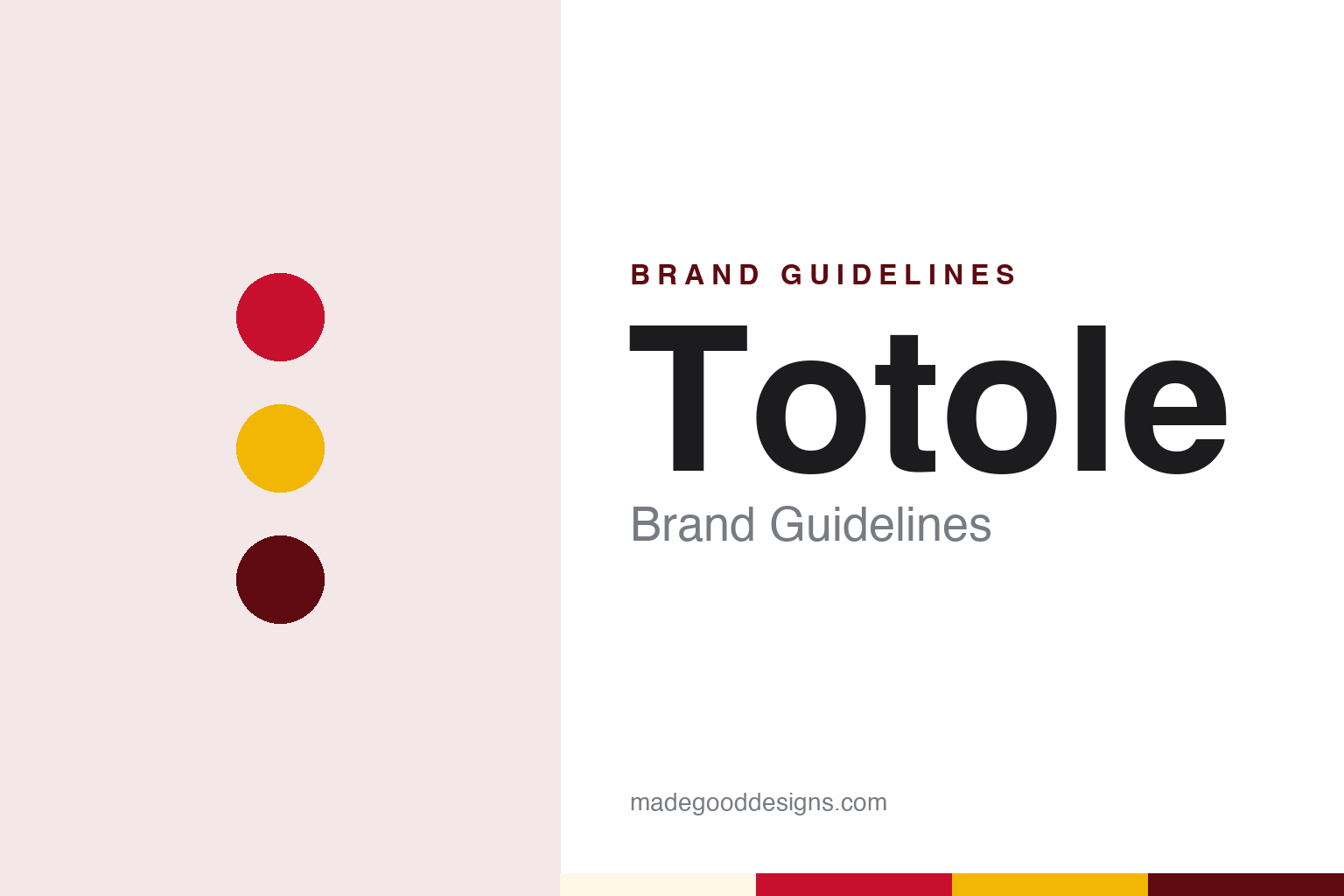
Two constants: a kitchen red and broth gold palette and a sturdy grocery sans register. Abstract homage — not a Totole product or mark; no pack, jar or logo is reproduced.
Essence of fresh chicken
A food technologist, two poor counties and a new seasoning.
Totole was founded in Shanghai in 1988, Chinese Wikipedia and the company agree, but its product is a few years older. A company timeline archived from the Totole website in 2008 says that in 1984 its founder, Rong Yaozhong, developed a seasoning with chicken as its base and named it jijing — usually translated as “chicken essence” — meaning, the company says, “the essence of fresh chicken.” Totole describes it as a third-generation compound flavour seasoning.
The idea came out of poverty-relief work. The company’s history says Rong, then working as a technical expert for the China National Food Industry Association, was sent in 1984 to two officially poor counties, Nanle in Henan and Puge in Sichuan, where many farmers kept chickens but struggled to sell them. The company says turning the meat into a seasoning that could be shipped was its answer. Totole says a first, small chicken-essence line was set up in Nanle in 1984, and that in 1985 a closed fructose plant in Puge was converted to make it. The Henan venture faltered, the company says, while the Sichuan one found a market in its province.
In 1988, by the company’s account, Rong decided to build a business of his own around the product, and in January 1989 the Totole chicken-essence factory began production in Jiading, on the north-western edge of Shanghai. Exports followed quickly: the timeline dates the first shipments to the United States to December 1993, with sales spreading to Canada, and says a Los Angeles company founded that year handled the products in North America. In August 1995 the foundation stone was laid for a much larger plant in Shanghai, designed for 56,000 tonnes of chicken essence a year; the company says it was completed in July 1999.
Colour
A new name, a newspaper and Ogilvy’s violin.
The Totole name itself dates from May 1996. The company timeline says that month it replaced its earlier trademark, Jiale, and established the Totole brand — in Chinese Taitaile, which can be read as “wives’ happiness.” Chinese Wikipedia gives the same year for the change. In October 1997 the business took the name Shanghai Totole Seasoning Food Co., Ltd.
The brand was built partly through the home cook. In June 1996, the company says, it set up a consumer club and launched its own newspaper, the Totole Bao. In 1998 it hired Ogilvy to plan and make a new television advertisement for its chicken essence, known as the “Violin” film, together with all-new packaging; the timeline says the aim was to lift the brand’s image. Later films followed on family themes, with titles the company gives as the mother, chef and family ads. In April 2005 a family advertisement directed by the film-maker Feng Xiaogang, with the actress Jiang Wenli as the brand’s face, ran on television stations across China, the company says.
From January 2000, Totole says, it was the exclusive sponsor of Tiantian Yinshi, a daily cooking programme on China Central Television; it later sponsored cooking shows on CCTV, Phoenix Television and Shanghai channels, and in 2003 the national cooking-skills competition. The company also says it led the drafting of China’s industry standard for chicken-essence seasoning, issued in July 2004, and of the chicken-powder standard that took effect in July 2007.
Totole has also opened its production to visitors. In January 2007, the company says, its factory became a Shanghai industrial-tourism site, and Chinese Wikipedia says an Umami Museum was built there in 2013.
Typography
Design and documentation.
The seven brands in this group all make food or drink, and all of them come from mainland China, from groups founded in Taiwan, or from Hong Kong: Haday, Wahaha, Master Kong, Want Want, White Rabbit, Totole and Vitasoy. Chinese food and drink brands in general sit at many different points in the trade, from firms that still carry a founder’s family at the top to names that now belong to much larger groups, and a single brand can be sold everywhere from a corner shop to a supermarket shelf abroad.
A food or drink brand’s identity is usually carried less by a single product than by a pack, a name and the meal or snack it promises, because the company behind the name may have changed hands, moved its factories or grown far beyond the city where it started. That makes the questions behind each name worth asking plainly: who started it, who owns it now, and where its products are actually made and packed.
Each guide separates what independent sources record from what the company says about itself — its founding story, its owners over time, where its products are made and how its packaging has changed — and marks plainly what rests only on the company’s own word.
Aa
A sturdy grocery sans for a seasoning sold in kitchens and restaurants. (Specimen set in Barlow, a sans STAND-IN; NOT the Totole logo.)
Totole
A Shanghai brand in the Nestlé family.
Totole has belonged to Nestlé since 1999. Chinese Wikipedia says the company joined Nestlé that year, and the company’s own timeline says that in September 1999 Totole completed its cooperation with the Swiss company and became “a member of the Nestlé family”; in January 2000, it adds, it adopted Nestlé’s quality management system. The same year, 1999, Totole chicken essence was launched in Hong Kong and sold on to Southeast Asia and Australia, the company says.
The business has kept its own name and base. In December 2005 it was renamed Shanghai Totole Food Co., Ltd., and Chinese Wikipedia places its headquarters in Jiangqiao, in Shanghai’s Jiading district, where the first factory opened in 1989. That year, 2005, the company says, Totole chicken essence was named a China Famous Brand product in the chicken-essence category. Its website in 2026 lists chicken essence and chicken powder alongside broth bases, recipe seasonings and sesame oil, and it also carries Nestlé’s Maggi seasoning sauce, the Swiss group’s older flavouring brand; one product is sold in packaging made only for the United States.
The brand’s Chinese slogan on its website today plays on freshness, saying that fresh ingredients lead naturally to fresh flavour. Totole’s design history is mainly an advertising history: a renamed brand in 1996, a professionally made television film and new packaging in 1998, and from 2000 a run of sponsored cookery programmes on national and regional television.
For a design guide, Totole shows how a seasoning brand from a single Shanghai factory built national recognition through a new name, an agency-made pack and television, and kept that identity after a multinational took over. Compare Maggi, Nestlé’s Swiss seasoning brand, and Lee Kum Kee, another Chinese sauce and seasoning house. For this guide we use kitchen red, broth gold and soy brown on rice cream with a sturdy sans, an unofficial interpretation; no product or logo is reproduced.
Explore & save
Keep Totole’s identity on hand — save it to a board in the Made Good inspiration library.
Totole identity set
Pin the Totole kitchen red and broth gold palette and the sturdy grocery sans register to your own board.