Uludağ Brand Guidelines
The Bursa mineral water and gazoz named after a mountain.
Aa
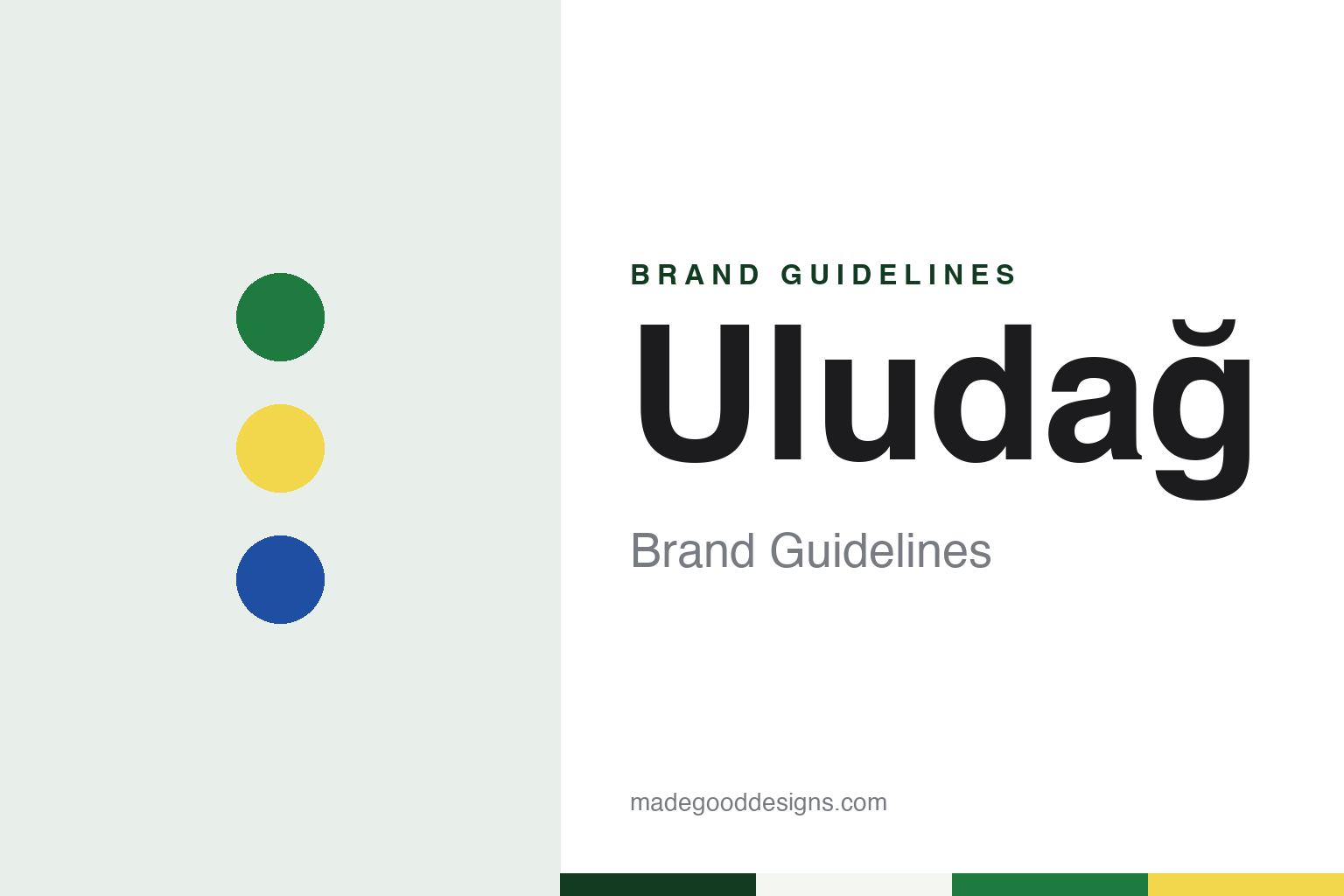
Two constants: a bottle green, lemon and cobalt palette and a sturdy grotesque sans register. Abstract homage — not an Uludağ product or mark; no bottle, label or logo is reproduced.
A spring, a mountain and a gazoz
From an Ottoman licence to a family firm in Bursa.
Uludağ is the drinks brand of Uludağ İçecek, a family company in Bursa, in north-western Türkiye, best known for its mineral water and for Uludağ Gazoz, a sweet carbonated soft drink. The brand counts its age from a mineral spring rather than from the soft drink. The company says the spring, then known as the Keşiş Mountain mineral water, was bought by İbrahim Talat Bey and a French partner in 1870, and that the business received its operating licence on 26 May 1912, under Sultan Mehmed V Reşad. A partner in those years, the company says, was Hüseyin Sıtkı Bey (later Ulusu), İbrahim Talat’s brother-in-law, to whom the concession passed in 1923.
The name came from the mountain. Keşiş Dağı, the high mountain above Bursa, was renamed Uludağ in the mid-1920s; the company says the new name followed a 1925 climb on which a Bursa doctor, Osman Şevki, exclaimed at what a grand mountain it was, and that its water took the same name in 1926. A new concession, the company says, was granted on 29 January 1930 in a document signed by Mustafa Kemal, and on 10 May 1931 the business became Uludağ Maden Suları Türk Limited, with the right to carry the word “Türk” in its title.
The family that runs Uludağ today arrived through soft drinks. Mehmet Hakkı Erbak, a Bursa-born insurer, owned the Nilüfer Gazoz factory, which made drinks under the Nilüfer name. The company says that in 1931 Hüseyin Sıtkı agreed with him to distribute Uludağ mineral water in and around Bursa, and that in November 1933 Mehmet Hakkı took over the right to run the business. Mehmet Hakkı’s younger son, Nuri Zafer Erbak, devised the recipe for Uludağ Gazoz; the company’s Turkish history dates it to 1932, while its US trademark for Legendary Uludağ Gazoz carries the year 1930. In 1958, the company says, Hüseyin Sıtkı’s shares passed by his will to the Erbak family. Habertürk reported in 2014 that in 1958 Nuri Erbak and his wife Neriman Erbak took over the shares.
Colour
Green bottles, a mountain label and a cobalt carafe.
Uludağ Gazoz is the brand’s best-known export. German Wikipedia describes its standard version as a mixed-fruit-flavoured soft drink, often compared with Sprite or 7 Up, and notes that its green bottles and cans are sold not only in Turkish shops abroad but in supermarket chains such as Edeka and Rewe in Germany and Coop in Switzerland. It also says the labels carry a drawing of Mount Uludağ, and that the drink was once made only with spring water from the mountain. In Turkish the company calls the drink the Efsane Uludağ Gazozu — the “Legendary” Uludağ Gazoz.
Bottles take up much of the company’s own history. It says its 250 ml glass bottle won a World Packaging Organization award, that it brought back the Gazoz bottle it had used from 1967 to 1984, and that it named its orange gazoz Uludağ Sarı after the everyday Turkish word for orange soda, “sarı,” or yellow. For Uludağ Premium, a lightly sparkling mineral water, it commissioned a cobalt-blue bottle from the Turkish fashion label Dice Kayek, which the company says drew on Ottoman glassmaking and vintage French Baccarat carafes; the company says the bottle later won a design award at the WorldStar packaging awards and a golden packaging award from the Turkish Standards Institute.
Advertising has leaned on the “legendary” idea. The company says a Legendary Uludağ Gazoz campaign built around the line “Be a Legend” won two gold Effie awards, and that Gazoz advertising has also won Crystal Apple advertising awards. Packs have also been used for sponsorship: the Bursa news agency İGFA reported in May 2024 that Frutti Extra, the brand’s fruit-flavoured mineral water, had been an official sponsor of basketball’s EuroLeague Final Four since 2019, and that the company had issued special 250 ml glass bottles with drawings of players from the competing teams on three label designs.
Typography
Design and documentation.
The seven brands in this group all make food or drink, and all of them come from Türkiye: Ülker, Torku, Pınar, Tat, Tukaş, Dimes and Uludağ. Turkish food and drink brands in general sit at many different points in the trade, from family firms that still carry a founder’s surname to names that now belong to much larger groups, and a single brand can be sold everywhere from a corner grocer to a supermarket shelf.
A food or drink brand’s identity is usually carried less by a single product than by a pack, a name and the meal or refreshment it promises, because the company behind the name may have changed hands, moved its factory or grown far beyond the town where it started. That makes the questions behind each name worth asking plainly: who started it, who owns it now, and where its products are actually made and packed.
Each guide separates what independent sources record from what the company says about itself — its founding story, its owners over time, where its products are made and how its packaging has changed — and marks plainly what rests only on the company’s own word.
Aa
A sturdy grotesque sans for a brand named after a mountain. (Specimen set in Archivo, a sans STAND-IN; NOT the Uludağ logo.)
Uludağ
Still a Bursa family company.
Uludağ has stayed with the Erbak family. The company says it is run by Nuri Erbak’s children and grandchildren, the third and fourth generations, and its board pages name his son Mehmet H. Erbak as chairman since 1993. In a 2014 interview with Habertürk, Mehmet Erbak said foreign companies regularly proposed partnerships and that the family turned them down, and that the Gazoz formula his father devised in the 1930s was still in use and kept secret. The company name has changed over the decades, from Uludağ Maden Suları Türk Limited to Erbak-Uludağ İçecek A.Ş.; in 2024 news coverage it appears as Uludağ İçecek Türk A.Ş.
Production stays in Bursa, the company says. It makes all of its soft drinks, including Gazoz and Uludağ Limonata, at a beverage factory in the Yenice area of Bursa, and bottles its natural mineral water at a separate facility near Çaybaşı village on the slopes of Uludağ, where it says the water has been bottled since 1912; the fruit-flavoured Frutti mineral waters are made there too. Turkish Wikipedia lists the range as Uludağ Gazoz, Frutti, Frutti Extra, the mineral water, Limonata and an energy drink, and German Wikipedia says the drinks were exported to more than 30 countries as of 2018. The company says it began exporting Uludağ Gazoz to the United States, and that it distributes directly with its own vehicles in Bursa, Istanbul, Izmir and Ankara.
For a design guide, Uludağ shows how a mountain’s name, a green bottle and a word like “legendary” can carry one brand from an Ottoman spring licence to supermarket shelves in Germany and Switzerland. Compare Tamek, another Bursa food maker, and Eti, the Eskişehir biscuit brand. For this guide we use a bottle green, a lemon yellow and a cobalt blue with a sturdy grotesque sans, an unofficial interpretation; no product or logo is reproduced.
Explore & save
Keep Uludağ’s identity on hand — save it to a board in the Made Good inspiration library.
Uludağ identity set
Pin the Uludağ bottle green, lemon and cobalt palette and the sturdy grotesque sans register to your own board.