Franck Brand Guidelines
The Zagreb chicory works that became Croatia’s coffee.
Aa
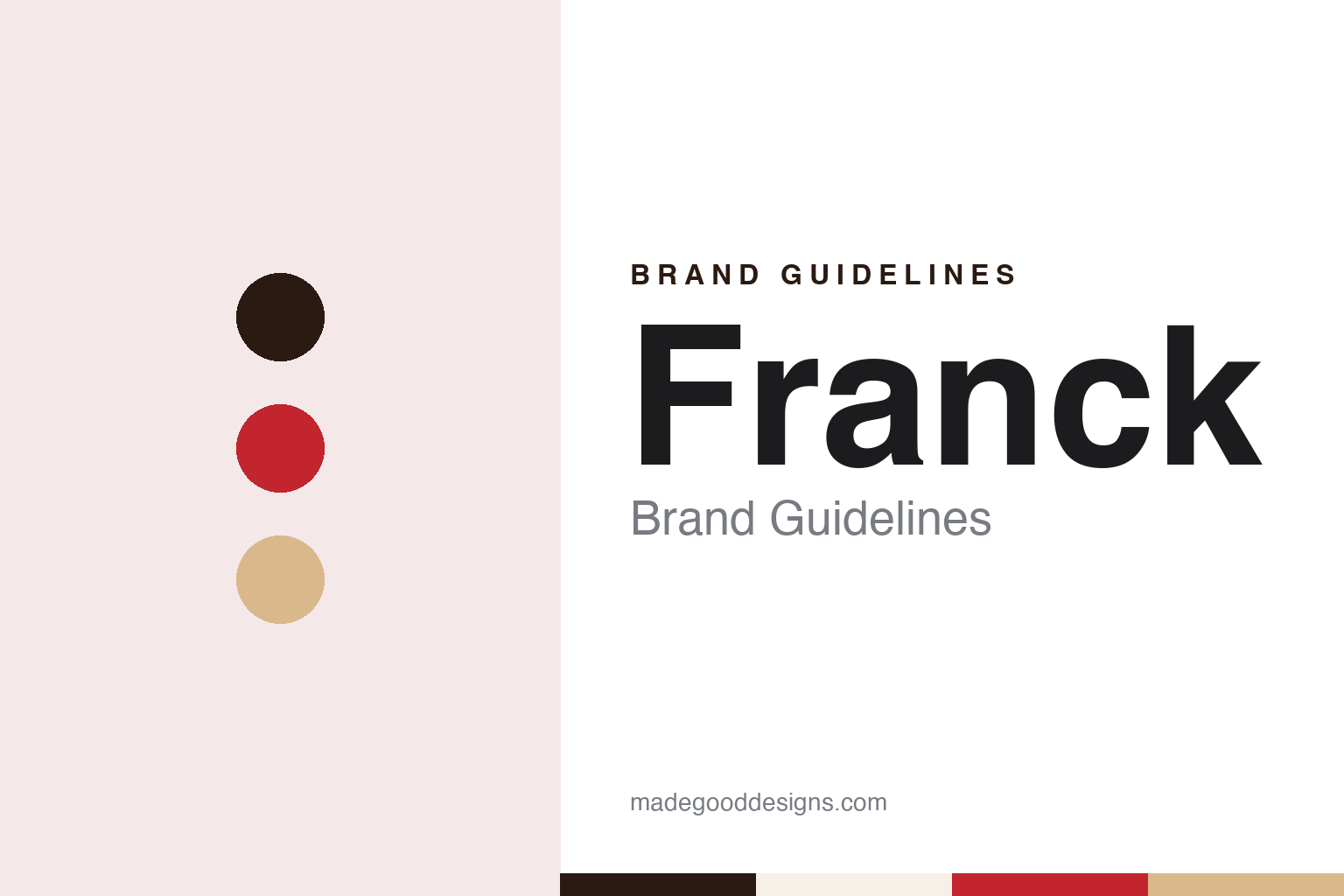
Two constants: a brick red, roast and crema palette and a sturdy grotesque register. Abstract homage — not a Franck product or mark; no pack, logo or brick is reproduced.
A chicory branch in Zagreb
A Württemberg merchant’s coffee substitute crosses into Croatia.
Franck is a Zagreb company, but its name comes from Württemberg. German Wikipedia says Johann Heinrich Franck settled in Vaihingen an der Enz in 1822 as a merchant and confectioner and in 1828 began factory-scale production of a coffee substitute made from chicory root; the Zagreb company’s own history uses the 1828 date, while its company profile says Franck was founded in 1827. The firm, Heinrich Franck Söhne, moved to Ludwigsburg in 1868–69 and spread across Europe: German Wikipedia lists branches in Linz in 1879, in Bohemia, Milan and Basel in 1883, and in Zagreb in 1892, followed by a factory in New York in 1895.
The Zagreb branch was built for chicory. The company says it opened in 1892 on Vodovodna ulica, where the company still has its seat, and that construction of a chicory-processing factory began there that year; Croatian Wikipedia dates the start of production to 21 June 1893. Croatian Wikipedia also says a chicory-drying plant opened in Bjelovar in 1900, pearl barley followed in 1910 and a Kneipp malt-coffee substitute in 1918.
The Zagreb factory went its own way after the Second World War. Croatian Wikipedia says it was nationalised by the communist authorities in 1945, the year, the company says, that the coffee substitute sold as “Franck” reached the Croatian market. In 1950, the company says, Franck was handed over to workers’ management under Yugoslavia’s self-management system. The German parent continued separately: German Wikipedia says Heinrich Franck Söhne merged with Kathreiner in 1944 and that its holding company was acquired by Nestlé in 1971.
Colour
Jubilarna, the “ciglica.”
Coffee came late to a company built on coffee substitutes. Croatian Wikipedia dates Franck’s first coffee production to 1960, with puddings and instant drinks following in the early 1960s, and English Wikipedia says the factory made its first tea filter bags in 1968.
The product that defines Franck is Jubilarna. The company dates it to 1972, the year it also launched the Minas and Prima coffees. Croatian Wikipedia calls Jubilarna the symbol of Franck and says it is popularly known as the “ciglica” — “little brick” — because of its distinctive shape and its red colour. The company still sells it under the Jubilarna name more than five decades later.
Packaging technology runs through the company’s own timeline. Franck says its Ideal 100 g of 1982 was the first vacuum-packed coffee, and that for its centenary in 1992 it launched Gold 100, a vacuum-packed coffee with a valve. Croatian Wikipedia says the first Franck fruit teas, in blueberry, apricot and tropical flavours, came in 1991.
Franck also spent four decades in snacks. The company says it opened a potato-processing plant at Hercegovec in 1977 and began making Čipi Čips, which it calls the first Croatian potato chips. In 2015, according to Croatian and English Wikipedia, it formed the Adria Snack Company as a joint venture with the German snack maker Intersnack, and in 2018 it sold its stake to Intersnack. Croatian Wikipedia says the Čipi Čips campaign won a Grand Prix and a Gold Effie in 2014, with a Silver Effie for a Franck Café cappuccino campaign.
Typography
Design and documentation.
The seven brands in this group all make food or drink, and all of them come from Croatia: Dukat, Vindija, Zvečevo, Franck, Cedevita, Jamnica and Ledo. Croatian food and drink brands in general sit at many different points in the trade, from firms that still carry the name of the town or region where they started to names that now belong to much larger food groups, and a single brand can be sold everywhere from a corner kiosk to a supermarket shelf.
A food or drink brand’s identity is usually carried less by a single product than by a pack, a name and the everyday moment it promises, because the company behind the name may have changed hands, moved its production or grown far beyond the town where it started. That makes the questions behind each name worth asking plainly: who started it, who owns it now, and where its products are actually made and packed.
Each guide separates what independent sources record from what the company says about itself — its founding story, its owners over time, where its products are made and how its packaging has changed — and marks plainly what rests only on the company’s own word.
Aa
A sturdy grotesque for a coffee known by the shape of its brick. (Specimen set in Libre Franklin, a sans STAND-IN; NOT the Franck logo.)
Franck
Privatised in 1992 and growing across the region.
The Zagreb company left state hands in its centenary year. Croatian Wikipedia says the factory became private property in 1992 and that Franck became wholly owned by its employees at that point; the company today trades as the joint-stock company Franck d.d., with its seat still on the Vodovodna ulica site where the chicory works was built.
Growth since then has come through regional brands and plants. The company says it set up a subsidiary in Sarajevo in 2000; in 2008 it bought the Victoria factory and brand and founded a coffee-processing plant at Grude, in Bosnia and Herzegovina; and in 2009 it bought the Gloria factory and brand. Croatian Wikipedia adds that in 2015 Franck took over the Slovenian brands Santana and Loka. The company lists offices across the former Yugoslavia and Albania, from Ljubljana and Belgrade to Skopje, Podgorica, Tirana and Priština, and describes itself as one of Croatia’s most successful food manufacturers and exporters, with leading positions in coffee and tea.
The heritage is now used in hospitality and partnerships. For the company’s 130th anniversary in 2022, Franck says, it opened a Franck Experience Store in central Zagreb, and it runs a café, bistro and bar under the Johann Franck name, after the founder. In 2024 it announced a collaboration with the Zagreb confectioner Kraš, launching cappuccino flavours inspired by Kraš pralines.
The name has two lives. In Croatia, Franck means the independent Zagreb coffee and tea company; in Germany, the Franck chicory tradition passed with Heinrich Franck Söhne into Nestlé, where German Wikipedia says the Ludwigsburg works closed in 2018. This guide covers the Zagreb company only.
For a design guide, Franck shows how a single pack can become a brand: a red brick of coffee so familiar that it has its own nickname, backed by a 19th-century chicory story the company now uses for its cafés. Compare it with Kraš, its Zagreb neighbour and 2024 partner, and with Thomy, another name tied to the German Franck firm’s later history. For this guide we use brick red, roast and crema with a sturdy sans, an unofficial interpretation; no product or logo is reproduced.
Explore & save
Keep Franck’s identity on hand — save it to a board in the Made Good inspiration library.
Franck identity set
Pin the Franck brick red, roast and crema palette and the sturdy grotesque register to your own board.