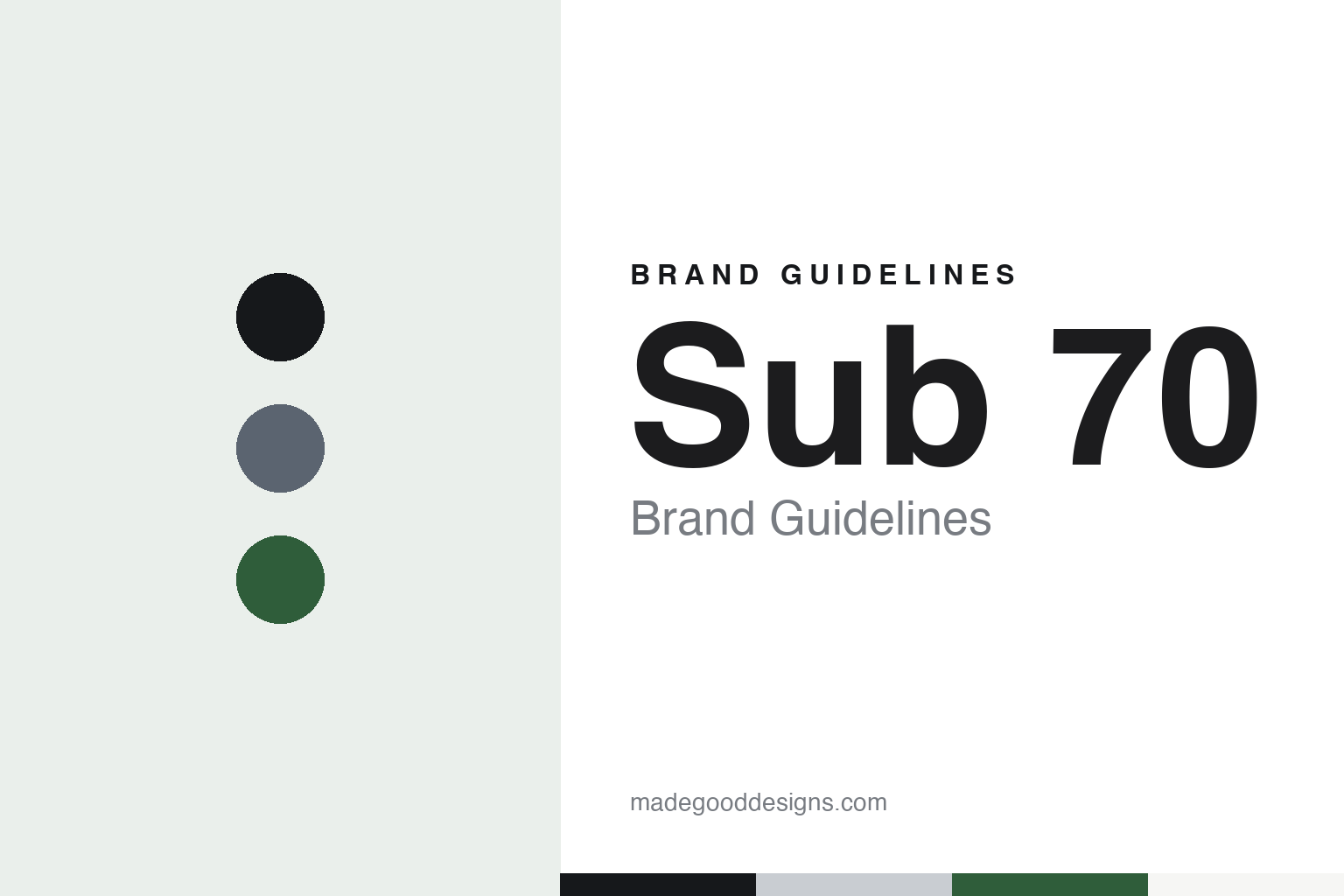
Sub 70 Brand Guidelines
The Sycamore club maker that sells direct and builds to order.
Aa
Two constants: a carbon black, steel grey and prairie green palette and a plain workshop sans register. Abstract homage — not a Sub 70 product or mark; no club, logo or headcover is reproduced.
A barn roof and a junior six-iron
A founder from the components trade starts a brand of his own.
Sub 70 Golf is a golf club company based in Sycamore, Illinois, the county seat of DeKalb County, west of Chicago. It was started by Jason Hiland, who was still its owner when the Wisconsin golf blog WiscoGolfAddict described it in July 2022 as “the Sycamore, Illinois based club manufacturer Sub 70,” “started by current owner Jason Hiland.”
Hiland’s own account of the company’s beginnings appears in an interview with the business site Starter Story. There he says he established a company called Diamond Tour Golf in 1995 and founded Hurricane Golf in 2008, before launching what he calls his “true passion project,” Sub 70 Golf, in 2018; the same interview says the website went live in December 2018. The company’s question-and-answer page, as archived in July 2019, said Hiland had worked in the golf equipment industry for more than 25 years. An archived capture of the website from August 2018 already carried the name, with a single line promising “hand-crafted, custom-fit, ultra-premium golf equipment.”
The company tells its origin as a childhood story. Its “Our Story” page, archived in 2019, describes Hiland at nine years old standing on the roof of his parents’ barn in the Midwest summer, hitting worn balata balls through the trees and fence posts with a junior six-iron his father had let him choose at the local farm store. The page sets that memory against an older picture of club-making — clubs “handcrafted by a man you knew,” built by someone who lived in your town and might play in your Saturday four-ball — and presents Sub 70 as Hiland’s attempt to bring that feeling back. Those words are the company’s own, and they frame everything else it says about itself.
Colour
Clubs assembled to order, in one Illinois town.
The central promise is where the clubs are put together. The 2019 question-and-answer page said: “All clubs will be built when ordered in Sycamore, IL,” that customers could ask for their own length and lie adjustments, shafts and grips, and that “nothing will be ‘stock.’” It said the company had a staff of more than 20 and described the stock shafts in its woods as True Temper Project X shafts made specifically for Sub 70 with input from True Temper; those are the company’s statements. Its “About Us” page, in the 2019 archived version and again in a 2025 capture, says that “the people that started Sub 70 are also the people that build your clubs, answer your calls, and play a lot of golf.”
What the company says about the heads themselves is more general. The “Our Story” page says its irons are “forged in the same fires as many of the artful irons of the major club makers,” that its putters are milled from carbon steel and hand-painted, and that its wedges are CNC-milled and hand-ground. It also says each box arrives with a handwritten note from the person who assembled the clubs, with a number to call.
The product names are mostly numbers. The company’s 2019 menu listed 639 forged irons in muscle-back and cavity-back forms, the 699 irons, a 739 iron-and-hybrid combination, an 839D driver and 939X fairway woods and hybrids, along with a putter series named after the town, the Sycamore 001 blade, 002 mid-mallet and 003 mallet. By 2025 the menu had grown to include the 659 and 669 iron families, later versions of the 699, a TAIII range and JB forged wedges, alongside pre-owned clubs, loose heads for other builders and apparel.
Typography
Golf clubs and documentation.
The seven brands in this group all make golf clubs: Cobra, Ben Hogan, Cleveland, PXG, Tour Edge, XXIO and Sub 70. A golf club brand has to work inside a narrow set of rules. The R&A and the United States Golf Association set what shapes and physical characteristics of clubs are allowed in competition, and the Rules of Golf limit a player to a maximum of 14 clubs in the bag, English Wikipedia notes — so every maker is designing variations on the same few objects: woods and drivers, irons and wedges, hybrids and putters.
Because the objects are so tightly defined, identity tends to live in the details: the shape of a head seen at address, the finish on a forged or cast iron, the name or number stamped on the sole, the colour of a headcover, and the way a brand sells and fits its clubs. Many modern iron heads are investment-cast from steel alloys, while forged irons remain popular with skilled players, English Wikipedia says, and heads, shafts and grips can be combined and fitted to a player in a great many ways.
The brands here differ in age, in ownership and in how they sell their clubs; two of them, Tour Edge in Batavia and Sub 70 in Sycamore, are Illinois companies, according to their own websites. Each guide separates what independent sources record from what the company says about itself — who founded it, who owns it now, where its clubs are designed, made and assembled, and how its marks have changed — and marks plainly what rests only on the company’s own word.
Aa
A plain, sturdy sans for a numbered workshop line. (Specimen set in Barlow, a sans-serif STAND-IN; NOT the Sub 70 logo.)
Sub 70
Expectations Redefined.
Much of Sub 70’s identity is carried by words rather than an emblem. The website has carried the tagline “Expectations Redefined” since at least 2019, and the August 2018 capture already spoke of “redefining expectations.” The “About Us” page says the company has no advertising budget and no third party marking up its clubs; in the 2025 version it adds that by “cutting out the middleman” Sub 70 can sell for less than traditional retail channels and offer more custom options and limited editions. In the Starter Story interview Hiland describes the business the same way — “we have cut out the middleman” — and names the designer Tom Ford and the watch executive Jean-Claude Biver, of Hublot, as inspirations for its branding.
The model has a physical side too. In the 2022 WiscoGolfAddict piece Hiland called The Seventy “our state of the art fitting location in Sycamore, IL,” and the writer described visiting the company’s fitting centre in downtown Sycamore. The name also appears on the company’s own merchandise, such as tees and ball markers sold under “The Seventy” in 2021 and 2022. By 2025 the website also listed a trade-in programme, international distributors, travelling fitting-cart locations and brand ambassadors, and its “In the News” page collected reviews from MyGolfSpy, Driving Range Heroes and the fitting channel TXG.
For a design guide, Sub 70 shows how a small direct-to-consumer brand can make its town and its workbench part of the name: a putter line called Sycamore, a fitting room called The Seventy, and a note from the assembler in every box. Compare Tour Edge, another Illinois club maker, based in Batavia, and PXG, another American golf club brand. For this guide we use carbon black, steel grey and prairie green with a plain sans, an unofficial interpretation; no product or logo is reproduced.
Explore & save
Keep Sub 70’s identity on hand — save it to a board in the Made Good inspiration library.
Sub 70 identity set
Pin the Sub 70 carbon black, steel grey and prairie green palette and the plain workshop sans register to your own board.