Oscar Mayer Brand Guidelines
A Chicago sausage maker, a yellow paper band and a hot dog on wheels.
Aa
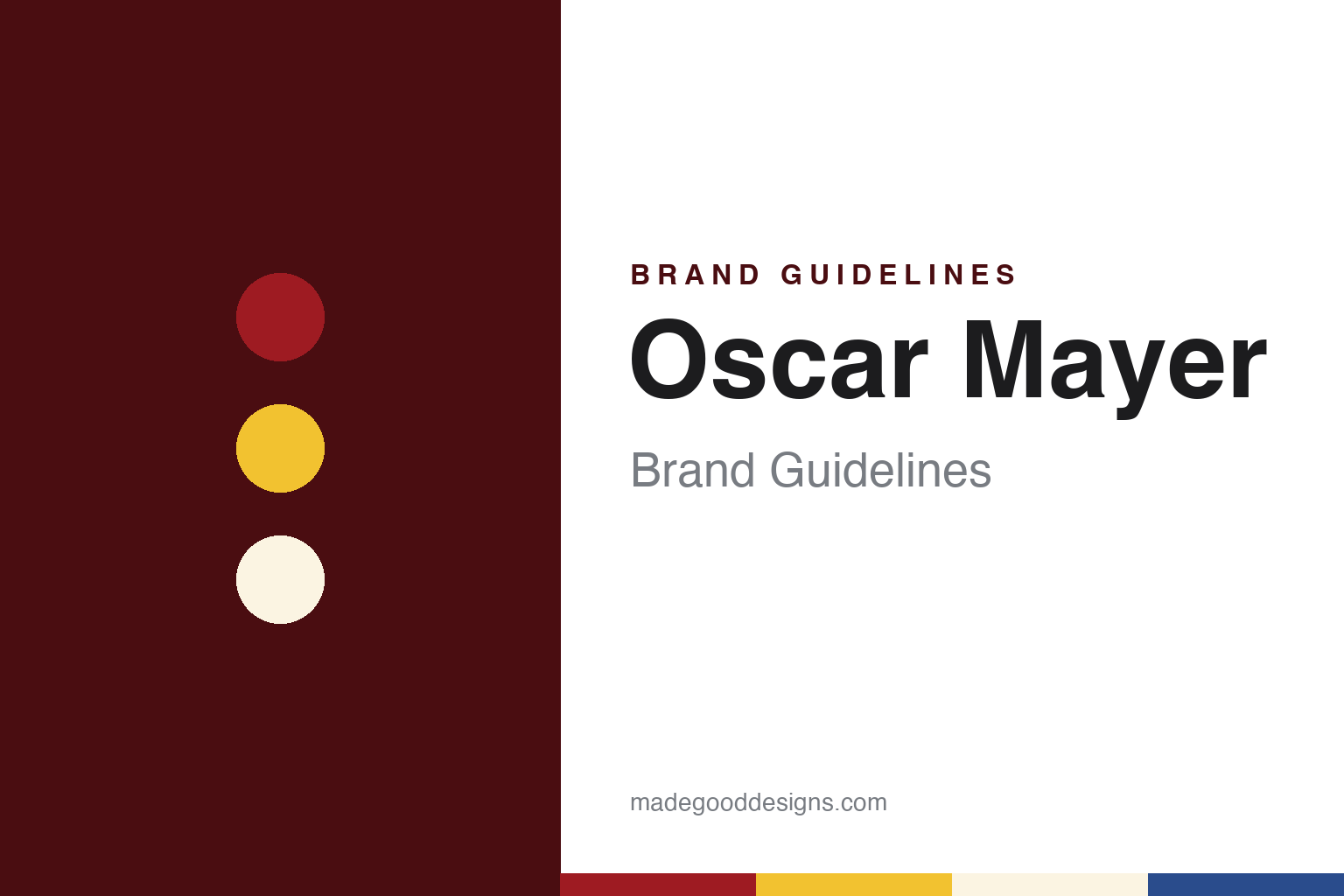
Two constants: a wiener red, band yellow and bun cream palette and a rounded display sans register. Abstract homage — not an Oscar Mayer product or mark; no package, vehicle or logo is reproduced.
A leased market on the North Side
Two brothers from Württemberg, a failing shop and a horse-drawn wagon.
Oscar Mayer is an American brand of hot dogs, bacon, bologna and cold cuts, owned today by Kraft Heinz. It carries the name of a real person. The Takeout reported in October 2019 that Oscar F. Mayer emigrated to the United States in 1873 from Kaesingen, in Württemberg, Germany. He worked first in a meat market in Detroit, the article said, and then moved to Chicago, where he apprenticed as a buyer in the Armour & Co. stockyards.
The business itself began in 1883. The Takeout says Oscar persuaded his brother Gottfried, a sausage-maker, to join him in Chicago, and that the two leased a failing meat market on the city’s North Side. A biography of the founder’s son published by the Meat Science programme at the University of Wisconsin–Madison names Oscar F. Mayer and Gottfried as the founders of the firm in 1883 and describes the first premises as a small retail meat market on Chicago’s near north side.
The early firm traded as Oscar F. Mayer & Bro., according to The Takeout. It set itself apart with its sausage, made to a recipe that Gottfried kept in a small black book, and with deliveries across the city and its suburbs by horse-drawn wagon. Five years after the lease, the article says, the brothers bought a building of their own. Oscar also sponsored polka bands in Chicago and took a booth at the 1893 World’s Fair, The Takeout reported.
The company formalised its structure in the following decades. The University of Wisconsin biography says the firm was incorporated as Oscar F. Mayer & Brothers in 1911 and renamed Oscar Mayer & Co. in 1919. That same year it made its first move outside Chicago. The biography says Oscar G. Mayer, the founder’s son, who had graduated from Harvard in 1909 and joined the family business, saw a bankrupt farmers’ cooperative meat-packing plant for sale in Madison, Wisconsin, and recommended buying it to secure a supply of raw materials. He became the company’s president in 1928.
Colour
A family firm, General Foods, Kraft and Kraft Heinz.
For close to a century the company stayed in the family. Mental Floss reported in March 2016 that Oscar Mayer remained a family-run business until 1981, when it was sold to the General Foods Corporation. The same article says the company had already bought the turkey brand Louis Rich in 1979, and that it introduced Lunchables in 1988, packing its bologna with crackers and cheese as a kit children could assemble themselves.
General Foods did not stay independent for long. Mental Floss said Philip Morris acquired General Foods soon afterwards and in 1989 placed Oscar Mayer under its newly acquired Kraft business. The present owner took shape in 2015. The Associated Press, in a report carried by PBS NewsHour on 2 September 2025, said Kraft Heinz was formed in 2015, when Warren Buffett and the Brazilian investment firm 3G Capital decided to merge Heinz with Kraft. Kraft Heinz has owned Oscar Mayer since that merger; FreightWaves described Oscar Mayer as a subsidiary of Kraft Heinz in January 2023.
The merger brought the brand back to the city where it began. PBS Wisconsin’s programme Here and Now reported on 6 November 2015 that the company had announced it would relocate its corporate headquarters to Chicago, and that the Madison operation, close to a century old, would close within 12 to 24 months.
Another change of structure was announced in 2025. The same Associated Press report of 2 September 2025 said Kraft Heinz planned to split into two companies. One, provisionally called North American Grocery Co., would include legacy brands such as Oscar Mayer, Maxwell House, Kraft Singles and Lunchables. The other, provisionally called Global Taste Elevation Co., would include Heinz, Philadelphia cream cheese and Kraft Mac & Cheese. The AP said the company expected the transaction to close in the second half of 2026, with the official names of the two companies to be released later.
Typography
Design and documentation.
The brands in this group sell hot dogs, sausages, sliced deli meats and breakfast meats, foods that are bought chilled or frozen and are often chosen quickly from a long refrigerated case. Packaging in this category has to work at a glance: a name, a colour and a picture of the food have to be legible through clear film or on a small carton, under bright supermarket lighting, next to many similar packs.
That is why identity in this part of the grocery trade tends to rest on a few repeated signals rather than on a single container. A wordmark, a founder’s name, a slogan, a mascot or a jingle can travel across packs, advertising and sponsorships, while the pack itself changes size and format many times over the decades.
The companies behind these names have often changed hands, merged their factories or moved production, so each guide asks plain questions: who started the brand, who owns it now, where its meat is processed and how its look has been presented. Each separates what independent sources record from what a company says about itself.
Aa
A rounded, heavy display sans — the friendly, lunchbox register of a grocery hot dog. (Specimen set in Lilita One, a rounded display STAND-IN; NOT the Oscar Mayer logo.)
A band, a vehicle and a song
Edelweiss, a yellow paper band, a hot dog on wheels and a jingle written overnight.
The brand name came after an earlier one. The Takeout says that around the turn of the twentieth century the company sold its meat under the name Edelweiss, after the alpine flower, and that the name appeared on its packaging and delivery wagons. During the First World War, the article says, Mayer dropped the Edelweiss branding in the face of anti-German sentiment. After Congress passed the Pure Food and Drug Act in 1906, The Takeout reported, the company added a small purple stamp to its packages reading “U.S. Inspected and Passed”, and from 1915 it bought large newspaper display ads stressing the purity of its sausage.
The device that still identifies the brand dates from 1929. The Takeout, citing the historian Bruce Kraig’s book Hot Dog: A Global History, says the Mayers began putting small yellow bands on their sausages that year. Mental Floss described them as yellow paper bands and said the practice became part of the Oscar Mayer logo, and FreightWaves dated the yellow stripe in the company logo to the same year.
Then came the vehicle. FreightWaves reported in January 2023 that the Wienermobile debuted in 1936, and that Oscar Mayer says the idea came from Carl Mayer, the founder’s nephew. The Takeout names Carl as the company’s advertising manager. The original concept was a 13-foot metal hot dog on wheels, built by the Chicago manufacturer General Body Co., with an open cockpit and the line “Look for the Yellow Label”. It carried a small chef called Little Oscar, who handed out samples; Mental Floss and The Takeout both name Meinhardt Raabe as the first to play him.
FreightWaves traces the vehicle’s later shapes. Wartime gas rationing parked it from 1942. In 1952 the body builder Gerstenslager made five new Wienermobiles on a Dodge chassis, and one of those post-war vehicles is displayed at the Henry Ford Museum of American Innovation in Dearborn, Michigan. A bubble-nosed version of 1958 was created by the designer Brooks Stevens, and a 1969 model used Ford Thunderbird tail lights. The company retired the vehicle in 1977 to focus on television, brought it back in 1986 for its fiftieth anniversary and put six on the road by 1988. Its drivers are recent college graduates known as “hotdoggers”.
Television brought the brand its song. The Takeout says the wiener jingle was written in a single hour on a September night in 1962 by Richard Trentlage, a Chicago advertising man entering a company contest, and recorded with his own children singing; Mental Floss says the words “I wish I were an Oscar Mayer Wiener” first reached the airwaves in 1963. A decade later, Mental Floss reported, a bologna jingle that spelled out the name was filmed with children, and the take that aired was sung on a pier by a boy named Andy Lambros.
For a design guide, Oscar Mayer shows how one colour device, a yellow band first wrapped around a sausage, can move onto a logo, a vehicle and a song while the family name stays at the centre. Compare it with Claussen, another brand founded in nineteenth-century Chicago, and Velveeta, a fellow Kraft brand. For this guide we use wiener red, band yellow, bun cream and jingle blue with a rounded sans, an unofficial interpretation; no product or logo is reproduced.
Explore & save
Keep Oscar Mayer’s identity on hand — save it to a board in the Made Good inspiration library.
Oscar Mayer identity set
Pin the Oscar Mayer wiener red, band yellow and bun cream palette and the rounded display sans register to your own board.