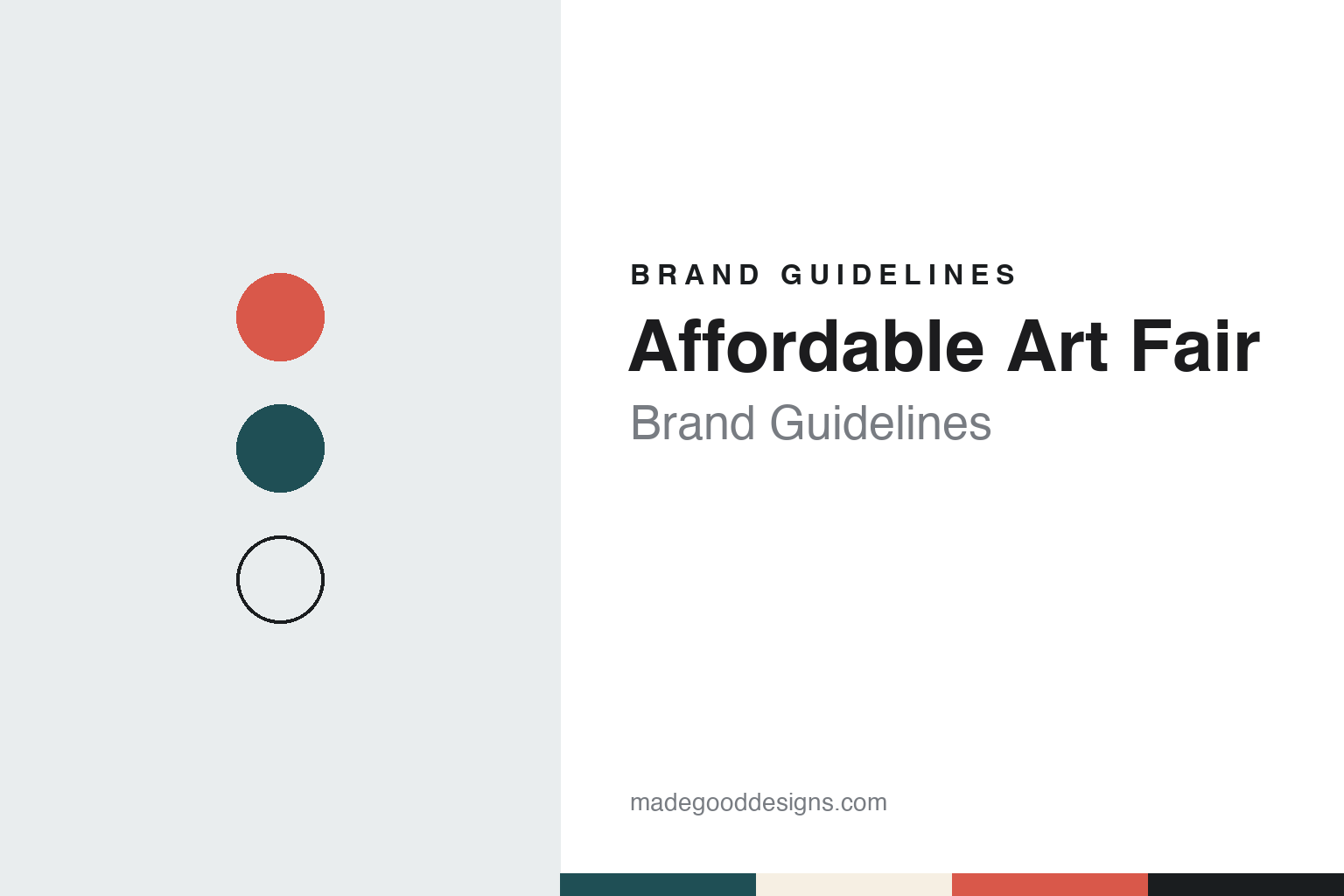
Affordable Art Fair Brand Guidelines
The gallery-led art fair that began in Battersea Park in 1999.
Aa
Two constants: a teal, cream and coral palette and a friendly humanist sans register. Abstract homage — not an Affordable Art Fair asset; no logo, poster or artwork is reproduced.
Battersea, 1999
A gallery owner’s fair in a London park.
Affordable Art Fair is a fair for contemporary art that began in London. English Wikipedia and MoneyWeek, writing in January 2026, both date the first edition to October 1999 in Battersea Park, on the south bank of the Thames, and name its founder as Will Ramsay. In an interview with Spear’s in September 2019, the year the fair turned twenty, Ramsay said he had found commercial galleries intimidating in his early twenties and had first opened a gallery of his own, Will’s Art Warehouse, whose name he described as a riff on the wine retailer Majestic Wine Warehouse. He told the magazine that he knew the idea worked at that first edition, when the aisles were crowded and visitors queued at a wrapping station.
The name describes a part of the market rather than a city. The fair presents original work by living artists through galleries, for people buying art for the first time as well as for collectors. MoneyWeek quoted the UK fair director, Hugo Barclay, in January 2026 as saying that the fair is “predominantly gallery-led,” with galleries taking a space to promote their artists, and that work by 900 to 1,000 artists is typically on show. Galleries rotate about 90 per cent of their artists between the spring and autumn fairs in Battersea. A quarter of the exhibiting galleries come from abroad, according to the same interview.
Ramsay described the selection to Spear’s in 2019: the team visits degree shows to choose artists for a recent-graduates exhibition, looks for galleries at other exhibitions and is approached directly by artists and galleries. In 2026 Barclay said an external curator now visits art schools to choose the graduates shown at the autumn fair in Battersea.
Colour
New York, Amsterdam, a group of fairs and Vienna.
The fair went abroad within three years. English Wikipedia records a New York fair from 2002, an expansion into Europe starting with Amsterdam in 2007, five more cities in 2012 and Hong Kong in 2013. Ramsay, writing for the wealth manager JM Finn, a partner of the fair, in September 2024, listed editions in 13 cities, among them New York, Hong Kong, Amsterdam and Sydney, and three fairs a year in London. MoneyWeek counted 16 cities in January 2026 and described the London pattern: two fairs a year in Battersea, in spring and autumn, close to the river, and one in Hampstead, in north London. Battersea and New York hold spring and autumn editions, English Wikipedia says, while the other cities hold one fair a year.
The company behind the fair has become a group. English Wikipedia says the fair is owned by Ramsay Fairs, which also owns the British Art Fair, held each autumn at the Saatchi Gallery in London, and VOLTA, the fair with editions in Basel and New York. The Art Newspaper reported on 20 November 2019 that VOLTA had been acquired by Ramsay Fairs the month before, and that the group also owned the Pulse fair in Miami at the time. Ramsay wrote in 2024 that the group added the British Art Fair in 2021. The 2020 fairs did not take place in person and moved online, returning to the halls in 2021, according to English Wikipedia.
The newest European city is Vienna. The Austrian broadcaster ORF reported on 22 May 2025 that the fair was being held there for the first time, in the Marx Halle, with work by more than 350 artists shown by more than 60 galleries from Austria and abroad and a programme for children and young people run with the Kunstforum Wien; it quoted the fair director, Tanya Van Breda Vriesman. On 28 May 2026 ORF reported the second Vienna edition in the same hall, with 62 galleries, more than 1,000 works by about 350 artists, a focus on Spain and an accompanying programme of tours, workshops and talks.
Typography
Names, halls, sections.
Many newer art fairs choose their dates in one of two ways. Some open in the same week as a larger fair in the same city, so that collectors and curators who are already in town can walk from one to the other: VOLTA was founded in Basel in 2005 as an alternative fair during the week of Art Basel, and Paris Internationale runs in Paris each October alongside what is now Art Basel Paris. Others take a slot of their own in the calendar and build an audience around it, without a larger neighbour to draw on.
Either way, the name is what holds steady. The city, the building and the edition number change, while the wordmark carries over. VOLTA writes its name in capitals and adds the city, as in VOLTA Basel and VOLTA New York; Paris Internationale kept its Paris name when it held its first edition in Milan in 2026, adding only Milano. A short name travels easily from one city to another and from one building to the next.
Who takes part is decided before the doors open. Some fairs invite their exhibitors; others take applications and pass them to a selection committee, often made up of gallerists, which chooses galleries for the projects they propose as well as for their programmes. The resulting exhibitor list, with each gallery’s city, is published ahead of each edition, as both VOLTA and Paris Internationale do.
The visit itself is designed. Floor plans and maps tell visitors how to move through a hall, a tent or a building of several floors; signage, printed guides, websites and apps carry the exhibitor list, the sections and the programme of talks and tours. At a fair that changes buildings, the signage and stand walls may be reused from year to year, while the campaign image and the venue give each edition its own look.
Aa
A friendly humanist sans for a name that describes an idea rather than a place. (Specimen set in Nunito Sans, a sans STAND-IN; NOT the Affordable Art Fair logo.)
Affordable
Three words that travel from city to city.
The name carries the identity. Affordable Art Fair names an idea rather than a place, so the same three words can move from Battersea to Hampstead, New York or Vienna; in the reports used for this guide only the city and the season change around them.
The visit is designed as a day out as much as a market. Ramsay told Spear’s in 2019 that the fairs offer workshops and demonstrations, such as how an etching is made, cafés and bars, and in some places a crèche, and that children and dogs are welcome. In 2026 MoneyWeek described talks, tours, workshops and evening sessions, activity packs and an “art trail” for children at weekends, and shuttle buses from Sloane Square to Battersea. A recent-graduates section and stands from abroad complete a format that can be repeated in each new city.
For a design guide, Affordable Art Fair shows how a fair can build a brand on a descriptive name and a repeatable format — gallery stands, workshops and a family day out — that opens in a new city without changing its words. Compare VOLTA, the fair Ramsay Fairs bought in 2019, and Frieze, whose London fair MoneyWeek set beside it in the city’s art calendar. For this guide we use a deep teal, a warm cream and a coral with a sans, an unofficial interpretation; no product or logo is reproduced.
Explore & save
Keep Affordable Art Fair’s identity on hand — save it to a board in the Made Good inspiration library.
Affordable Art Fair identity set
Pin the Affordable Art Fair teal, cream and coral palette and the friendly humanist sans register to your own board.
Source & notes
Frequently Asked Questions
What font can I use to match the Affordable Art Fair look?
This guide describes Affordable Art Fair’s type as “A friendly humanist sans for a name that describes an idea rather than a place”. Its type specimen is set in Nunito Sans from Google Fonts as a stand-in; Nunito Sans is not Affordable Art Fair’s own lettering.
What colours are in the Affordable Art Fair palette?
This guide’s Affordable Art Fair palette is Deep teal #1F4F55, Ink #1A1D1F, Cream #F6EFE3, Coral #D9584A and Paper #FBF8F3. The tones are the guide’s own unofficial interpretation, not official Affordable Art Fair hex codes.
When was Affordable Art Fair founded?
Affordable Art Fair was founded in October 1999, in Battersea Park, London.
Who founded Affordable Art Fair?
Affordable Art Fair was founded by Will Ramsay in October 1999.
Who owns Affordable Art Fair?
Affordable Art Fair is owned by Ramsay Fairs. This guide dates Affordable Art Fair to October 1999, in Battersea Park, London.