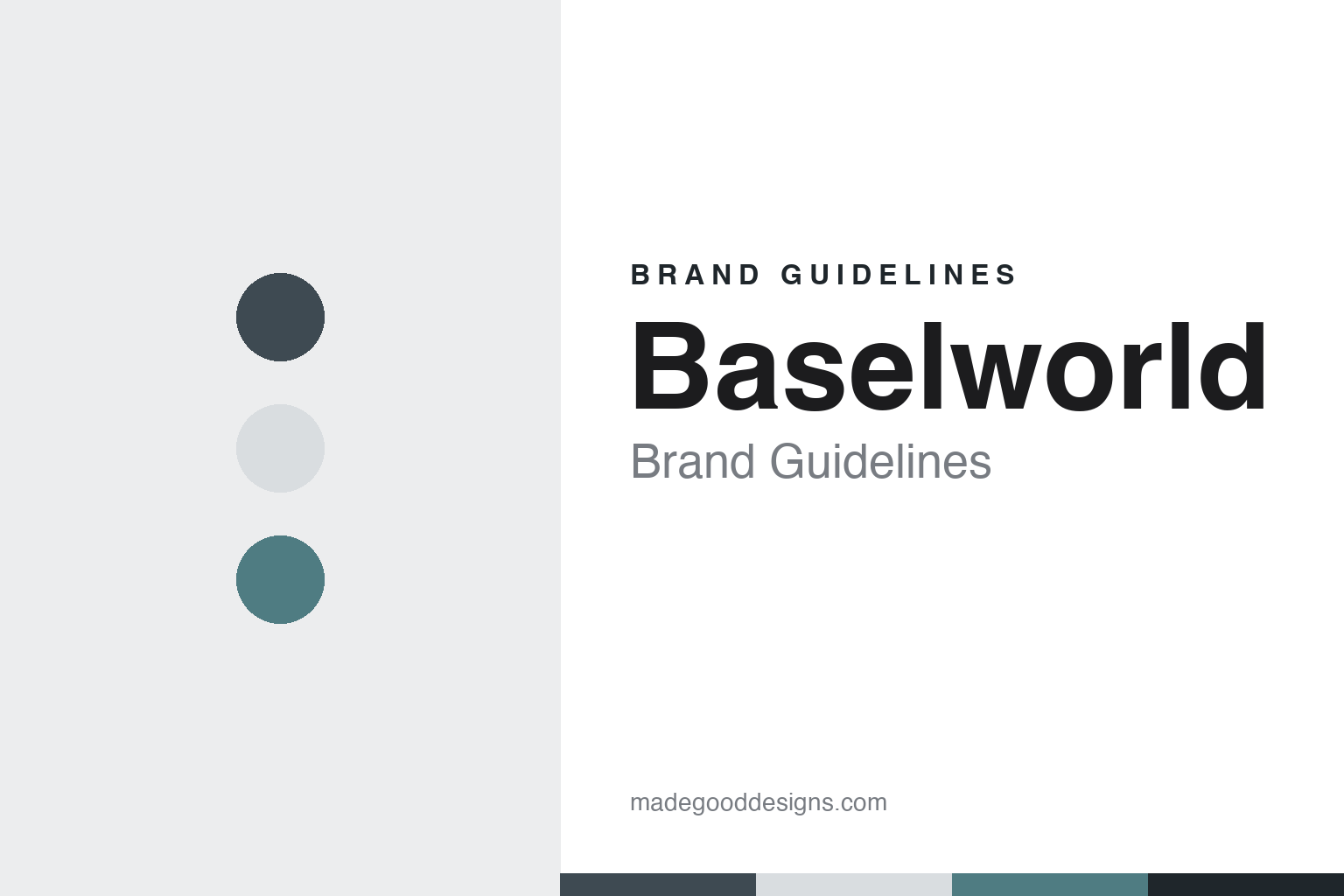
Baselworld Brand Guidelines
The Basel watch and jewellery fair, from muba to 2019.
Aa
Two constants: a slate and pale silver palette and a Modernist sans register. Abstract homage — not a Baselworld product or mark; no logo, key visual or stand is reproduced.
From muba to BASEL
A section of a sample fair becomes a watch show.
Baselworld was a trade fair for the watch, jewellery and gem industries, held each spring at the exhibition grounds in Basel, Switzerland, and organised by MCH Group. Its last edition took place from 21 to 26 March 2019, and the fair has not been held since.
Its roots go back to the Schweizer Mustermesse Basel, the Swiss sample fair known as muba. French Wikipedia dates the first muba to 15 April 1917, with 831 companies from many branches of the Swiss economy exhibiting in the city’s casino; 29 of them came from watchmaking and jewellery. English Wikipedia says muba invited several watch manufacturers to take part in 1925, and French Wikipedia says that in 1926 a hall was given over to watches and jewellery alone for the first time. In 1931 the Schweizer Uhrenmesse, the Swiss watch fair, was held in a pavilion of its own within muba, both encyclopaedias say.
The fair opened to the rest of Europe in the early 1970s. English Wikipedia says that after a 1972 exhibition titled “Europe’s meeting place,” companies from France, Italy, Germany and the United Kingdom were invited, and French Wikipedia dates the first European watch and jewellery fair, the Foire européenne de l’horlogerie et de la bijouterie, to 1973. In 1983 the fair took the short name BASEL followed by two digits for the year, as in BASEL 83, and in 1986 exhibitors from outside Europe took part for the first time, according to both encyclopaedias.
Colour
BASEL 95, Baselworld and the years after 2019.
The name kept changing with the fair’s reach. In 1995 it became BASEL 95 – The World Watch, Clock and Jewellery Show, English Wikipedia says, and a new hall with 36,000 square metres of exhibition space was added in 1999. In 2003 it was renamed Baselworld, The Watch and Jewellery Show. A new hall complex followed in 2004, taking the exhibition area to 160,000 square metres, according to English Wikipedia. French Wikipedia gives attendance of more than 100,000 visitors in 2007, and more than 145,000 visitors and 1,500 brands in 2016, the edition that marked the fair’s centenary.
In 2019, English Wikipedia says, the organiser announced that Baselworld would coordinate its dates with the Geneva SIHH from 2020 to 2024, and presented a new concept that would move the event from a classic trade fair towards an “experience platform” that also addressed consumers. Monochrome Watches reported in October 2019 that the two fairs were to run back to back in 2020, Geneva at the end of April and Basel in early May.
The 2020 edition, scheduled for 30 April to 5 May, did not take place, National Jeweler reported in January 2021. In July 2020 the same magazine, calling Baselworld “now-defunct,” reported that MCH Group had announced a successor named HourUniverse: an online platform for networking and content, active all year, with one annual live event, the first of which was planned for Basel in April 2021. In January 2021 National Jeweler reported that the live HourUniverse show, set for 8 to 12 April 2021 at Messe Basel, had been postponed “by a few months,” with mid-June the earliest date under consideration.
MCH Group then went back to the Baselworld name. A Baselworld pop-up event was held at the Geneva Watch Days fair from 30 August to 3 September 2021, and a relaunched Baselworld was due to take place in Basel from 31 March to 4 April 2022, physically and online, SWI swissinfo.ch reported in November 2021. That month MCH Group said the relaunch “needs more time,” and the 2022 edition did not take place. German Wikipedia records that after the 2020, 2021 and 2022 editions were called off, MCH Group said the fair would not be held for the time being.
Typography
How the trade fairs present themselves.
Jewellery, watch, beauty and textile trade fairs usually take their names from one of three places: the trade itself, the city that hosts them, or a coined word. Some names spell out the goods on show, some lead with a city such as Basel, Geneva, Munich, Vicenza, Bologna, Frankfurt or Paris, and some combine the two, so that the name tells a visitor both what is shown and where.
Most of these fairs are built first for the trade. Their halls are planned for retailers, buyers, designers, manufacturers and the press, who come to see new collections, materials and ingredients and to place orders. Some fairs set aside trade days and then open their doors to the public for a day or more, and some add a programme of talks, tours and events in the host city around the halls.
Behind each fair sits an organiser: a foundation set up by the exhibitors, a trade association, or an exhibition company that runs many shows in its own halls and abroad. The organiser often shapes the layout, grouping exhibitors by product, from brand booths and private appointment rooms to shared areas for suppliers, trend presentations and materials forums, and some run sister editions in other cities under a related name.
Visually, these fairs tend to keep a name and a wordmark from one edition to the next while the key visual, season theme or hall design changes each year. This guide describes those identities plainly, as dated sources describe them; the colours and type shown here are our own interpretation, and no logo, key visual or stand is reproduced.
Aa
A modernist sans — a city name with the year attached. (Specimen set in Inter Tight, a sans STAND-IN; NOT the Baselworld logo.)
Baselworld
A name built from a city.
Baselworld’s names trace the fair’s reach. Schweizer Uhrenmesse named a country and a trade; the European fair of 1973 named a continent; BASEL 83 and its successors used the city alone, with the year attached; and Baselworld, from 2003, joined the city to the word “world.” The HourUniverse name of 2020 moved away from the city altogether, before the organiser returned to Baselworld for the relaunch it had planned for 2022.
The fair belonged to a group that runs many events. English Wikipedia describes MCH Group as an organiser of around 30 live-marketing platforms in Switzerland and abroad, and Baselworld was its watch and jewellery show in its home city. The exhibition grounds in Basel, where muba began and where the watch fair grew from a single section into a full show, were the fair’s only home across its long history.
For design work, Baselworld is useful as a closed archive: a long run of names and halls in one Swiss city, from a section of a general sample fair to a dedicated watch and jewellery show, and then to a fair whose last edition took place in 2019. Any reuse of its look today has to treat it as a historic event rather than a running one, and its typography and colours here are a reading of that history, not a copy of any fair material.
For a design guide, Baselworld shows how a fair’s name can follow its market, from national to European to global. Compare Watches and Wonders Geneva, the Geneva watch fair that grew out of the SIHH, and Vicenzaoro, a jewellery fair in Vicenza. For this guide we use a slate and a pale silver with a sans, an unofficial interpretation; no product or logo is reproduced.
Explore & save
Keep Baselworld’s identity on hand — save it to a board in the Made Good inspiration library.
Baselworld identity set
Pin the slate and pale silver palette and the Modernist sans register to your own board.
Source & notes
Frequently Asked Questions
What font can I use to match the Baselworld look?
This guide describes Baselworld’s type as “A modernist sans — a city name with the year attached”. Its type specimen is set in Inter Tight from Google Fonts as a stand-in; Inter Tight is not Baselworld’s own lettering.
What colours are in the Baselworld palette?
This guide’s Baselworld palette is Slate #3E4A52, Graphite #1F262B, Pale silver #D9DDE0, Rhine teal #4F7C82 and Paper #F6F7F7. The tones are the guide’s own unofficial interpretation, not official Baselworld hex codes.
When was Baselworld founded?
Baselworld was founded in 1917 (muba), in Basel, Switzerland.