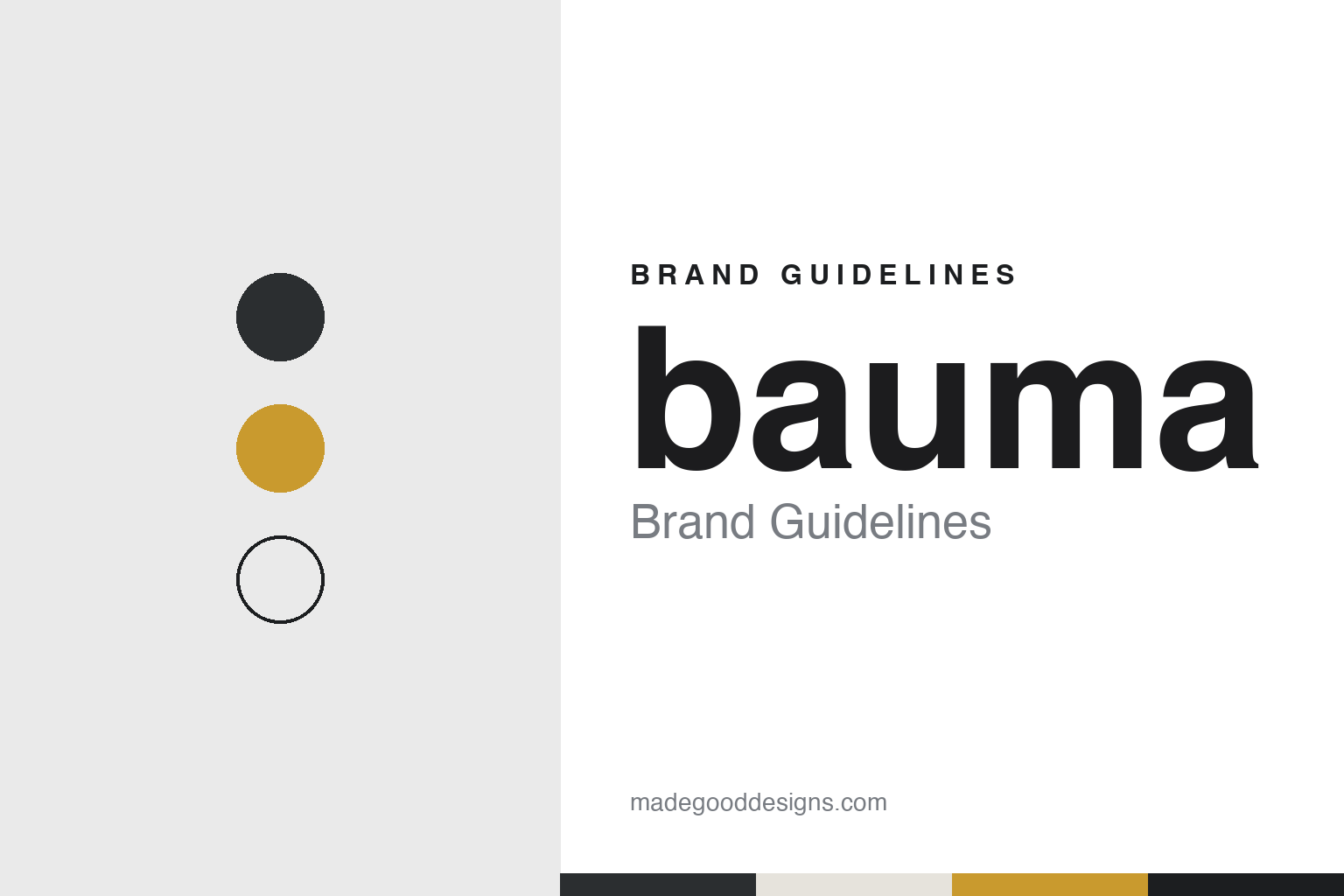
bauma Brand Guidelines
Munich’s three-yearly fair for construction, building-material and mining machinery.
Aa
Two constants: a basalt, ochre and concrete palette and a heavy grotesque register. Abstract homage — not a bauma or Messe München mark; no logo, key visual or machine is reproduced.
From Theresienhöhe to Riem
A spring show, three venues and a three-year rhythm.
bauma traces its roots to 1949, when the publisher Karl Rudolf Schulte started the “1. Fränkische Bauausstellung,” a building exhibition in Würzburg, German Wikipedia says, citing the Jahrbuch Baumaschinen 2020. After that show went well, he staged a Frühjahrsschau für Baumaschinen, a spring show for construction machinery, in 1954, as part of the Baumusterschau on Munich’s Theresienhöhe exhibition grounds. English and German Wikipedia, citing the Jahrbuch Baumaschinen 2005, give that first Munich edition 58 exhibitors, a gross area of about 20,000 square metres and around 8,000 visitors.
Two years later the area had doubled and the show took the name it still uses. In its early years only German makers took part; the first 13 exhibitors from abroad came in 1958. The site soon became too small, and in 1962 bauma opened on the former airfield of Oberwiesenfeld, with more than 450 exhibitors. That location did not last: Munich was chosen to host the 1972 Summer Olympics, the Olympic Park was built on the site, and in 1967 the then annual show returned to the Theresienhöhe grounds, where it stayed for decades.
Ownership changed in the same year. In 1967 the trade-fair company Messe München acquired the rights to the event, and 1969 was the first bauma held under its management. From 1969, German Wikipedia says, the VDMA, the German mechanical and plant engineering association, has acted as the fair’s professional sponsor, and the show moved to a two-year rhythm. A slowdown in construction led to the 1975 edition being called off; bauma returned in 1977, and the three-year cycle dates from then.
In 1998 Messe München left the Theresienhöhe for its new grounds at Riem, in the east of the city, and bauma has been held there since. The 2022 edition, first set for 4 to 10 April 2022, was moved to 24 to 30 October 2022, Powertrain International reported in April 2021, quoting Messe München’s then chairman and chief executive, Klaus Dittrich, on the decision.
Colour
Four sectors under one lower-case name.
The organiser writes the name in lower case, bauma, a short form of the German word Baumaschinen, construction machines. Its long title, as English Wikipedia gives it, is the International Trade Fair for Construction Machinery, Building Material Machines, Mining Machines, Construction Vehicles and Construction Equipment. The fair runs for seven days, usually in April, every three years.
The halls and open-air grounds are organised in four sectors, according to English and German Wikipedia, which cite the fair’s own sector pages. “All around construction sites” covers construction vehicles and machines, tools, lifting gear, formwork and scaffolding. “Mining, extraction and processing of raw materials” brings together machines for extraction and mining and for mineral processing. “Production of building materials” covers plant for concrete, asphalt, clay and similar materials. “Components and service suppliers” covers drive technology, testing, measurement and control, accessories and services. English Wikipedia adds that many makers of scale models show miniature versions of the machines.
Much of the show sits outdoors. For the 2025 edition, held from 7 to 13 April 2025, the organiser lists 200,000 square metres of hall space and 414,000 square metres of outdoor space, with 3,548 exhibitors from 57 countries and 605,974 visitors from more than 200 countries and regions, Messe München says. iVT International, the industrial-vehicle trade magazine, reported on 14 April 2025 that the show drew around 600,000 visitors against a pre-show forecast of 550,000; it gave a pre-final count of 3,601 exhibitors from 57 nations and quoted Stefan Rummel, chief executive of Messe München. For earlier editions, English Wikipedia, citing the German trade-fair association AUMA, gives 3,425 exhibitors and 583,736 visitors in 2016, and 3,256 exhibitors in 2010.
Talks and specialist forums run alongside the stands. In 2025 the fair added a special show on recycling and resource efficiency, German Wikipedia says, citing the trade-fair channel Messe.TV; the organiser’s site groups its programme under named themes, among them alternative drives, connected construction and mining.
Typography
How industrial fairs present themselves.
Industrial, print and packaging trade fairs tend to present themselves through a short coined name rather than a description. Some compress two words into one, as drupa does with the German for print and paper; others are written entirely in lower case or entirely in capitals, and some add the host city to the name, as with EMO Hannover. The name is usually the most stable part of the identity, carried from one edition to the next for decades while organisers, halls and themes change around it.
The second constant is the calendar. Rather than meeting every year, many of these fairs keep a fixed cycle of two, three or four years, set to suit industries whose machines take years to develop, and an edition is known by its year in a way that buyers and exhibitors plan around. Behind most of them stands an exhibition company working with an industry association or an exhibitor committee whose recommendations the organiser takes into account.
The halls themselves are part of the language. These fairs fill very large exhibition grounds and arrange them by segment, such as prepress, printing, finishing, packaging materials or machine tools, so that a visitor reads the show hall by hall. Stands often carry working machines rather than models, which gives the halls the look of a temporary factory floor alongside conference stages and themed special areas.
Visually, the pattern is a fixed wordmark with a changing key visual. Each edition receives its own campaign image, edition line or set of themes, presented in the year or two before opening, while the name and the venue stay put. For a design guide, the lesson is that balance between a permanent mark and a temporary campaign.
Aa
A heavy grotesque — a lower-case name set to read across a yard of machines. (Specimen set in Archivo, a sans STAND-IN; NOT the bauma logo.)
bauma
A network of sister fairs abroad.
bauma has carried its name abroad. In 2002 Messe München launched bauma CHINA in Shanghai, the first fair outside Germany in what the company calls the bauma NETWORK, English and German Wikipedia say, citing Messe München’s history pages. The organiser’s site now lists bauma CHINA, with an edition dated 23 to 27 November 2026, alongside bauma CONEXPO INDIA and M&T Expo.
Across these editions the constant is the short lower-case wordmark, used on the Munich fair and on the sister events. For 2025 Messe München says that 44 per cent of visitors came from abroad, that most visitors came from Europe, and that manufacturers and industry made up about a third of trade visitors.
Two figures explain the way the fair is laid out. Of the area booked in 2025, about two-thirds was open-air ground, the organiser’s figures show, which is where the larger construction and mining machines stand; the four sectors above divide both the halls and the outdoor plots. The German trade-fair channel Messe.TV, cited by German Wikipedia, covered the 2025 edition through its new construction machines and vehicles.
For a design guide, bauma shows how a trade fair can keep one short, lower-case name for seven decades while its venue, cycle and owner change around it. Compare Messe München, the company that has run the fair since 1969, and EuroShop, another German trade fair held every three years. For this guide we use basalt, a site ochre and concrete grey with a sans, an unofficial interpretation; no product or logo is reproduced.
Explore & save
Keep bauma’s identity on hand — save it to a board in the Made Good inspiration library.
bauma identity set
Pin the bauma basalt, ochre and concrete palette and the heavy grotesque register to your own board.
Source & notes
Frequently Asked Questions
What font can I use to match the bauma look?
This guide describes bauma’s type as “A heavy grotesque — a lower-case name set to read across a yard of machines”. Its type specimen is set in Archivo from Google Fonts as a stand-in; Archivo is not bauma’s own lettering.
What colours are in the bauma palette?
This guide’s bauma palette is Basalt #2B2E30, Night shift #1C1E20, Site ochre #C99A2E, Gravel grey #8C8F91 and Concrete #E6E3DC. The tones are the guide’s own unofficial interpretation, not official bauma hex codes.