DesignArt Tokyo Brand Guidelines
The October festival that turns Tokyo shops into galleries.
Aa
Two constants: a DesignArt Tokyo indigo, stone and vermilion palette and a Grotesque sans register. Abstract homage — not a DesignArt Tokyo work or mark; no logo, poster or campaign image is reproduced.
Design plus art
A coined word and a group of founders.
DesignArt Tokyo is a design and art festival held across Tokyo every autumn since 2017. Its organisers write the name in capitals, DESIGNART TOKYO. The company behind it, DESIGNART Inc., gives 2017 as its founding year and names its chief executive as Akio Aoki of the studio Miru Design. Its English about page lists six founders from Tokyo studios: Aoki; the architects Astrid Klein and Mark Dytham of Klein Dytham architecture; and an artist, a graphic designer and a creative director from three other studios.
Dezeen reported in October 2017 that Aoki had come up with the idea about eight years earlier, as a way to support the creative industries after the financial crisis of 2008, and that at the end of 2016 he decided it was time to make the festival happen, bringing in an interdisciplinary team of co-founders. The opening edition ran from 16 to 22 October 2017, with 72 exhibitions and talks across the city, the magazine reported, and the co-founders paid the running costs of that year themselves. Japanese Wikipedia gives the same opening date and describes the festival as held every year since.
The name carries the idea. Dezeen wrote that the crossover between different strains of design and art led to the name Designart, and that Aoki hoped the word would take root so that the creative industries would be recognised collectively rather than as separate fields. The company’s English about page describes DESIGNART as “a planning and management firm” and the festival as a platform that brings art, architecture, interior design, product design, fashion, food, sports and technology into galleries, shops and other locations around Tokyo. Its motto, as Japanese Wikipedia records it, is that the whole city of Tokyo becomes a museum.
Colour
Shop windows, showrooms and an October slot.
DesignArt Tokyo has no single exhibition hall. In 2017, Dezeen reported, its exhibitions were largely clustered on Aoyama-dori and Omotesando, an upmarket shopping and design district, and many were shown in fashion shop fronts and foyers: the Fred Perry store hosted furniture by a Japanese designer and the Louis Vuitton store displayed pieces from its own collection. The magazine described the aim as a relationship between the festival and fashion retailers that would bring customers through the door while giving designers and artists affordable space to exhibit. After-parties were held at SuperDeluxe, the events space run by Klein and Dytham, and their PechaKucha night of quick-fire presentations became part of the programme.
The second edition grew. Wallpaper* reported in October 2018 that it ran from 19 to 28 October with more than 100 exhibits, deliberately timed to overlap with Tokyo’s fashion week, under the theme “Into the emotions.” Venues that year included a Designart Gallery at Francfranc Forest in Omotesando; the AXIS Building in Roppongi, where four young creators showed work; and an installation inside the Canada Goose flagship store in Harajuku.
The festival has kept its autumn slot. Japanese Wikipedia lists the dates of each edition: 18–27 October 2019, 23 October–3 November 2020, 22–31 October 2021, 21–30 October 2022, 20–29 October 2023, 18–27 October 2024 and 31 October–9 November 2025. Citing the business paper Nikkei MJ of November 2025, it says the festival began mainly as a showcase for independent creators and has since drawn more large companies, with about 130 groups from Japan and abroad taking part in 2025 and around 230,000 visitors. The 2024 theme was “Reframing—The Beginning of a Shift,” designboom reported, and its central Reframing exhibition brought together 18 creators chosen by four curators from art, design, craft and technology.
Typography
Design weeks and biennials.
Design weeks and architecture biennials usually announce themselves with a city and a rhythm. Most take a city name plus “design week,” or “biennial” and “triennale” for events that return every two or three years; a few coin a word of their own, as DesignArt Tokyo did in 2017 by joining design and art into one name, Dezeen reported. The name tells visitors where to go and roughly when, and each edition then adds a year or a number to it.
The organisations behind them vary. DesignArt Tokyo is run by a company set up by a group of Tokyo designers and architects, working through an executive committee for each festival. Beijing Design Week is carried out by a company acting for an organising committee, with a design association among its partners. Elsewhere the same role falls to associations, foundations, museums, city agencies or trade-fair companies, and the organiser often stays in the background while the city takes the title.
Most of these events are spread out rather than gathered in one hall. Visitors follow district trails and showroom maps: Beijing Design Week’s Design Hop has led from the courtyard houses of Dashilar to the former power plant of 751 D·Park, and in 2013 a Japanese designer drew a map and identity for Dashilar, Wallpaper* reported. DesignArt Tokyo places its exhibitions in shop windows, galleries and showrooms from Omotesando to Ginza.
Each edition usually brings a curated theme, a guest city or country, and a catalogue, poster and campaign identity designed anew, so the look of a festival changes from year to year while its name stays fixed. This guide records the dated facts about each event, its organisers, venues and editions, and uses palettes and typefaces of our own; no official logo or campaign image is reproduced.
Aa
A grotesque sans — a city-wide festival name set in capitals. (Specimen set in Archivo, a sans STAND-IN; NOT the DesignArt Tokyo logo.)
DesignArt Tokyo
The tenth edition, themed “Hibiki.”
The tenth edition ran from 30 October to 8 November 2026. In a press release dated 1 October 2026, the DESIGNART TOKYO executive committee, which the release names as organiser, gave the theme as “Hibiki,” a Japanese word for resonance, and said about 150 creators and brands from 13 countries were taking part at about 70 venues in Ginza, Tokyo, Roppongi, Gaienmae, Omotesando, Harajuku, Daikanyama and Ikejiri. Its main venue, open from 30 October to 3 November, was an exhibition space of about 4,000 square metres on the KK Line, the former Tokyo Expressway in Ginza, laid out in four areas: an exhibition, a design store, a park and café, and a stage for talks and live music. Other venues named in the release included Tokyo Midtown, Hibiya OKUROJI and the AXIS Building.
Hibiya OKUROJI had also appeared in 2024, when designboom described it as a walkway of brick arches more than a century old, deep in Ginza. The festival’s map has thus moved over the years from its 2017 base on Aoyama-dori towards Ginza, while keeping Omotesando, Harajuku and Roppongi.
Beyond the festival, DESIGNART Inc. says it runs an initiative called Under-30, which connects young designers, artists and curators with shops, galleries and manufacturers, and that it coordinates public art and advises on cultural events with regions of Japan. Its website lists DESIGNART conferences held each year from 2018 to 2022. Its about page sums up the visitor’s experience as strolling the city and taking in each display, a format that depends on the cooperation of shops and showrooms rather than on one building.
For a design guide, DesignArt Tokyo shows how a festival can borrow a city’s shop windows, galleries and showrooms as its exhibition space and give every edition a theme of its own, from “Into the emotions” in 2018 to “Hibiki” in 2026. Compare London Design Festival, another city-wide design event, and Beijing Design Week, which also spreads its programme across the districts of an Asian capital. For this guide we use an indigo ink, a warm stone and a vermilion with a sans, an unofficial interpretation; no product or logo is reproduced.
Explore & save
Keep DesignArt Tokyo’s identity on hand — save it to a board in the Made Good inspiration library.
DesignArt Tokyo identity set
Pin the DesignArt Tokyo indigo, stone and vermilion palette and the Grotesque sans register to your own board.
Source & notes
Frequently Asked Questions
What font can I use to match the DesignArt Tokyo look?
This guide describes DesignArt Tokyo’s type as “A grotesque sans — a city-wide festival name set in capitals”. Its type specimen is set in Archivo from Google Fonts as a stand-in; Archivo is not DesignArt Tokyo’s own lettering.
What colours are in the DesignArt Tokyo palette?
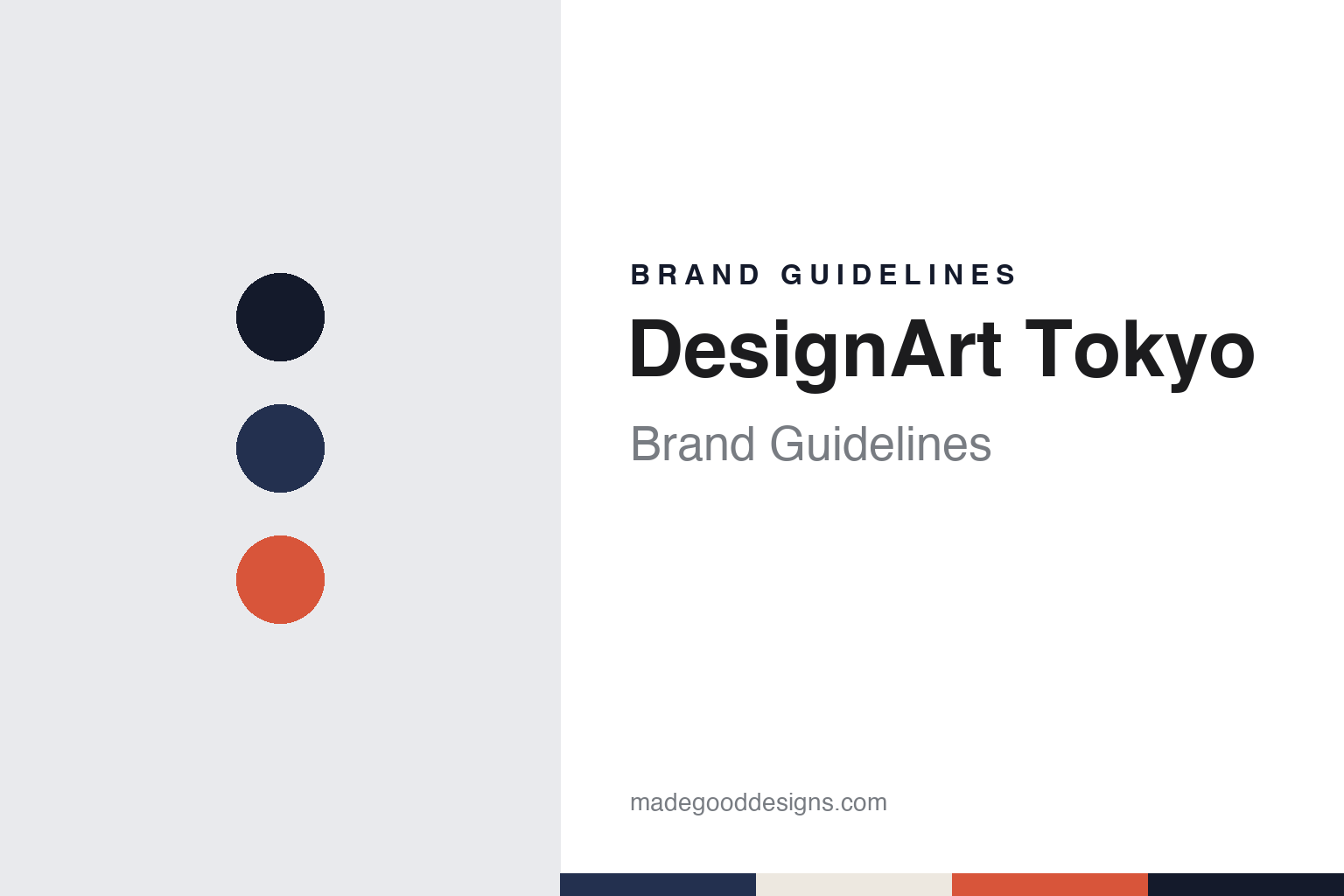
This guide’s DesignArt Tokyo palette is Indigo ink #23304F, Night #141A2B, Warm stone #EDE8E0, Vermilion #D8553A and Paper #F8F6F2. The tones are the guide’s own unofficial interpretation, not official DesignArt Tokyo hex codes.
When was DesignArt Tokyo founded?
DesignArt Tokyo was founded in 2017, in Tokyo, Japan.
Who founded DesignArt Tokyo?
DesignArt Tokyo was founded by Six Tokyo creatives incl. Akio Aoki, Astrid Klein and Mark Dytham in 2017.