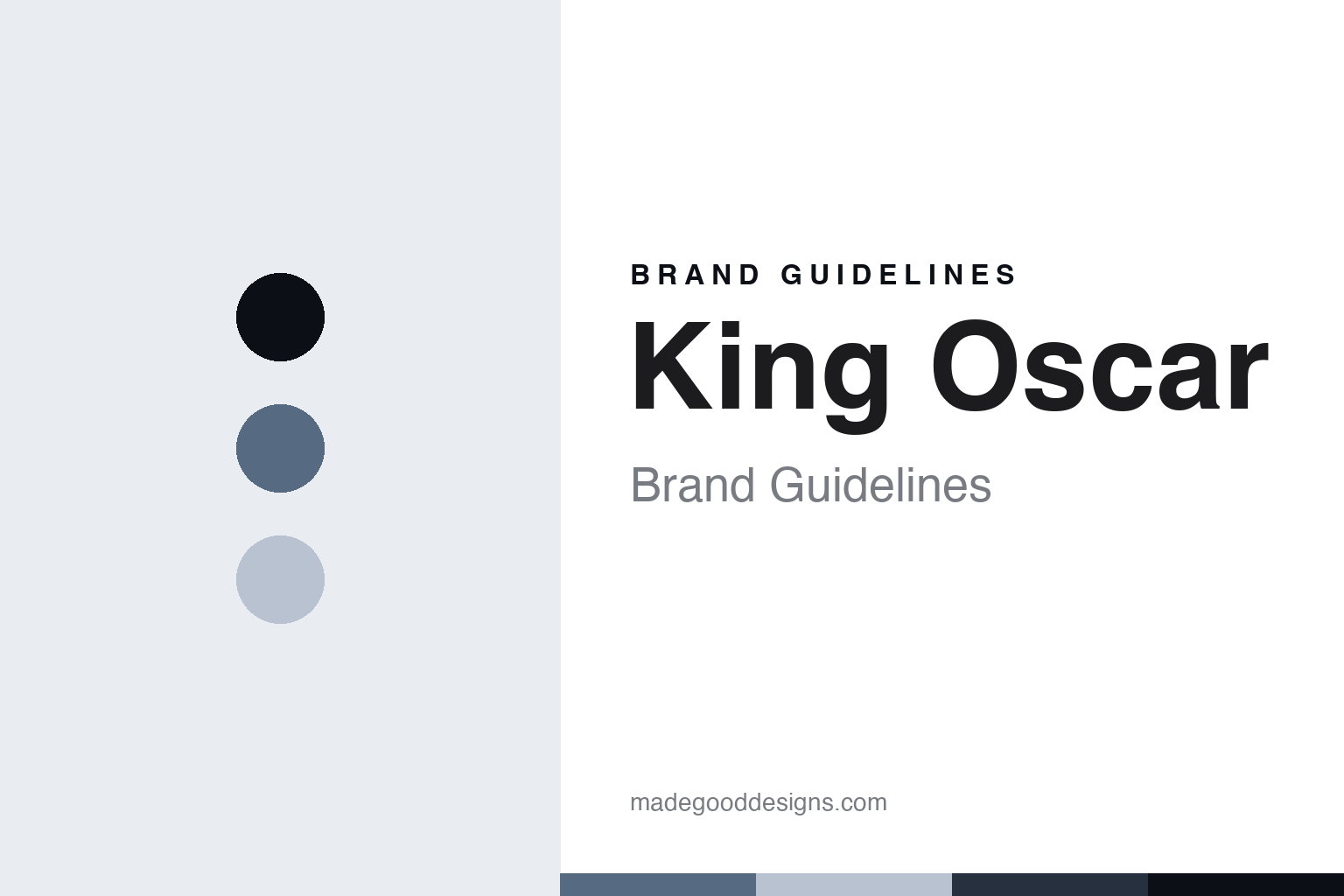
King Oscar Brand Guidelines
The sardine with a king’s name.
Aa
Two constants: a slate-silver palette and a royal-sans register. Abstract homage — not a King Oscar product or mark.
The sardine with a king’s name
King Oscar is the 1902 Norwegian brisling-sardine brand with a royal namesake — now part of Thai Union.
King Oscar brings the round its royal namesake — the sardine brand that took its name in 1902 from King Oscar II, then ruler of the union of Sweden and Norway, whose Norwegian brisling sardines are its classic product. King Oscar makes tinned seafood, and its answer to a round about the art of the tin is a story of endorsement and heritage: a Norwegian sardine with a king’s name and a century-plus of canning. A brand, with a king’s name.
Its identity is the sardine with a king’s name. King Oscar’s brisling sardines, its royal namesake and its Norwegian heritage are the story here. A brand, royal. The sardine with a king’s name.
(Honest notes, so the story stays precise. King Oscar — at kingoscar.com, a live, maintained site — makes tinned seafood, with Norwegian brisling sardines as its classic product, plus mackerel, kipper snacks, anchovies and tuna. The King Oscar brand dates to 1902, when King Oscar II, ruler of the union of Sweden and Norway, granted special royal permission to use his name, on sardines from the Norwegian canning firm Chr. Bjelland and Co. of Stavanger, so we frame 1902 as the brand and royal-permission origin, not a fresh company founded from scratch. On where it is made — a theme of this round — we do not claim it is all Norwegian: production is split between Norway, at Svolvær, and Poland, at Gniewino since 2008, so we say Norway and Poland. On ownership, King Oscar is owned by Thai Union Group of Thailand, since 2014, which we state as of the latest available records, after an ownership chain through Bjelland, later owners and a private-equity phase. Its King Oscar II portrait and crown imagery are IP, and King Oscar II is a real historical monarch, so we describe them respectfully and do not reproduce them; there is no official brand hex; these tones are an unofficial interpretation. This is design commentary.)
Colour
King Oscar lives in a slate silver. Click a swatch to copy the hex.
King Oscar’s identity is heritage, Nordic and silver-toned — a slate silver, an ink, a mist, a deep slate, and a paper. The palette leans slate silver and mist: a cool, northern register that nods to cold waters and a silver tin rather than a loud palette. It signals a heritage sardine brand. The honest caveat: with no published brand hex, these values are an original, unofficial interpretation, not first-party colours.
The lesson is a slate silver signals a heritage, Nordic identity. King Oscar’s world is a heritage, made object. For designers, it is a reminder that a slate silver and a soft mist can carry a food brand — the tone of the cold North Atlantic. Because these tones can fail as small text, keep type dark and let the colour live in the accents, palette and band. The takeaways: own a heritage; frame a namesake precisely; be honest where it is made; and treat any single hex as unofficial.
Typography
The register is a royal sans — heritage, Nordic, plain.
King Oscar’s identity carries a heritage, Nordic, plain spirit — a sardine brand with a royal namesake, not a fashion. A royal sans captures the mood: clean, cool and confident, the register of a century-old name. Set in a slate-silver palette, the royal sans feels heritage and Nordic — exactly the personality King Oscar carries. It is a namesake rather than a logo, mirroring tinplate and brine. (King Oscar’s real portrait and crown are things we describe but do not reproduce, and the exact typeface is not ours to use.) Because it is not ours to use, the honest description is “a royal-sans spirit,” shown here in a stand-in. The type behaves like the brand: heritage, Nordic and plain.
Aa
A royal-sans spirit — heritage and Nordic. (Specimen set in Libre Franklin, a royal-sans STAND-IN; NOT the King Oscar logo.)
The art of the tin
King Oscar stands for the sardine with a king’s name.
King Oscar brings the round its royal namesake. A slate-silver palette, a royal sans and a brisling sardine make one thing — the sardine with a king’s name — the whole identity: heritage, Nordic and silver-toned. The royal namesake is the differentiator, and Norwegian brisling heritage is the meaning. The point is a sardine brand that took a king’s name in 1902 and built a century-plus of canning on it, now part of a larger seafood group.
Put to work, the identity is a namesake heritage told straight, as design. A maker in this spirit would own a heritage, frame a namesake precisely, and be honest where it is made. A reader in this spirit would keep the facts right: the King Oscar brand dates to 1902, when King Oscar II granted royal permission to use his name on sardines from Chr. Bjelland of Stavanger; its classic product is Norwegian brisling sardines; its production is split between Norway, at Svolvær, and Poland, at Gniewino since 2008, so it is not all Norwegian; and it is owned by Thai Union Group since 2014, as of the latest available records. King Oscar sits in the round’s heritage span alongside the Iberian houses, the Nordic entry, and its where-made thread is an honest split, not a single country. The honest editorial moves are to frame 1902 as the brand and royal permission, to say Norway and Poland, to state the Thai Union ownership as of latest records, and to treat the royal imagery respectfully. The lesson King Oscar teaches is that a namesake can be a whole identity, and honesty about the split making keeps it credible.
For designers and brand-builders, King Oscar continues the art of the tin: own a heritage — and be honest where it is made. The lessons: build on a distinctive namesake; frame a royal endorsement as history, not a living claim; say where production really is; state a corporate owner plainly and date it; and never reproduce a portrait or logo. It is also a reminder to stay precise: King Oscar is the 1902 Norwegian brisling-sardine brand with a royal namesake, now part of Thai Union — with the palette here an unofficial interpretation. Read that way, King Oscar is less a tin than a name: a sardine that borrowed a king’s. The lesson for a brand is that a namesake and honest making reinforce each other, and saying Norway-and-Poland keeps the heritage earned. King Oscar made the-sardine-with-a-kings-name the identity — proof that a name can define a brand.
Explore & save
Keep King Oscar’s identity on hand — save it to a board in the Made Good inspiration library.
King Oscar identity set
Pin the slate-silver palette and the royal-sans register to your own board.