La Roche-Posay Brand Guidelines
The dermatologist’s sunscreen, owned by L’Oréal.
Aa
Two constants: a clinical-teal palette and a derm-serif register. Abstract homage — not a La Roche-Posay product or mark.
The dermatologist’s sunscreen, owned by L’Oréal
La Roche-Posay is the French dermatological sun and skincare brand, part of L’Oréal.
La Roche-Posay opens the fourth sun round from the pharmacy — the French dermatological skincare brand, built around a spa town’s thermal spring water, whose Anthelios sun line is a dermatologist-recommended fixture, and which is part of L’Oréal. La Roche-Posay makes derm skincare, and its answer to a round about sun care is the clinic: a high-protection sun range with a proprietary filter technology, sold in pharmacies, positioned for sensitive skin. A brand, clinical.
Its identity is the dermatologist’s sunscreen, owned by L’Oréal. La Roche-Posay’s Anthelios line, its thermal-water heritage and its L’Oréal ownership are the story here. A brand, clinical. The dermatologist’s sunscreen, owned by L’Oréal.
(Honest notes, so the story stays precise, and the claims stay the brand’s own. La Roche-Posay, at laroche-posay.com, makes French dermatological skincare sold heavily through pharmacies, its sun-care line Anthelios built on filter technologies the brand markets as Mexoryl and UVMune 400, alongside ranges such as Cicaplast, Effaclar and Toleriane, and because sunscreen is a regulated product, we report every sun-protection, filter and dermatologist-recommended claim strictly as the brand’s own marketing, never as established fact, and we give no sun-safety advice. It is widely documented as established in 1975, linked to a pharmacist, in the spa town of La Roche-Posay, a real French commune whose thermal spring water is its origin story, which we present with the year as reported. On where it is made, a theme of this round, a blanket country-of-manufacture is not fully documented, so we do not assert one. On ownership, a star theme of this round, it is a brand of L’Oréal, in its dermatological-beauty division alongside CeraVe and Vichy, so it is not independent. Its “number-one dermatologist-recommended” type language is its own survey-based claim. Its name and filter marks are IP we describe but do not reproduce; there is no official brand hex; these tones are an unofficial interpretation.)
Colour
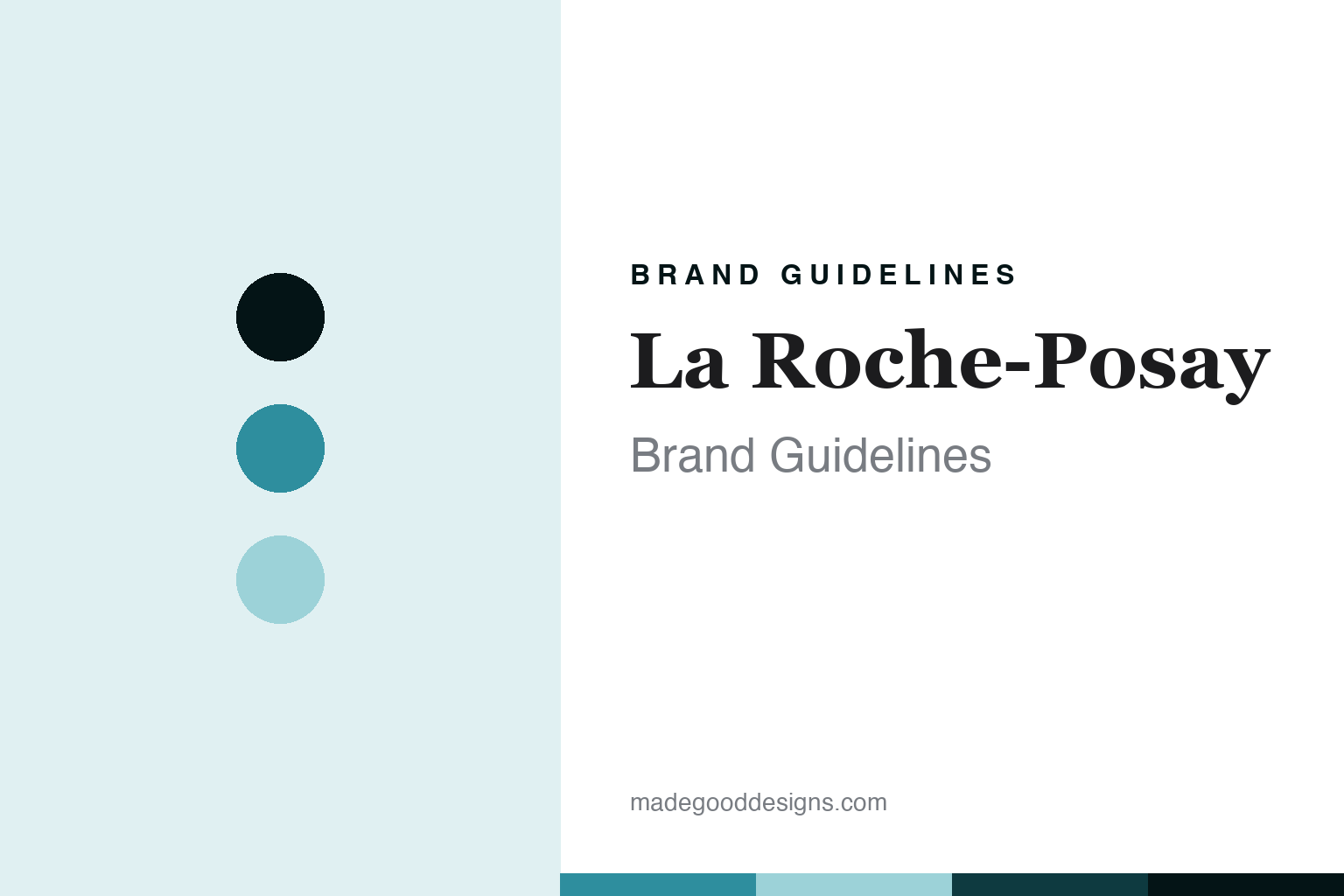
La Roche-Posay lives in a clinical teal. Click a swatch to copy the hex.
La Roche-Posay’s identity is clinical, French and trusted — a clinical teal, an ink, an aqua, a deep teal, and a paper. The palette leans clinical teal and aqua: a cool, pharmacy register that nods to thermal water and a dermatological range rather than a loud palette. It signals derm sun care. The honest caveat: with no published brand hex, these values are an original, unofficial interpretation, not first-party colours.
The lesson is a clinical teal signals a clinical, trusted identity. La Roche-Posay’s world is a considered, made object. For designers, it is a reminder that a clinical teal and a soft aqua can carry a sunscreen brand — the tone of the pharmacy. Because these tones can fail as small text, keep type dark and let the colour live in the accents, palette and band. The takeaways: sell the derm; name the technology; report claims as marketing; and treat any single hex as unofficial.
Typography
The register is a derm serif — clinical, refined, trusted.
La Roche-Posay’s identity carries a clinical, refined, trusted spirit — a dermatological brand, not a fashion. A derm serif captures the mood: refined, clinical and confident, the register of a pharmacy house. Set in a clinical-teal palette, the derm serif feels clinical and trusted — exactly the personality La Roche-Posay carries. It is a clinic rather than a logo, mirroring a sunscreen and thermal water. (La Roche-Posay’s real packaging is a thing we describe but do not reproduce, and the exact typeface is not ours to use.) Because it is not ours to use, the honest description is “a derm-serif skincare,” shown here in a stand-in. The type behaves like the brand: clinical, refined and trusted.
Aa
A derm-serif skincare — clinical and trusted. (Specimen set in Cormorant Garamond, a derm-serif STAND-IN; NOT the La Roche-Posay logo.)
Who owns the sun
La Roche-Posay stands for the dermatologist’s sunscreen, owned by L’Oréal.
La Roche-Posay opens the round from the pharmacy. A clinical-teal palette, a derm serif and a filter technology make one thing — the dermatologist’s sunscreen, owned by L’Oréal — the whole identity: clinical, French and trusted. The Anthelios line is the substance, and the L’Oréal ownership is the meaning. The point is a high-protection derm sun range, sold in pharmacies, from a brand inside the world’s largest beauty group.
Put to work, the identity is the clinic told straight, as design. A maker in this spirit would sell the derm, name the technology, and report claims as marketing. A reader in this spirit would keep the facts right: La Roche-Posay makes French dermatological skincare, its Anthelios sun line built on marketed filter technologies; it is documented as established in 1975 in the spa town of La Roche-Posay, whose thermal water is its origin; a blanket country of manufacture is not fully documented; and it is a brand of L’Oréal’s dermatological-beauty division, so it is not independent. La Roche-Posay opens the round’s who-owns spine, where six of the seven brands are conglomerate-owned. The honest editorial moves are to present the year as reported, to say the making is not fully documented, to state the L’Oréal ownership, and to report the derm and filter claims as marketing. The lesson La Roche-Posay teaches is that a clinic can be a whole identity, and stating the ownership keeps it credible.
For designers and brand-builders, La Roche-Posay opens who owns the sun: sell the derm — and name the technology. The lessons: build trust on a dermatological positioning; name a proprietary technology, like a filter; report protection and recommendation language strictly as your own; be honest that a pharmacy brand is conglomerate-owned; and never reproduce packaging. It is also a reminder to stay precise: La Roche-Posay is the French dermatological sun and skincare brand, part of L’Oréal — with the palette here an unofficial interpretation. Read that way, La Roche-Posay is less a bottle than a clinic: the pharmacy sunscreen. The lesson for a brand is that a clinic and honest ownership reinforce each other, and stating the L’Oréal ownership keeps the story earned. La Roche-Posay made the-dermatologist’s-sunscreen-owned-by-L’Oréal the identity — proof that a clinic can open a round.
Explore & save
Keep La Roche-Posay’s identity on hand — save it to a board in the Made Good inspiration library.
La Roche-Posay identity set
Pin the clinical-teal palette and the derm-serif register to your own board.