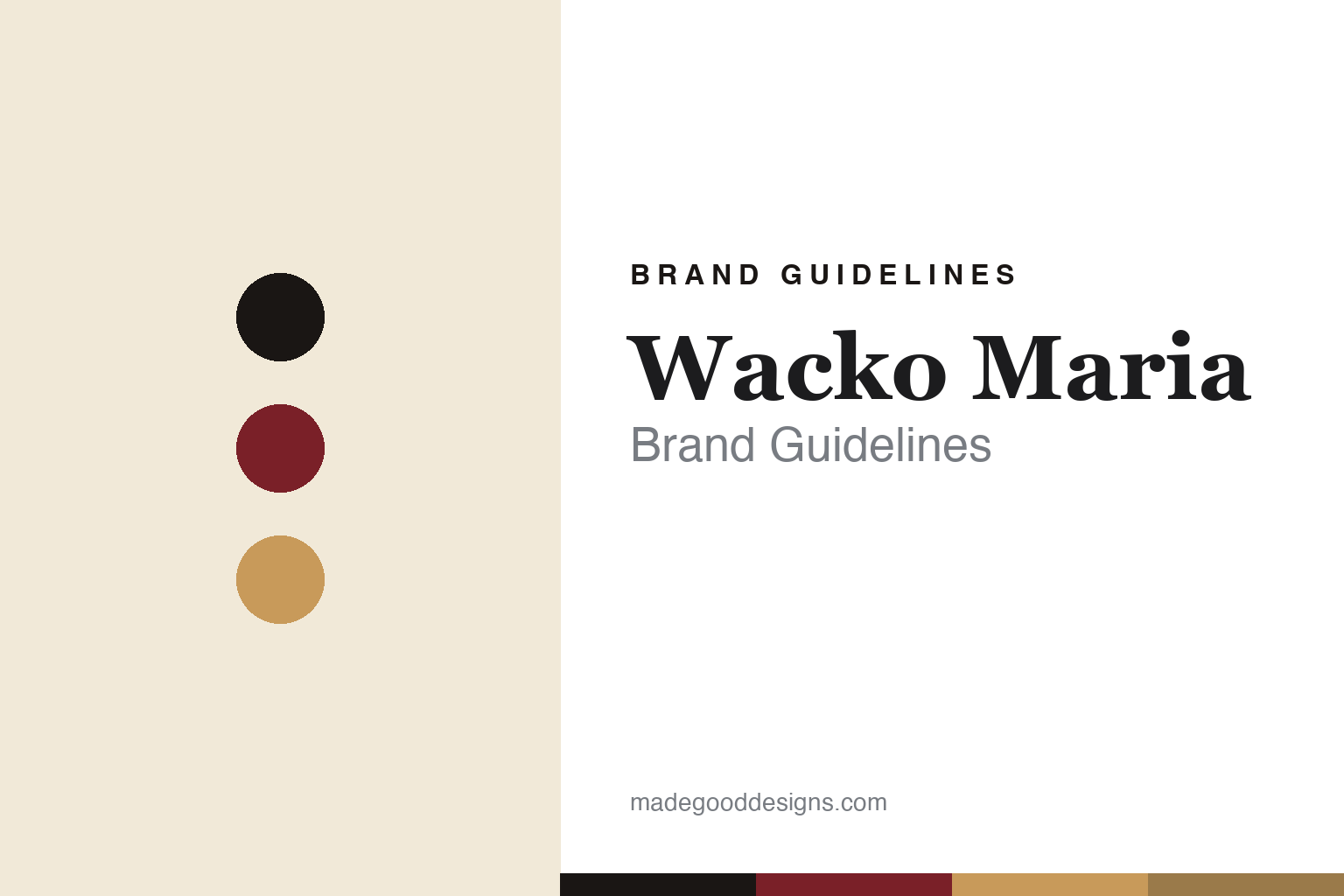
Wacko Maria Brand Guidelines
Music & aloha.
Aa
Two constants: a vintage-lounge palette and a vintage serif register. Abstract homage — not the Wacko Maria wordmark or logo.
Music & aloha
Wacko Maria dresses a late-night, music-first world.
Wacko Maria is a lesson in music and mood as a design language. Founded in 2005 in Tokyo by two former J-League footballers — one of them Keiji Ishizuka — the independent label runs on a music-first ethos it sums up as “music is the trigger of imaginations,” with a creative collective it calls Guilty Parties.
Its brand identity is vintage, cinematic and louche — the signature piece is the rayon aloha (open-collar) shirt, and the world around it draws on vintage Americana, film, photography and music, with a recurring leopard motif. It reads less like hype streetwear than a late-night lounge.
(Honest notes: the two founders were J-League footballers; sources agree on Ishizuka but disagree on the co-founder’s first name, so we leave it as “co-founder Mori.” We use the official 2005 founding date (some retail copy says 2004). The exact meaning of the name isn’t documented, so we don’t invent one. And there’s no official brand hex, so the tones here are an unofficial interpretation.)
Colour
Wacko Maria lives in a vintage-lounge palette. Click a swatch to copy the hex.
Wacko Maria’s identity is vintage, warm and cinematic — an ink, an oxblood, a leopard tan, a sepia, and a cream. The palette leans on oxblood and leopard tan against ink — the register of a jazz bar, a film still and a vintage aloha shirt. It signals mood, music and old-world cool rather than logo hype. The honest caveat: with no published brand hex, these tones are an original, unofficial interpretation, not first-party values.
The lesson is a vintage-lounge palette signals mood and music. Wacko Maria’s world is a late-night bar. For designers, it is a reminder that oxblood, sepia and leopard tan on ink read as cinematic and louche — right for a brand built on music, film and the aloha shirt. The takeaways: anchor with ink and cream; warm it with oxblood and tan; and treat any single hex as unofficial — using ink for small text so the oxblood stays rich.
Typography
The register is a vintage serif — cinematic and warm.
Wacko Maria’s identity carries a vintage, cinematic, louche spirit — music, film and the aloha shirt. A vintage display serif captures the mood: it is warm and theatrical, the register of an old film title and a bar sign. Set in vintage-lounge tones, the serif feels cinematic and warm — exactly the personality Wacko Maria carries. It is theatrical rather than clinical, mirroring a late-night scene. (Wacko Maria’s real wordmark and logo are trademarks we describe but do not reproduce, and the exact brand typeface is not ours to use.) Because the mark is not ours to use, the honest description is “a vintage serif spirit,” shown here in a stand-in. The type behaves like the brand: vintage, cinematic and warm.
Aa
A vintage serif spirit — cinematic and warm. (Specimen set in Yeseva One, a vintage display serif STAND-IN; NOT the Wacko Maria wordmark or logo, which are trademarks.)
Mood as identity
Wacko Maria stands for music and mood.
Wacko Maria is a lesson in making mood the identity. A vintage-lounge palette, the aloha shirt and a music-first ethos make cinematic mood the whole brand — louche, warm, culturally deep. The mood is the differentiator. The differentiator is a vintage, cinematic, music-driven identity.
For designers and brand-builders, Wacko Maria offers a clear takeaway: a coherent mood can be a brand. The lessons: build from a real passion (music, film); anchor with a signature piece (the aloha shirt); and keep a warm, vintage palette. It is also a reminder to stay accurate: use the 2005 date, leave the disputed co-founder first name out, and treat the palette as an unofficial interpretation. Wacko Maria made mood the brand — proof that atmosphere can be the difference.
Explore & save
Keep Wacko Maria’s identity on hand — save it to a board in the Made Good inspiration library.
Wacko Maria identity set
Pin the vintage-lounge palette and the vintage-serif register to your own board.