art KARLSRUHE Brand Guidelines
The February art fair of Messe Karlsruhe, with sculpture in its halls.
Aa
Two constants: a slate, daylight and sandstone palette and a lowercase geometric sans register. Abstract homage — not an art KARLSRUHE asset; no logo, poster or artwork is reproduced.
A fair in Baden
A trade-fair company, a gallerist and a February date since 2004.
art KARLSRUHE is an art fair for classical modern, post-war and contemporary art held each February in Karlsruhe, in south-west Germany. It is organised by the city’s trade-fair company, Messe Karlsruhe: German Wikipedia says the company has run it every year since 2004 on its own exhibition grounds, and the fair’s website in 2026 still presents it as an event of Messe Karlsruhe. The newspaper Die Rheinpfalz, previewing the 2026 edition, placed the fair in the exhibition grounds at Rheinstetten, beside Karlsruhe.
The fair grew out of a gallery. The Berlin daily taz reported in July 2017 that in 2003 the gallerist Ewald Karl Schrade began asking colleagues to help him build an art fair in Karlsruhe, at a time when the German calendar already had several established fairs. German Wikipedia names Schrade as the fair’s curator from the start, and the fair’s own website calls him the founder who led it for twenty years. The same taz article said that the fair would open for the fifteenth time the following spring, that about 200 galleries from eleven countries had taken part in 2017, and that about 50,000 visitors came to Karlsruhe each February. It described a public of private collectors from the border region of Germany, Switzerland and France, a motto of “Entdecken. Lieben. Sammeln.” (“Discover. Love. Collect.”) and the daylight of the exhibition halls.
From the beginning the fair has given floor space to sculpture. German Wikipedia describes generous sculpture spaces inside the halls and an outdoor sculpture garden, complemented by smaller sculpture spots along the circulation routes between the stands. Each year the fair has also staged special exhibitions drawn from private and corporate collections: its own list begins in 2004 with a show titled “Kunst nach 1945” (“Art after 1945”) and later includes several presentations of the collection of the regional bank LBBW. A series of talks has run alongside the fair since 2006 and has carried the name ARTIMA art meeting since 2008, according to German Wikipedia, which also lists talks organised with the broadcaster SWR and the art magazine Monopol.
Colour
A new team, fewer stands and named formats.
The leadership changed after two decades. German Wikipedia says that in May 2023 Schrade handed the running of the fair to the art historian Olga Blaß and the Berlin gallerist Kristian Jarmuschek, who chairs its advisory board; the fair’s website describes the pair as responsible for it since 2024. Schwäbische Zeitung reported on 23 February 2024, from the first fair under the new team, that there were 71 fewer galleries than the year before, that the aisles had become noticeably wider and that the new formats all carried English titles. Galleries founded after 2020 could apply as newcomers, a gallery could share the stand of a friendly gallery, and a format called re:discover was set up to present twenty artists a year who, despite their place in art history, play little part in the current market. The paper also noted that the sculpture places had been renamed “Skulpturen-Spots,” or sculpture spots.
The slimmer format has stayed. Die Rheinpfalz reported on 4 January 2026 that, according to the organisers, the edition of 5 to 8 February 2026 would bring together 180 galleries from 18 countries, 30 per cent of them from abroad and 18 taking part for the first time. It gave the numbers as more than 200 exhibitors before the change, 177 in 2024 and 180 in 2025, with 60 one-artist shows and 18 sculpture places. In February 2026 the design magazine Slanted described the academy:square, where up to six recent graduates or collectives from each of three art schools — the State Academy of Fine Arts Karlsruhe, the Karlsruhe University of Arts and Design and the Stuttgart State Academy of Art and Design — showed their work, along with a presentation of the LBBW collection on digital themes and an installation by the ZKM | Center for Art and Media Karlsruhe, a separate institution in the city.
The fair’s website in 2026 describes the route through the four halls: classical modern art in Hall 1, post-war art in Hall 2 and newcomers and the most recent work in Hall 4, with Hall 3 given over to paper:square for works on paper, the academy:square, a start:block for new collectors, the talks and a “museum mile” of museums, art associations and foundations. It names further formats — the one:artist show, on a stand of at least 25 square metres, re:frame for artists’ estates and new:comer for young galleries. In 2021 the fair did not take place in the halls; German Wikipedia records a digital-only edition, art karlsruhe selections, in May of that year.
Typography
Names, halls, sections.
Many newer art fairs choose their dates in one of two ways. Some open in the same week as a larger fair in the same city, so that collectors and curators who are already in town can walk from one to the other: VOLTA was founded in Basel in 2005 as an alternative fair during the week of Art Basel, and Paris Internationale runs in Paris each October alongside what is now Art Basel Paris. Others take a slot of their own in the calendar and build an audience around it, without a larger neighbour to draw on.
Either way, the name is what holds steady. The city, the building and the edition number change, while the wordmark carries over. VOLTA writes its name in capitals and adds the city, as in VOLTA Basel and VOLTA New York; Paris Internationale kept its Paris name when it held its first edition in Milan in 2026, adding only Milano. A short name travels easily from one city to another and from one building to the next.
Who takes part is decided before the doors open. Some fairs invite their exhibitors; others take applications and pass them to a selection committee, often made up of gallerists, which chooses galleries for the projects they propose as well as for their programmes. The resulting exhibitor list, with each gallery’s city, is published ahead of each edition, as both VOLTA and Paris Internationale do.
The visit itself is designed. Floor plans and maps tell visitors how to move through a hall, a tent or a building of several floors; signage, printed guides, websites and apps carry the exhibitor list, the sections and the programme of talks and tours. At a fair that changes buildings, the signage and stand walls may be reused from year to year, while the campaign image and the venue give each edition its own look.
Aa
A lowercase geometric sans for a name that begins with a small “art.” (Specimen set in Manrope, a sans STAND-IN; NOT the art KARLSRUHE logo.)
art karlsruhe
Two spellings, one small “art.”
The name has been written in two ways. The fair’s own list of earlier special exhibitions uses art KARLSRUHE, with the city in capitals, and the design magazine Slanted set the whole name in capitals in 2026. German Wikipedia, in April 2026, gives the fair’s own spelling as art karlsruhe, all in lower case, and that is the form used across most of the fair’s 2026–27 website, which speaks of a new brand appearance introduced with the new formats. In every version the word “art” comes first and stays in lower case, and the city name carries the rest.
The same habit runs through the programme. On the website the formats share one pattern — two lowercase words joined by a colon, as in paper:square, academy:square, start:block and re:discover. The halls are numbered and ordered by period, from classical modern art to the newest work, and the sculpture spots are spread along the routes between them rather than gathered in one place.
For a design guide, art KARLSRUHE shows how a regional fair can build an identity from a fixed month, a hall plan ordered by period and a family of lowercase format names, rather than from its host city alone. Compare Art Cologne, the fair in Cologne, and Art Düsseldorf, another German art fair. For this guide we use a slate blue, a warm sandstone and a daylight white with a sans, an unofficial interpretation; no product or logo is reproduced.
Explore & save
Keep art KARLSRUHE’s identity on hand — save it to a board in the Made Good inspiration library.
art KARLSRUHE identity set
Pin the art KARLSRUHE slate, daylight and sandstone palette and the lowercase geometric sans register to your own board.
Source & notes
Frequently Asked Questions
What font can I use to match the art KARLSRUHE look?
This guide describes art KARLSRUHE’s type as “A lowercase geometric sans for a name that begins with a small “art.””. Its type specimen is set in Manrope from Google Fonts as a stand-in; Manrope is not art KARLSRUHE’s own lettering.
What colours are in the art KARLSRUHE palette?
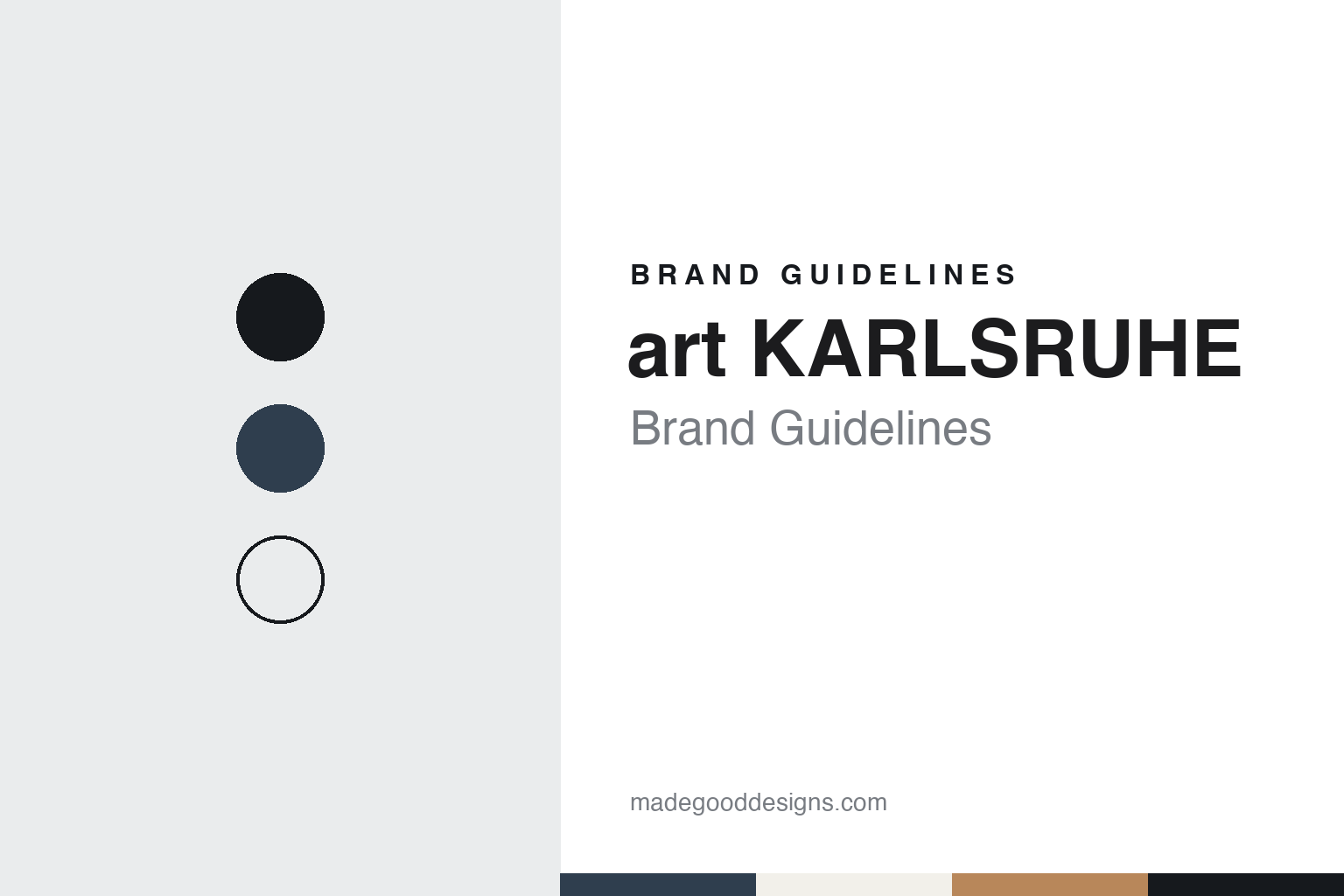
This guide’s art KARLSRUHE palette is Hall slate #2F3E4E, Ink #16191D, Daylight #F2F0EA, Sandstone #B8875A and Paper #FAF9F6. The tones are the guide’s own unofficial interpretation, not official art KARLSRUHE hex codes.
When was art KARLSRUHE founded?
art KARLSRUHE was founded in 2004, in Karlsruhe, Germany.
Who founded art KARLSRUHE?
art KARLSRUHE was founded by Ewald Karl Schrade (led it until 2023) in 2004.